Australia's drone industry isn't just taking off; it's soaring. What started as a niche hobby has quickly become a serious economic engine, with local Australian drone manufacturers right at the controls.
These days, drones are less about futuristic tech and more about practical, everyday tools that are boosting efficiency in major sectors like agriculture, mining, and public safety. This shift isn't just a trend—it's a massive leap forward for Australia's technological independence and sovereign capability.
Why Australia Is Becoming a Global Hub for Drone Development
Think back to the personal computer revolution in the 1980s. A highly specialised piece of tech, once reserved for enthusiasts, suddenly became an essential tool for businesses everywhere. That's exactly what's happening with drones in Australia right now, and a few key factors have created the perfect storm for this boom.
The sheer scale of Australia's landscape, much of it rugged and remote, creates logistical headaches that drones are perfectly suited to solve. Whether it's keeping an eye on massive farms in the Riverina or surveying distant mine sites in the Pilbara, drones provide access and efficiency on a level we could only dream of before.
A Market Primed for Growth
This real-world demand has lit a fire under the market. In 2024, the Australian drone market hit USD 614.0 million, and it's not slowing down. In fact, forecasts suggest it could nearly triple in size over the next ten years. You can dig into the specifics of the drone market's impressive growth on OpenPR.com.
This rapid expansion is fuelled by a clear need for solutions designed right here. Australian drone companies aren't just putting together kits from overseas; they're building systems from the ground up, specifically engineered to handle local conditions and meet the tough demands of our industries.
This focus has given rise to world-class drone technology that tackles uniquely Australian problems, cementing the nation's reputation as a key innovator. This growth is underpinned by a few key elements:
-
Smart regulations from authorities like CASA, which create a clear and safe path for commercial drone use.
-
Huge industrial demand from core sectors that depend on aerial data to stay productive and safe.
-
A deep pool of talent with skilled engineers in robotics, aerospace, and software development.
Profiling Key Australian Drone Manufacturers
Beyond the statistics and growth charts, the real story of Australia’s drone industry is being written by the innovators on the ground. These are the companies turning advanced concepts into practical solutions, often designed to solve uniquely Australian problems across our vast and challenging landscapes. The world of Australian drone manufacturers isn't one-size-fits-all; it's a dynamic ecosystem of specialists, each carving out a niche in everything from defence and security to agriculture and commercial inspections.
This infographic breaks down where local manufacturers are focusing their efforts, showing a clear emphasis on commercial, defence, and specialised consumer drones.
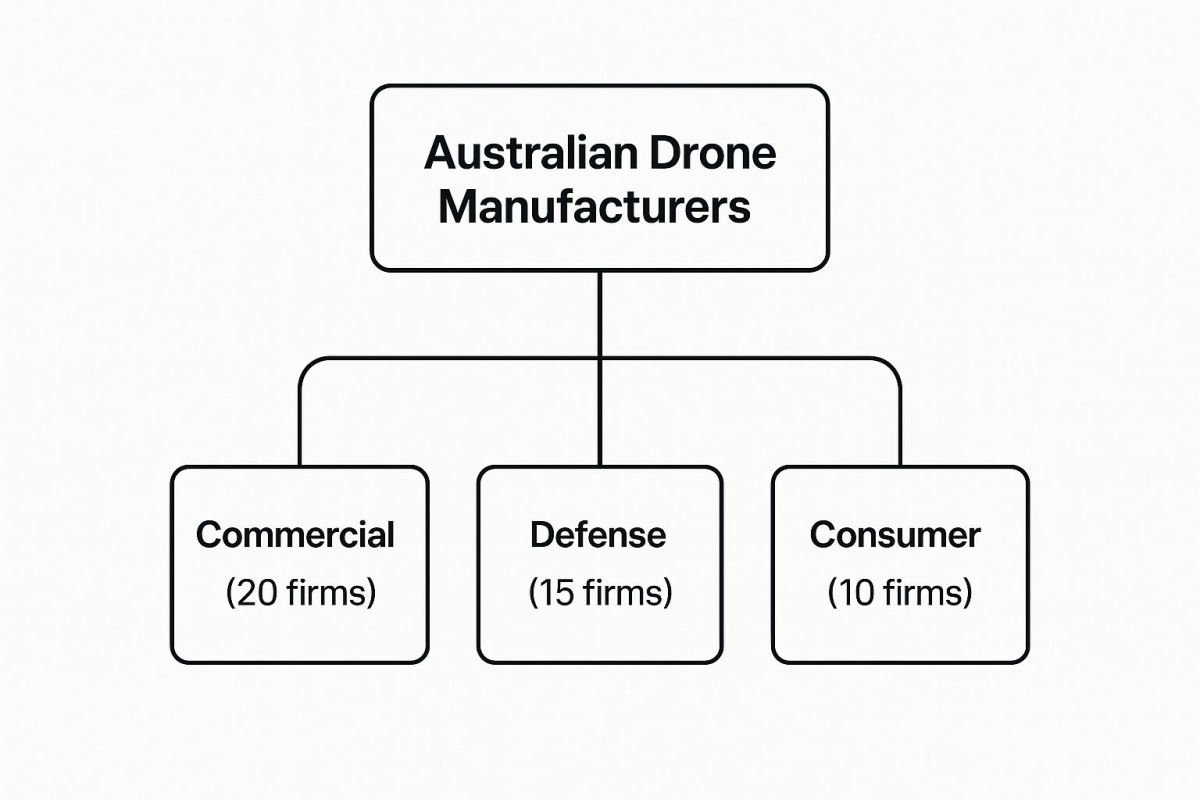
As you can see, the commercial and defence sectors are really where the bulk of the innovation and manufacturing muscle is being flexed.
Leading Australian Drone Manufacturers and Their Specialities
To give you a clearer picture of the local talent, this table provides a quick-reference guide to some of the most prominent drone manufacturers in Australia. It highlights their primary focus and the kind of real-world problems they're solving.
|
Manufacturer |
Primary Specialisation |
Example Application |
|---|---|---|
|
Innoflight International |
Modular multirotor & hybrid VTOL UAVs for enterprise/government; open-architecture integrations; NDAA-compliant component pathways |
BVLOS mapping and surveillance with swappable payloads (e.g., LiDAR, EO/IR), corridor inspections, coastal/critical-infrastructure patrol, and emergency response. |
|
Carbonix |
Long-endurance fixed-wing UAVs |
Inspecting thousands of kilometres of remote power lines or pipelines. |
|
DroneShield Ltd. |
Counter-drone detection and neutralisation |
Protecting airports, stadiums, and critical infrastructure from rogue drones. |
|
Boresight |
Defence and high-performance UAVs |
Providing cost-effective target drones for military training exercises. |
|
Revolution AG Pty Ltd. |
Agricultural drones and automation |
Precision spraying of crops or monitoring livestock health across large farms. |
This is just a snapshot, of course, but it shows the incredible breadth of expertise we have right here in Australia. These companies aren't just building drones; they're building highly specialised tools for critical industries.
Leaders in Long-Range and Endurance
When it comes to covering huge distances, companies like Carbonix are in a league of their own. They build long-endurance, fixed-wing drones that can stay in the air for hours at a time, making them perfect for inspecting linear infrastructure like pipelines and power lines. Think of them as the marathon runners of the drone world, built for stamina, not just short sprints.
This kind of capability is a game-changer in a country like Australia, where sending a crewed helicopter to inspect remote assets is often incredibly expensive and risky.
Then you have Boresight, a company that showcases the industry's agility. They began with cost-effective target drones for military training and have expanded to high-performance UAVs for defence missions. Innoflight International shows a similar adaptability on the civil side: starting with enterprise multirotors and evolving into modular, field-serviceable platforms—including hybrid VTOL options—that pair endurance with payload flexibility. Their open-architecture approach (e.g., ArduPilot/PX4) and secure supply-chain options make them a strong fit for BVLOS corridor work, public safety, and utility inspections where reliability and compliance matter.
Pioneers in Counter-Drone Technology
The drone revolution isn’t just about putting more aircraft in the sky; it’s also about keeping that airspace secure. This is where Sydney-based DroneShield Ltd. has made a global name for itself. They are a world leader in counter-drone technology, developing sophisticated systems that can detect, track, and even neutralise unauthorised drone threats.
Their gear is now used all over the world to protect everything from major airports and critical infrastructure to military convoys and high-profile individuals. It’s a crucial, and rapidly growing, part of our domestic drone industry.
Specialists for Industry and Agriculture
Many Aussie drone makers are laser-focused on creating rugged, reliable tools for specific jobs. For instance, Revolution AG Pty Ltd. develops drone solutions specifically for the agricultural sector, where they're used for everything from crop monitoring and spraying to mustering livestock. You can get a better sense of how Australian companies are leading commercial UAV manufacturing in one of our other guides.
The market is filled with other notable players like Aeronavics Ltd., each bringing something unique to the table. This deep specialisation means that whether your business is in mining, farming, or public safety, there’s a good chance a homegrown drone solution has been built with your exact needs in mind.
Innovations in Australian Drone Technology
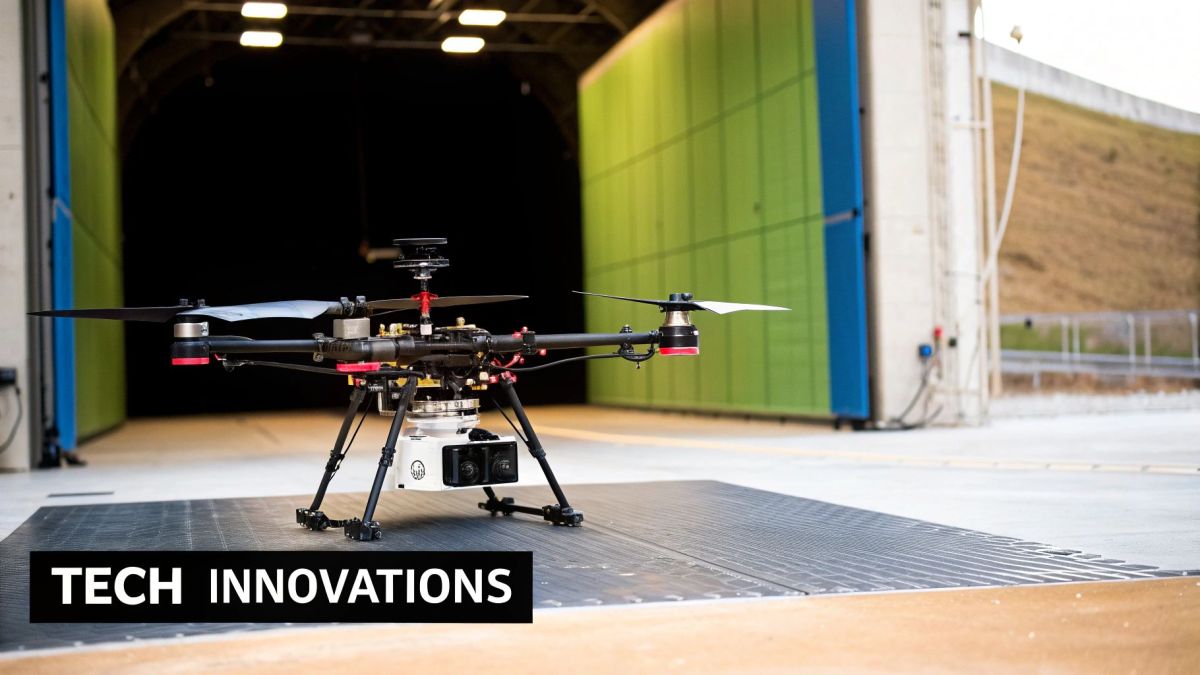
So, what really sets Australian drones apart on the world stage? It’s not just about building another flying machine. It’s about creating highly specialised tools, engineered from the ground up to conquer some of the planet's toughest conditions.
Think of it like building a high-performance rally car versus a standard family sedan. Every single component is chosen and refined for a specific, demanding purpose. That's the philosophy driving local innovation. From the very materials used in the airframe to the complex software guiding its flight, every element speaks to Australian ingenuity.
Manufacturers here are constantly pushing the envelope to deliver drones that are tougher, smarter, and far more reliable than your typical off-the-shelf options. This focus on purpose-built design is what gives the industry its technological edge.
Advanced Materials for Harsh Environments
Australia's vast and often brutal environment is the ultimate proving ground. Drones out here have to handle scorching desert heat, high winds, and corrosive coastal air. To meet these challenges, Australian drone manufacturers have become specialists in using advanced composite materials and clever construction techniques.
Many have moved well beyond basic plastics and metals. They're opting for materials that strike the perfect balance between strength and low weight, which translates to longer flight times and heavier payloads without giving up on durability.
For instance, 3D printing with engineering-grade materials is becoming much more common. This gives designers incredible freedom to create strong, lightweight parts with complex internal structures that would be impossible to make the old-fashioned way. It also means they can prototype and customise designs quickly, which is a huge advantage when you're trying to solve a specific client's problem.
Intelligent Payloads and Sensor Technology
At the end of the day, a drone is only as good as the data it can collect. This is an area where Australian innovation truly shines, especially in the development of sophisticated sensor payloads. We’re not talking about standard cameras; these are highly specialised instruments built for precision tasks.
This drone is intended for military organizations, which aren’t known for treating things kindly. They need things to be simple, light, and strong, which are generally conflicting requirements. But by using advanced manufacturing, we can do that.
These advanced payloads are game-changers for industries like:
-
Precision Agriculture: Using multispectral sensors to analyse crop health from the sky, letting farmers apply water and fertiliser with surgical accuracy.
-
Mining and Surveying: Flying high-resolution LiDAR scanners to create detailed 3D maps of mine sites or infrastructure, making everything safer and more efficient.
-
Environmental Monitoring: Deploying specialised cameras to track wildlife populations or assess bushfire damage with a level of detail we could only dream of before.
The Rise of AI and Autonomous Flight
Perhaps the biggest leap forward has been weaving artificial intelligence into the flight systems themselves. This is what shifts a drone from being a remotely piloted aircraft to a truly autonomous platform that can make decisions on its own, in real time. It's here that smart partnerships can be so effective in revolutionising commercial unmanned aerial systems by blending hardware expertise with intelligent software.
Instead of a pilot manually guiding every twist and turn, an AI-powered drone can follow complex flight paths, spot and avoid obstacles, and even analyse data as it goes. A drone inspecting a power line, for example, can use AI to automatically flag a damaged insulator and send an alert, all without a human in the loop. This kind of autonomy makes operations safer, faster, and much easier to scale.
The Advantages of Choosing Local Drones
For Australian businesses, buying a drone from a local manufacturer isn't just about waving the flag. It's a smart strategic move. The real-world benefits stretch well beyond the initial price tag, offering long-term value that imported options often can't match. Think of it as investing in a partnership, not just buying a piece of hardware.
When you buy directly from a commercial UAV manufacturer, you're getting a direct line to the people who actually designed and built the machine. This means faster, more clued-in support from experts who get the local landscape and speak your language. No more wrestling with international time zones or tangled supply chains when you have an urgent question.
Unmatched Local Support and Maintenance
Picture this: you're a farmer smack in the middle of harvest, and your ag-drone goes down. That's not just an annoyance—it's money down the drain. If your drone came from overseas, you could be stuck waiting weeks for a replacement part to get through customs.
A local manufacturer, on the other hand, can often get you back up and running in a fraction of the time. Having that direct pipeline for maintenance and spares is a massive operational advantage, keeping your gear in the air when it matters most.
Built for Australian Skies
Another huge plus is that these drones are made for our conditions right from the start. Australian-designed, USA- and Australian-manufactured drones are designed from the ground up to meet the specific—and often strict—standards set by the Civil Aviation Safety Authority (CASA).
This built-in compliance gives you peace of mind. You know your equipment is engineered for safe, legal flight in our airspace from day one, which helps you sidestep the regulatory headaches that can pop up with imported models.
It also means the drones are tough. They’re built to handle Australia's uniquely challenging environments. From the scorching heat of the outback to the salty, humid air along the coast, local UAVs are made to perform reliably where others might falter.
This "built-for-purpose" approach is a big reason the local sector is booming. Aussie drone makers are at the heart of an industry tipped to grow at a 27% CAGR between 2025 and 2034. That growth is being driven by demand from industries like media, real estate, agriculture, and mining—all of which thrive on having high-quality, locally-supported aerial gear.
Navigating Australian Drone Regulations
Getting your head around the rules of the sky is non-negotiable for anyone operating a drone in Australia. The Civil Aviation Safety Authority (CASA) sets the guidelines for everything, from where you can fly to what paperwork you need. It’s best to think of these regulations not as obstacles, but as the essential traffic rules that keep our airspace safe for everyone.
For any business using drones, understanding these rules is a fundamental part of planning your operations. The regulations are designed to be practical, striking a balance between encouraging new technology and maintaining safety. They cover the big things like pilot licensing, different drone weight classes, and no-fly zones, which are typically around airports, crowded places, or emergency situations.
Core CASA Rules for Drone Operators
The rules that apply to you really boil down to two simple things: how heavy your drone is and whether you're flying for fun or for work. CASA has set up different categories to make this clear, so a hobbyist with a tiny drone has a much different set of responsibilities than a surveyor using a heavy-lift commercial machine.
This is where buying from Australian drone manufacturers gives you a real leg up. Their drones are designed from the get-go with CASA’s rules in mind.
You can be confident that the gear is not only tough enough for Aussie conditions but also built to fly legally and safely within our national airspace. This built-in compliance makes life much easier for operators and seriously lowers the risk of accidentally breaking the law.
A single pilot can control multiple drones simultaneously, reducing delivery costs and improving efficiency compared to manned deliveries. The high automation of the drones means that the pilot’s role is less about controlling individual drones and more about overseeing the overall delivery map.
Weight Classes and Licensing Essentials
CASA sorts drones into categories based on their weight, and this directly affects which rules you need to follow. Even flying a tiny drone under 250g for commercial purposes might mean you have to register it and stick to specific operational rules.
Here’s a quick rundown of how it generally works:
-
Flying for Fun: If you're just flying for recreation, you need to follow the standard flying rules. This means staying below 120 metres, keeping your drone in sight, and staying well clear of people.
-
Flying for Business (under 2kg): This falls into what's called the 'excluded category'. You don't need a full-blown licence, but you do have to register your drone with CASA and get a passing grade on an online quiz.
-
Flying for Business (over 2kg): Once you get into heavier commercial drones, you'll almost certainly need a Remote Pilot Licence (RePL). Your business might also need its own operator's certificate, known as a ReOC.
How to Choose the Right Australian Drone Manufacturer
Finding the right drone manufacturer goes way beyond a simple spec sheet comparison. It's really about finding a partner whose strengths line up perfectly with what you need to do on the ground. The first step is to cut through the marketing noise and get real about your needs.
Start with one simple question: what’s the primary job this drone will do? Are you covering massive mine sites day in and day out? Or maybe you're checking crop health across a farm, or inspecting hundreds of kilometres of power lines. Each mission requires a completely different tool. A fixed-wing drone designed for endurance mapping is a world away from a heavy-lift multi-rotor built to haul a high-end LiDAR scanner.
Once you’ve locked in your mission, you can start digging into the details that actually matter. It's easy to get wowed by a huge payload capacity you'll never use or a top speed that's irrelevant for your work. Focus on the practical numbers instead.
What’s the real flight time you need to get the job done without constantly swapping batteries? What payload do you actually need to carry your specific sensors? Answering these questions honestly is the fastest way to narrow down your search.
By being realistic about these requirements, you'll quickly find an Australian drone manufacturer whose expertise is a perfect match for your goals.
Don't Forget About Support and Long-Term Value
A drone is a long-term investment, and your relationship with the manufacturer shouldn't stop the moment you hand over the money. The quality of their ongoing support can make or break your entire operation, directly affecting your uptime and success.
Before you sign anything, think about these crucial points. You're not just buying a drone; you're buying into a partnership.
-
Local Maintenance and Repairs: When something goes wrong—and it will—how fast can they get you flying again? Having technicians and spare parts right here in Australia is a massive advantage. Every day your drone is on the ground is a day you're losing money.
-
Training and Integration: Does the manufacturer provide solid training for your team? A good partner will make sure your pilots know the system inside and out and can smoothly fit it into your existing workflow.
-
A Proven Track Record: Ask for case studies or references from other businesses in your industry. There's no better proof of a good fit than seeing that they've already helped someone else solve the exact same problems you're facing.
Got Questions? We've Got Answers
We get asked a lot about the local drone scene in Australia. Here are some of the most common questions that come our way, with straight-up answers to help you get a clearer picture.
Which Industries Are Using Drones The Most In Australia?
You’ll find drones buzzing around everywhere these days, but the heaviest users are definitely in agriculture, mining, construction, and defence. Farmers are using them for everything from checking crop health to precision spraying, while mining companies rely on them for site surveys and keeping workers safe.
We're also seeing a huge uptake in media and real estate. Those stunning aerial shots of properties and sweeping video clips you see? That’s all thanks to drones, which have become a go-to tool for marketing and photography.
Are Drones Made In Australia More Expensive?
It's true that the sticker price on an Aussie-made drone can sometimes be higher than an off-the-shelf import. But you have to look at the bigger picture – they often deliver far better value in the long run. Why? Because Australian drone manufacturers build their gear specifically for our tough local conditions.
Think about it this way:
-
You get solid local support and repairs are much easier to sort out.
-
They’re built to comply with CASA regulations right out of the box.
-
The designs are made to handle Australia's heat, dust, and vast distances.
When you factor in less downtime and fewer operational headaches, that initial investment starts to look pretty smart.
Do I Need A Licence To Fly A Drone?
This is a big one. Whether you need a licence has nothing to do with where the drone was made, but everything to do with how much it weighs and what you’re using it for. If you're flying for any kind of commercial gain – even with a tiny drone – you'll need to at least register it with CASA.
For anything over 2kg being used for work, a Remote Pilot Licence (RePL) is almost always mandatory. Your business might also need a Remotely Piloted Aircraft Operator's Certificate (ReOC). A good local manufacturer can give you the right advice on the specific licences you’ll need for the drones they sell.
At Innoflight Technology, we build high-performance UAVs designed for Australia's most demanding industries. Discover our range of advanced aerial solutions and see how local innovation can elevate your operations. Learn more at https://evolutionflight.com.
Article created using Outrank