It's easy to think of Australia as just another market for drones made overseas, but that picture is changing fast. A new breed of Australian UAV manufacturers is emerging, and they aren't just building drones—they're engineering solutions purpose-built for our country's most demanding environments.
These aren't your typical off-the-shelf models. We're talking about specialized systems designed to operate reliably across remote mine sites, vast farmlands, and thousands of kilometres of power lines. They’re built to solve uniquely Australian problems.
The Boom in Homegrown Drone Innovation
Australia’s vast, rugged, and often punishing landscape creates challenges that most standard drones simply can't meet. From the scorching heat of the Pilbara to the dense, wet forests of Tasmania, our industries need aerial tools that are tough, reliable, and perfectly adapted to extreme conditions.
This gap in the market has ignited a fire under local engineers. Australian UAV manufacturers have stepped up, moving away from generic imports to create highly specialized drones that deliver where others fail. They're focused on solving tangible, high-stakes problems, like the immense cost and safety risks of manually inspecting remote infrastructure.
The result is a new generation of drones that fly longer, carry heavier, more sophisticated sensors, and operate dependably in weather that would ground most other aircraft.
Solving Real Problems and Fueling Growth
This focus on real-world problems is driving serious growth. The Australian commercial drone market, led by local innovators like Aeronavics Ltd. and V-TOL Aerospace, was valued at USD 772 million in 2023. It’s on track to hit a massive USD 2,091.33 million by 2032, growing at a compound annual rate of 15.3%.
You can dig deeper into this trend by exploring the full research on the Australian commercial drone market. This isn't just growth for growth's sake; it's a direct outcome of solving specific industry pain points.
Let’s look at a classic example. Energy companies are in a constant battle with vegetation growing too close to power lines—a leading cause of bushfires and blackouts.
The old way of doing things involves slow, expensive manual inspections that often miss risks until it's too late. This forces companies into a cycle of reactive, costly emergency repairs that put grid stability and public safety on the line.
An Australian-designed drone like the Evolution Heavy-Lift Multi-Rotor completely changes the game. It was built to solve this exact problem with a high payload capacity designed specifically to carry heavy, advanced LiDAR scanners. This technical feature allows it to map entire power corridors with incredible precision.
Instead of just reacting to problems, utilities can now proactively identify hazardous trees with centimetre-level accuracy before they become a threat. The business outcome is clear: this not only prevents expensive outages but also dramatically improves safety for workers and the public. It’s a perfect illustration of the practical, real-world value Australian UAV manufacturers are delivering today.
To get a broader sense of this, here’s a look at how different Australian industries are using locally-made drones to tackle their biggest headaches.
Australian UAV Applications at a Glance
| Industry and Pain Point | Dominant Australian UAV Solution | Key Business Outcome |
|---|---|---|
| Energy & Utilities: High cost and risk of inspecting thousands of kilometres of power lines for vegetation encroachment. | Heavy-lift drones (e.g., Evolution) with LiDAR payloads for corridor mapping. | Proactive risk identification, preventing bushfires and blackouts, and reducing manual inspection costs by over 70%. |
| Mining & Resources: Inefficient and unsafe manual surveying of stockpiles, open pits, and tailings dams. | Ruggedized, long-endurance VTOL drones with high-resolution photogrammetry sensors. | Rapid, accurate 3D modeling for volumetric calculations and geotechnical monitoring, improving site safety and planning. |
| Agriculture: Inconsistent crop yields and overuse of water/fertiliser due to lack of precise field data. | Lightweight multi-rotor drones equipped with multispectral sensors for crop health analysis. | Precision spraying and targeted irrigation, boosting crop yields by up to 15% while cutting down on resource waste. |
| Emergency Services & ISR: Limited situational awareness during bushfires or search-and-rescue operations in remote areas. | Drones with thermal and optical zoom cameras, capable of long-loiter times and secure data links. | Real-time intelligence for incident commanders, enabling safer, more effective deployment of ground crews. |
As you can see, the solutions aren't just about flying; they're about collecting the right data to make smarter, faster, and safer decisions on the ground. This is the core strength of Australia's domestic UAV industry.
A Look at the Australian UAV Market
To really get a handle on what Australian UAV manufacturers bring to the table, you need to look at the different kinds of drones being built and the specific jobs they're designed for. It’s not just about what can fly, but why a particular drone is the right tool for one task and the wrong one for another. The local market is a direct response to Australia’s unique industrial challenges.
And this isn't a niche market. Australia’s unmanned aerial vehicle (UAV) sector, with homegrown companies like XAG Australia and Skyborne Technologies Pty Ltd, is on a serious growth trajectory. It's projected to climb from USD 0.57 billion in 2023 to USD 1.19 billion by 2031.
That represents a compound annual growth rate of 11.12%. This growth is fueled by innovators like Orbital Corporation Limited, who are pushing the boundaries of what's possible with both fixed-wing and rotary-blade aircraft. You can dig deeper into these figures in the Australia Unmanned Aerial Vehicle Market report.
This expansion is happening across a few key platform types, each with its own strengths.
Core Australian UAV Platform Types
The drone landscape in Australia is really built around three main designs: multi-rotor, fixed-wing, and hybrid VTOL systems. Think of it like a toolbox—you wouldn't use a hammer to cut a piece of wood. Each design is a specialised tool for a specific job.
Multi-Rotor Drones: These are the drones most people picture, with several propellers giving them lift and stability. They operate like helicopters, able to hover in one spot with incredible precision. This makes them perfect for getting up close to inspect something like a wind turbine or for detailed surveys of a small area, like a construction site or mine pit.
Fixed-Wing Drones: These look more like small planes, using wings to stay in the air. While they can't hover, they are champions of efficiency and can cover huge distances. When you need to map a massive farm or inspect a 50-kilometer stretch of remote power lines, a fixed-wing drone is the most practical and cost-effective option.
Hybrid VTOL Drones: By blending the best of both worlds, hybrid Vertical Take-Off and Landing (VTOL) drones have changed the game. They take off and land vertically like a multi-rotor but then transition to fly like a fixed-wing plane. This gives them the precision of a helicopter and the endurance of an airplane, making them perfect for complex missions that need both hovering and long-distance flight.
This infographic shows how these different platforms are being put to work across Australia's biggest industries.
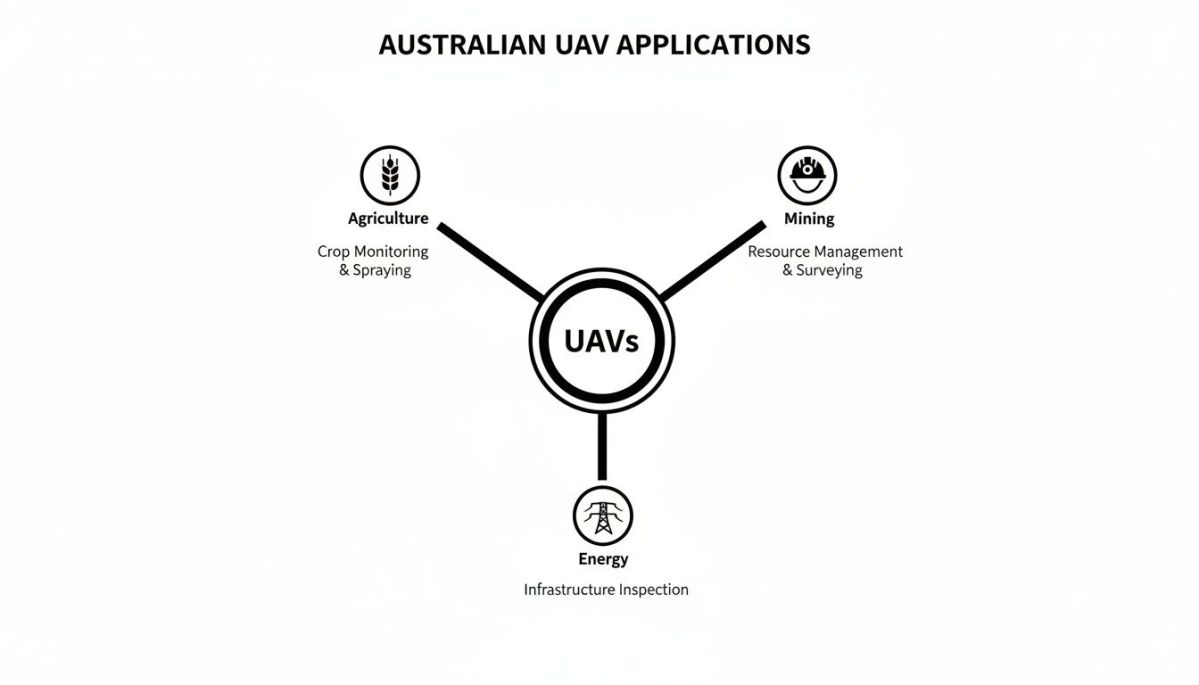
As you can see, these specialised UAVs are built to solve very specific problems in sectors like mining, agriculture, and energy.
Connecting Drone Type to Business Outcomes
Knowing the difference between these drone types is the first step. The real insight comes when you connect a drone’s capabilities to the business problems it can solve. This is where a technical spec sheet translates directly into operational success.
Take, for instance, a common headache for large-scale geospatial firms: trying to capture high-density LiDAR data over long, linear assets like highways or pipelines. A standard multi-rotor drone just doesn't have the flight time, forcing crews to constantly land, swap batteries, and redeploy—a costly and slow process.
This inefficiency isn't just a nuisance; it's a major business obstacle. It drives up project costs, blows out timelines, and limits how much ground can be covered in a day, directly hitting a firm's bottom line and competitive edge.
This is exactly the kind of problem the Evolution Flight EF-100 Heavy-Lift VTOL was built to solve. Its technical specification of 3-hour flight endurance while carrying a 3kg payload is a direct solution to this pain point. This capability produces a tangible business outcome: geospatial firms can now map an entire corridor in a single flight.
The result? They slash their time in the field, cut operational costs by up to 60%, and deliver complete datasets to clients faster than ever before.
How Australian Drones Solve Major Industrial Problems
A drone's real value isn’t just in its technical specs or flight time. It’s in its ability to tackle the tough, expensive, and often dangerous jobs that keep managers up at night. The best Australian UAV manufacturers get this. They're not just selling flying machines; they’re providing solutions that fix your biggest operational headaches, turning a problem on the ground into a clear, data-driven answer from the sky.
Let's look at how this plays out in the real world. I'll walk through a couple of common scenarios where drones designed right here in Australia are making a huge difference. For each one, we'll look at the pain point, how a specific drone's features solve it, and the business outcome that follows.
Preventing Blackouts and Bushfires in the Energy Sector
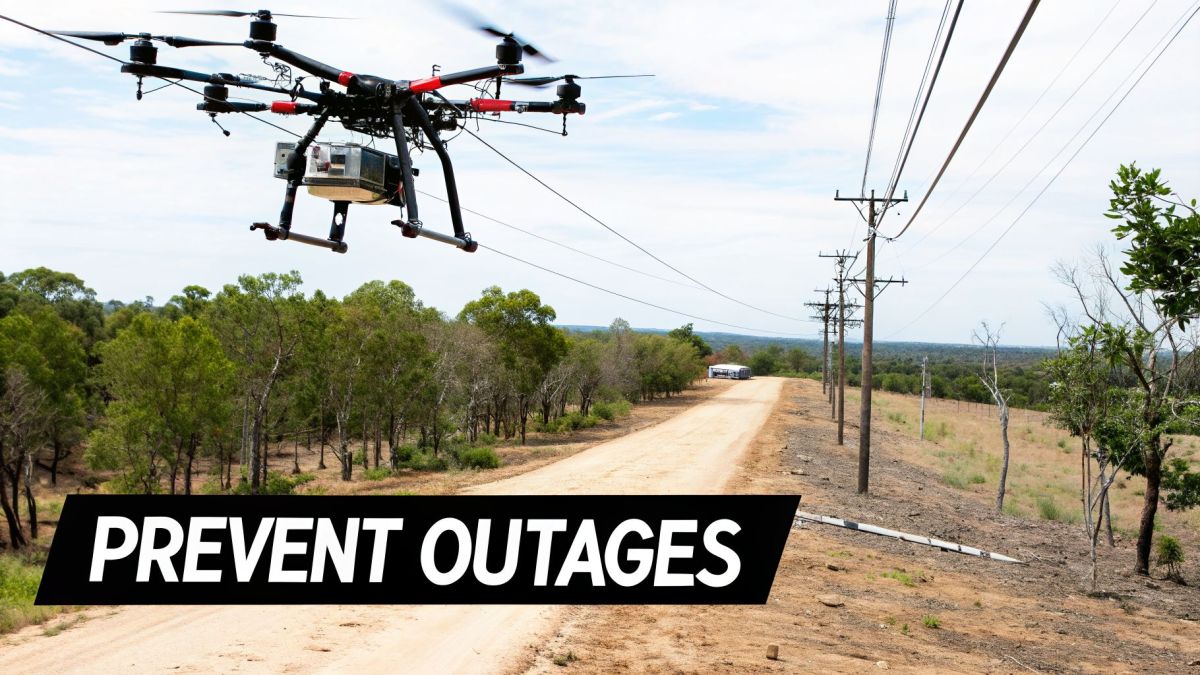
For any Australian power utility, managing vegetation is a constant, high-stakes headache. The problem is simple but severe: a tree growing too close to a power line can trigger a catastrophic bushfire or a massive blackout. The old way of doing things—sending out ground crews or expensive helicopters—is slow, risky, and can easily miss threats along thousands of kilometres of remote power corridors.
This reactive approach means utilities are always playing catch-up, leading to emergency repairs, steep fines, and a hit to their reputation. The cost goes beyond money; it's about public safety and keeping the lights on.
This is where a purpose-built Australian drone proves its worth. The challenge isn't just spotting trees. It's about collecting precise, measurable data that can predict risk before something goes wrong, which requires a platform that can carry advanced sensors for extended periods.
This is a job tailor-made for a platform like the Evolution Heavy-Lift Multi-Rotor. Its standout feature is its impressive payload capacity. This technical specification allows it to carry a heavy, sophisticated LiDAR scanner, which standard drones cannot lift.
The business outcome is a fundamental shift from reactive repairs to proactive management. The LiDAR data collected by the drone builds a stunningly detailed 3D "digital twin" of the entire power line corridor. This allows utilities to:
- Pinpoint Risk Trees: Measure the exact distance between any tree and the power lines with centimetre-level accuracy, identifying specific encroachment risks before they become a danger.
- Optimize Maintenance: Send vegetation clearing crews to precise GPS coordinates, eliminating guesswork and focusing resources only where they're needed most.
- Boost Grid Reliability: Dramatically reduce vegetation-related outages and deliver a more stable and resilient power supply to homes and businesses.
By matching the drone's heavy-lift capability to the need for predictive data, utilities can transform a major operational risk into a smart, manageable process.
Improving Safety and Efficiency in Mining Operations
The mining industry has its own set of critical challenges. For mine operators, the big pain point is the need for frequent, accurate surveys of open pits, stockpiles, and tailings dams without putting people in harm's way. Traditional surveying is notoriously slow and exposes teams to serious hazards, like working near unstable pit walls or massive machinery.
This operational friction often means surveys happen less frequently than they should. That leads to outdated site models, which can throw off everything from resource management and blast planning to geotechnical monitoring. Inaccurate stockpile measurements can mess with financial reporting, and a delay in spotting ground movement creates a huge safety risk.
Here, the solution is a drone that can deliver rapid, repeatable, and highly precise mapping. The Evolution Flight EF-100 Heavy-Lift VTOL is built for this kind of work. Its hybrid design, which combines vertical takeoff and landing with efficient fixed-wing flight, is a key technical feature that makes it perfect for the mixed terrain of a mine site.
However, the most critical specification for this pain point is the drone's high-precision RTK (Real-Time Kinematic) positioning. This goes way beyond just taking photos; it means every single pixel in the images is geotagged with centimetre-level accuracy.
The business outcome is a safer, more productive, and better-managed mine. With an RTK-equipped drone, operators can:
- Enhance Worker Safety: Keep surveyors out of hazardous areas entirely by running survey missions remotely from a safe location.
- Achieve Accurate Volumetrics: Measure stockpiles in a fraction of the time, providing near real-time data for inventory and reconciliation, which sharpens financial accuracy.
- Improve Operational Planning: Generate frequent, incredibly detailed 3D models of the entire site to optimize haul road designs, blast patterns, and long-term mine development.
The drone's precision mapping turns a dangerous and time-consuming task into a fast, automated, and safe process that feeds essential data directly into critical decisions.
Powering the Future of Precision Agriculture
The agricultural sector is, without a doubt, one of the biggest success stories for Australian UAV manufacturers. Farmers today are dealing with a perfect storm of challenges, from persistent labor shortages to the volatile effects of climate change. In response, locally-made drones have become essential tools, offering far more than just simple aerial photos of crops.
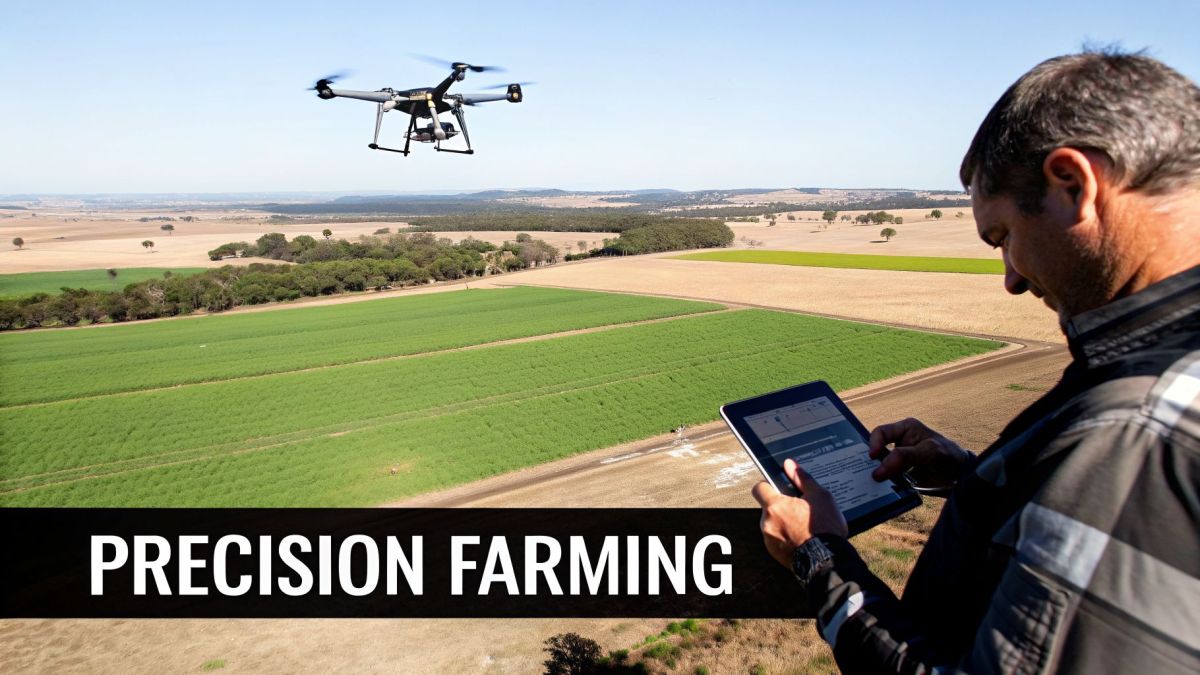
These sophisticated systems are now at the heart of modern farming, handling everything from targeted spraying and soil health analysis to incredibly accurate yield forecasting.
From Guesswork to Precision
One of the biggest headaches for Australian farmers is the spiraling cost of inputs like water, fertilizer, and pesticides. When you're operating on tight margins, broadcasting these resources across entire fields is a significant financial drain. That blanket approach inevitably means waste, environmental runoff, and unhealthy crops in areas that needed a different touch.
The old way of doing things relied on experience and historical data, but that can't account for the subtle variations that change from one acre to the next. What farmers have always needed is a way to see their land with a new level of clarity, turning broad assumptions into specific, actionable intelligence.
This is where the right drone completely changes the game. It’s not just about getting a "bird's-eye view." It's about collecting scientific-grade data that reveals the true health of a crop, almost down to the individual plant.
This is exactly the problem that the Evolution Agricultural Survey Drone was built to solve. It directly tackles the issue of resource waste by giving farmers the data they need to act with surgical precision.
The Technology Behind Smarter Farming
The Evolution Agricultural Survey Drone achieves this by integrating two key technical specifications: advanced multispectral sensors and high-precision RTK (Real-Time Kinematic) positioning.
Here’s how that tech creates a real-world business advantage:
Multispectral Sensors: This technology allows the drone to "see" light in wavelengths invisible to our eyes. By measuring things like chlorophyll levels and plant stress, it generates detailed health maps that pinpoint which parts of a field are thriving and which are struggling.
RTK Positioning: This system provides centimetre-level location data for every single image the drone captures. This precision is what makes the multispectral maps actionable, turning them into reliable guides for farm equipment.
The business outcome is immediate and tangible. When a farmer spots a patch of stressed crops on a multispectral map, the RTK data lets them program their smart tractor or sprayer to apply just the right amount of water or nutrients to that exact spot—and nowhere else. It transforms farming from a game of averages into a data-driven science.
The result? Farmers can cut their input costs by up to 30% while boosting the health and yield of every part of their property. It’s a powerful example of how Australian UAV manufacturers are creating tools that deliver a clear and direct return on investment.
This capability is fueling tremendous growth. The agriculture drone market, driven by Australian innovators like Carbonix and XAG Australia, is projected to skyrocket from USD 69.3 million in 2025 to USD 578.4 million by 2034. This boom is vital for tackling systemic issues like the chronic labor shortages affecting an estimated 40% of Australian farms. You can learn more about the trends in Australia's agriculture drone market in this detailed report.
Finding Your Ideal Australian UAV Partner
When you’re in the market for an enterprise drone, it’s easy to get lost in a sea of spec sheets, comparing flight times and payload capacities. But if you want a drone that will actually deliver for the long haul, you have to look past the hardware. The real difference between a decent purchase and a powerful strategic investment comes down to the partnership behind the technology, especially when you’re looking at the growing field of Australian UAV manufacturers.
You need to think about the entire lifecycle of the drone. How will it comply with local regulations? Where is your data going? How secure is the supply chain? This is where the advantages of partnering with a local, Australian-based manufacturer really start to shine.
The Strategic Value of Local Expertise
Sourcing enterprise drones from an overseas supplier might seem straightforward on paper, but it can quickly introduce hidden headaches that affect everything from daily flights to your data security. A local manufacturer like Evolution Flight offers a completely different experience—one built on being close by, easy to reach, and having a deep, shared understanding of what it’s like to operate in Australia.
Think about a common scenario: you’re managing sensitive data for a critical infrastructure project, like a pipeline inspection or monitoring the power grid. You’re bound by strict government and client rules that demand your data stay secure and sovereign. An overseas manufacturer might route your data through international servers, instantly creating compliance risks and opening the door to security vulnerabilities.
This is exactly the problem the Evolution Flight Secure Data Suite was built to solve. As a company with design in Australia and manufacturing in the USA and Australia, we offer on-shore data processing and storage as a core technical feature. This guarantees your mission-critical information never leaves the country, providing the business outcome of ironclad data security and making compliance straightforward. It’s about peace of mind.
That kind of assurance is fundamental when you work with a domestic partner who knows the local regulatory landscape inside and out.
Key Evaluation Criteria for Your Next UAV Partner
When you're sizing up potential suppliers, it helps to compare them on a few key points. The gap between a local Aussie manufacturer and a distant overseas supplier can be massive, and it directly impacts how efficiently you can operate and the return you get on your investment.
To make it clear, here’s a breakdown of what you can typically expect.
Local vs. Overseas UAV Manufacturer Comparison
| Evaluation Criteria | Manufacturer in the USA and Australia (e.g., Evolution Flight) | Overseas Manufacturer |
|---|---|---|
| Regulatory Support | Deep, hands-on expertise with CASA regulations, providing practical guidance for complex approvals (BVLOS, heavy-lift). | General advice, often leaving your team to figure out local certification and risk assessments on your own. |
| Technical Support | Quick, expert support in your time zone. This means less downtime and faster troubleshooting when issues pop up. | Slow responses due to time differences, language barriers, and a lack of familiarity with your specific working conditions. |
| Custom Integrations | Fast, collaborative work on custom payload integrations because the engineering team is local and you can talk to them directly. | Long lead times for custom work, complicated by communication hurdles and expensive international shipping for any physical changes. |
| Supply Chain Integrity | Transparent and secure supply chains, with a focus on programs like Green UAS to meet tough security needs for defence and government. | Opaque supply chains that can introduce security risks from non-compliant parts, failing standards like NDAA. |
| Operating Knowledge | An innate understanding of Australian challenges—from extreme heat to high winds—which is baked into the platform's design. | Designs built for generic international conditions that often aren't rugged enough for demanding Australian environments. |
As you can see, the choice goes far beyond just the initial price tag.
Beyond the Purchase Order
Choosing an Australian UAV manufacturer isn’t just about patriotism or convenience; it’s a smart, strategic move. Let’s say you need to integrate a specialised sensor for a unique environmental monitoring project. With an overseas company, you're often looking at shipping your drone internationally, waiting weeks or even months, and navigating customs and frustrating communication delays.
Now, picture this: with a partner like Evolution Flight, our Australian design team and manufacturing teams in the USA and Australia can work directly with your team. We can sit in a room together—or jump on a call at a reasonable hour—and get it sorted. This hands-on approach ensures the payload is integrated, tested, and calibrated to perform perfectly in Australian conditions. It gets your project up and running faster and more effectively, turning a simple purchase into a genuine competitive advantage.
Bringing Drones Into Your Operation: The Next Steps
So, you're considering bringing professional drones into your business. It's a big move, and the path from idea to full integration can seem complicated. The key is to break it down into simple, logical steps.
This isn't just about buying a drone off the shelf; it's about investing in a tool that changes how your team works, solves real problems, and ultimately improves your bottom line.
The first, most critical step is to get crystal clear on what you're trying to achieve. Start with the pain point. What specific challenge is costing you time, money, or safety? Are you trying to avoid sending people into risky situations for inspections? Do you need to slash vegetation management costs? Or maybe you need faster, more accurate data for your farm's planning.
For example, we often talk to asset managers who are frustrated with how slow and manual it is to update their digital twins. Their models are constantly out of date, which leads to poor maintenance decisions. That’s a perfect problem for a drone to solve.
This is exactly why we built the Evolution Flight EF-100 Heavy-Lift VTOL. Its 3-hour flight endurance isn't just a number on a spec sheet—it’s the technical feature that lets you finish a massive LiDAR scan in a single flight. The business outcome is that you get the data you need almost instantly, keeping your digital twin perfectly synchronized with reality. It turns a slow, reactive process into a smart, proactive one.
Building Your Business Case
Once you know the problem you're solving, you can build a business case that makes sense to everyone, especially the finance department. It all comes down to calculating your potential return on investment (ROI).
Start by adding up the full cost of how you do things now. Think beyond just wages—include equipment hire, insurance, vehicle costs, and the hidden costs of accidents or project delays.
Then, you can map out what a drone program would look like.
- Initial Investment: This covers the aircraft itself, plus the sensors, software, and crucial team training.
- Operational Savings: How much will you save on labour, fuel, and costly emergency repairs?
- Added Value: Don't forget the intangible benefits. What's the value of improved team safety, better data for decision-making, or increased uptime for your assets?
An experienced Australian drone manufacturer can walk you through this, using real-world figures to help you build a solid case.
From Inquiry to Integration
With your goals defined and a business case in hand, you're ready to start talking to potential partners. This is where all your prep work pays off. You can skip the generic questions and have a focused, technical conversation.
Putting together a Request for Proposal (RFP) is a great way to formalize this. In it, you should clearly describe your operational environment, what you need to achieve, and any key technical specs you require.
Think of this as the start of a partnership, not just a purchase. When you're ready, the expert team at Evolution Flight can help you refine your requirements and make sure you're choosing the right platform for the job. This kind of collaboration is the first step toward turning your vision into a real-world advantage.
FAQ About Australian UAV Manufacturers
We get a lot of questions from businesses looking to buy their first serious drone system. Here are some of the most common ones, with straight-to-the-point answers to help you make the right call.
Why Choose An Australian UAV Manufacturer?
Working with one of the top Australian UAV manufacturers isn't just about patriotism; it's a smart business decision. You get a team that understands local support, our unique regulations, and how to build a secure supply chain right here at home.
Think of it this way: a local partner has seen the specific challenges that come with Australian conditions, whether it's the dust of a Pilbara mine site or the tricky terrain of a remote utility line. This means you get faster customisations and on-the-ground help when you need it most. Your drone is built for Australia, not just tweaked for it.
What Is Green UAS Certification?
Essentially, Green UAS Certification is a stamp of approval that verifies a drone's entire supply chain is secure and doesn't use parts from countries identified as a security risk. It’s a key part of the US National Defense Authorization Act (NDAA) standards.
For anyone in defence, government, or managing critical infrastructure, this isn't just a "nice-to-have"—it's a must. This certification is your assurance that your data is secure and your operations are protected from digital threats, helping you meet strict procurement rules.
How Hard Is Integrating A Specialized Payload?
The truth is, integrating a specialised payload can be a nightmare if you choose the wrong drone. We’ve seen it happen. The industrial pain point is clear: a poorly integrated sensor can compromise millions of dollars in survey work.
That’s exactly why a platform like the Evolution Heavy-Lift Multi-Rotor was designed with technical features like flexible mounting options and dedicated power outputs for custom gear. Its specs are built to handle advanced LiDAR scanners without sacrificing flight stability or the quality of your data.
What this means for your business is a smooth, predictable integration. When you work directly with a manufacturer with Australian design and manufacturing in the USA and Australia, like Evolution Flight, our experts help you get the sensor, software, and aircraft working together perfectly. The business outcome is that it takes the guesswork out of the equation and ensures you can capture high-quality data from day one, giving you a much faster return on your investment.
Ready to see how a sovereign, Australian-designed, USA- and Australian-manufactured UAV can solve your biggest operational challenges? The team at Evolution Flight is here to provide a technical consultation and build a solution that delivers results. Request your custom quote today.