Biomechanics in sports is really about understanding how the human body moves, and then using that knowledge to move better. It's the science behind generating maximum power, improving your efficiency, and most importantly, reducing the risk of injury by optimising your technique.
You could almost think of it as the owner's manual for the human body in motion.
The Science of Peak Athletic Movement
Ever wondered why a perfectly timed kick feels so effortless, or how a swimmer seems to glide through the water with almost no resistance? The answer is hidden in the invisible forces and principles that govern every jump, throw, and sprint. This is the world of sports biomechanics, a field that pulls back the curtain on the physics behind peak performance.
This isn't just some abstract science stuck in a lab. Biomechanics gives us a practical framework to analyse how athletes actually move. It helps us answer the career-defining questions. For instance, why does one AFL player kick more accurately under pressure? Or how can a fast bowler in cricket generate more speed without wrecking their shoulder?
From Intuition to Intention
Most elite athletes have a great intuitive feel for good movement. What biomechanics does is take that gut feeling and turn it into concrete, actionable data. It helps coaches move from saying, "that looks right," to explaining, "this is why it's right." When you understand the principles at play, you can make intentional, targeted changes to technique that lead to real improvements.
This guide will break down these concepts in a simple, straightforward way. We'll explore how your body works like a high-performance engine and how biomechanics is the key to unlocking its full potential. At its core, it's here to help you:
- Maximise Power and Efficiency: Learn how to apply force in the most effective way to get more out of every single movement.
- Refine Athletic Technique: Pinpoint and correct the tiny flaws in your form that might be holding you back.
- Reduce Injury Risk: Understand how inefficient movement patterns create strain and how to build a more resilient body.
Biomechanics gives us a framework of information detailing how an athlete moves. The goal isn't to create a rigid guide for how every athlete should move, but to understand and optimise their own unique movement patterns.
To really get a handle on this, you can dive deeper into the science of movement and explore the biomechanics of sport and exercise. This knowledge is what turns complex principles into faster times, higher jumps, and a longer, healthier athletic career.
Understanding the Core Principles of Movement
To really get to grips with biomechanics in sports, we need to look beyond what we can see. Every single movement, whether it’s a powerful rugby tackle or the most delicate golf putt, is controlled by a set of invisible physical laws. Once you grasp these fundamental ideas, you start to see athletic performance in a whole new, much clearer light.
Think of it like this: a coach can tell you what an athlete is doing, but biomechanics explains why it’s either working or failing. It’s all about breaking down complex actions into their simplest parts. This whole process starts by understanding two key areas of study.
Kinematics vs Kinetics: What’s the Difference?
At first, these two terms might sound like dry, academic jargon. But the difference between them is simple, powerful, and absolutely central to analysing how we move.
-
Kinematics is all about describing motion. It focuses on the things you can see and measure, like speed, angles, and distance. When you clock a sprinter's 100m time or measure the arc of a high jumper, you're looking at kinematics. It’s the "what" of movement.
-
Kinetics, on the other hand, is the study of the forces that cause that motion. This covers everything from gravity and friction to the raw power generated by an athlete's muscles. When you analyse why that sprinter was able to generate so much speed, you're digging into kinetics. It’s the "why" behind it all.
Basically, kinematics paints the picture, while kinetics tells the story. You can't understand the full picture of an athlete's performance without both. To really get ahead, an athlete has to constantly work on their efficiency. For instance, you can improve your running economy by optimising kinetic forces to create more efficient kinematic results—letting you run faster with less effort.
The Building Blocks of Athletic Motion
Beyond kinematics and kinetics, a few other principles are the bedrock of sports biomechanics. Understanding them is what allows coaches and athletes to make those small tweaks that lead to massive gains.
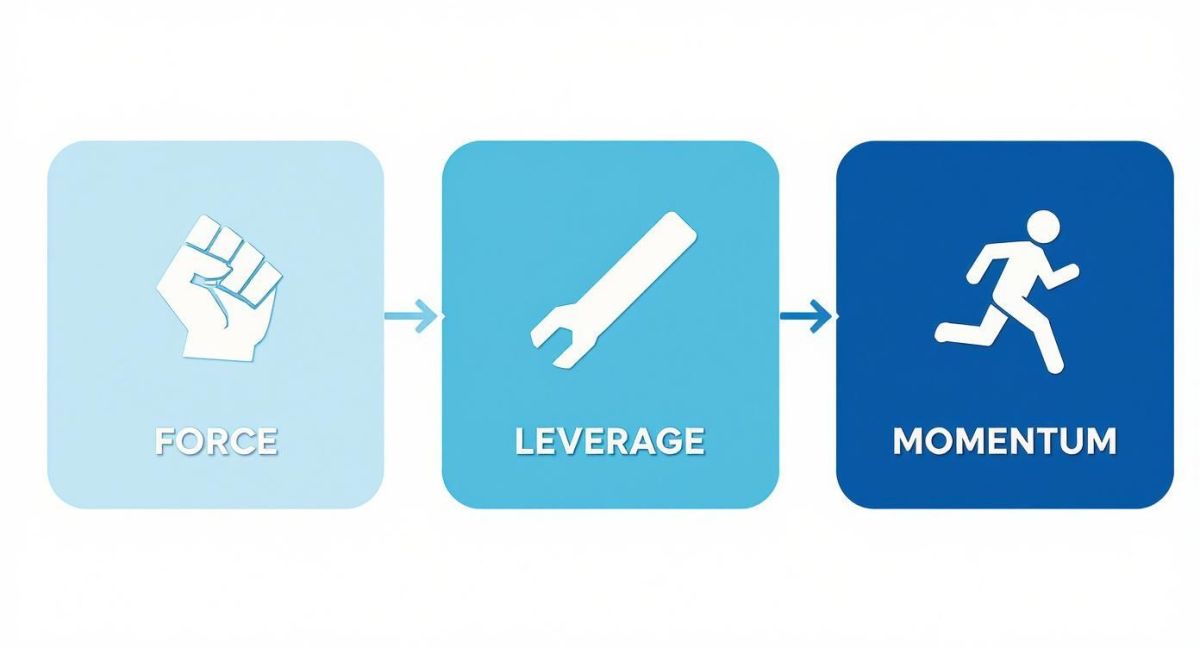
Force is just a push or a pull. In sport, athletes use their muscles to create internal forces, but they also have to deal with external ones like gravity and the force the ground pushes back with. A weightlifter has to generate an upward force that’s stronger than the downward pull of gravity on the barbell. Simple as that.
Leverage is another huge one. Our bones act as levers and our joints are the pivots (or fulcrums). The way our muscles attach to these bones dictates how well we can turn a simple muscle contraction into a powerful, explosive movement. A tennis player straightens their arm when they serve to create a longer lever, which helps them whip the racquet head through at maximum speed.
By understanding how the body works as a system of levers, athletes can tweak their movements to get the most force or speed with the least amount of effort.
This practical approach to biomechanics has been a massive part of elite sport in Australia for decades. The Australian Institute of Sport (AIS), which kicked off back in 1981, was a true pioneer in bringing biomechanics into everyday training. By the early 90s, they had dedicated facilities to break down movements in sports like swimming and javelin, turning hard data into Olympic medals.
Finally, there’s momentum—which is simply an object's mass multiplied by its speed. It's "mass in motion." A bigger, faster athlete has more momentum and is much harder to stop, something anyone who's watched a game of footy understands instinctively. But technique plays a role, too. Think of how a diver uses rotation to control their flips and twists before hitting the water—that’s all about manipulating momentum.
To help bring these ideas to life, here’s a quick look at how these principles show up across different sports.
Key Biomechanical Principles in Action
| Principle | Simple Explanation | Sporting Example |
|---|---|---|
| Force | A push or a pull that causes movement. | A boxer generates force from the ground up through their legs and torso to deliver a powerful punch. |
| Leverage | Using bones and joints to create a mechanical advantage. | A cricketer uses a straight front arm (a long lever) to maximise the speed of the bat through the ball. |
| Momentum | The amount of motion an object has. | A shot putter spins before releasing the shot to build up angular momentum, which is then transferred to the shot. |
As you can see, these aren't just abstract theories. They are the invisible engines driving every great sporting performance.
How Sports Scientists Analyse Movement
It’s one thing to understand the theories of force and momentum, but how do sports scientists actually measure these things in a real-life, moving athlete? Let's be honest, the human eye can only catch so much. To really break down a movement, experts need specialised tools that can uncover the hidden details of an athlete's performance and turn complex actions into clear, usable data.
This is where biomechanics moves from the textbook to the training ground. It’s all about capturing precise information that allows coaches and athletes to make small, evidence-based tweaks that can lead to massive breakthroughs. These technologies are the bridge between theory and real-world results.
Capturing Every Angle with Motion Capture
You’ve probably seen motion capture in behind-the-scenes clips for Hollywood movies, with actors in suits covered in little markers bringing digital characters to life. The technology used in sports biomechanics is pretty much the same concept, but it's designed to track human movement with incredible precision.
Athletes will either wear a specialised suit or have small reflective markers placed on key anatomical points, like their hips, knees, and shoulders. A whole system of high-speed cameras positioned around the room then tracks the exact position of these markers in three-dimensional space. All of this data feeds into a computer, which generates a detailed digital skeleton of the athlete in motion.
This gives us a deep-dive analysis of joint angles, limb speeds, and the timing of movements that would be impossible to see otherwise. For a cricketer, it might reveal a tiny flaw in their bowling arm's rotation that’s costing them speed. For a hurdler, it could show that their lead leg isn't clearing the barrier at the best angle, wasting precious energy.
Measuring Power from the Ground Up with Force Plates
Just about every powerful athletic move begins with the ground. Whether it's a jump, a sprint, or a swing, the athlete pushes into the ground, and the ground pushes back. Force plates are basically super-sophisticated scales embedded in the floor that measure these ground reaction forces with pinpoint accuracy.
They don't just tell you how much force is being applied; they measure the direction and how quickly it's generated. This gives coaches huge insights into an athlete's power and stability.
- Vertical Jump: Force plates can measure the explosive power a basketballer generates when they jump, showing exactly how effectively they’re using their leg strength.
- Balance and Stability: By analysing how an athlete’s weight is spread across their feet, coaches can spot imbalances that could eventually lead to injury.
- Landing Mechanics: The tech can also show how much impact force an athlete absorbs when they land—absolutely crucial for injury prevention in sports like netball and volleyball.
A study of MLB pitchers found that force plates could precisely measure how they generated and transferred force from the ground, through their body, and into the ball. This data helps coaches fine-tune pitching mechanics to boost velocity while reducing injury risk.
This flow from generating force, applying it through leverage, and creating momentum is the core of what these tools help us analyse.
Listening to the Muscles with Electromyography
So, motion capture shows us how the body is moving, and force plates measure the external forces at play. What about what’s happening on the inside? That's where Electromyography (EMG) comes in.
EMG involves placing sensors on the skin over specific muscles to measure their electrical activity. You can think of it as listening in on the conversation between the brain and the muscles. It tells sports scientists which muscles are firing, how hard they're working, and in what order.
This technology can answer some really important performance questions:
- Is there a muscle imbalance? It can show if one side of the body is working harder than the other, which is often a red flag for a future injury.
- Are the right muscles activating? For a weightlifter, EMG can confirm their glutes are firing properly during a squat, instead of their lower back taking all the strain.
- How quickly do muscles get tired? By tracking muscle activity over a training session, an analyst can see the exact point where fatigue starts to compromise an athlete's technique.
When you combine these different technologies, a sports scientist can build a complete performance blueprint. They see the movement (motion capture), measure the force behind it (force plates), and understand the muscle activity driving it all (EMG). This holistic approach is what turns raw data into a powerful tool for unlocking an athlete's true potential.
Biomechanics in Your Favourite Australian Sports
So, let's take these scientific principles out of the lab and put them right where they belong—on the fields, courts, and pools we all love. It’s one thing to understand the theory, but it’s another to see how biomechanics in sports gives athletes a real, tangible edge. This is where the magic happens. It’s the secret sauce behind a clutch goal, a lightning-fast delivery, or a record-breaking swim.
This is where data becomes dominance. For an elite athlete, one tiny adjustment discovered through biomechanical analysis can be the difference between a near miss and a perfect performance. Let's look at how this science creates game-changing advantages in some of our nation's favourite pastimes.
Optimising the Perfect Kick in AFL
In Aussie Rules, kicking for goal under pressure is what separates the good from the great. It’s a skill that seems simple but is actually a complex sequence of movements, from the run-up right through to the follow-through. And as motion analysis has shown us, even tiny tweaks can have a massive impact on accuracy.
Coaches and sports scientists use high-speed cameras to dissect every single part of a player's kick. They look at things like:
- The angle of the support leg as it plants, which creates the stable base for the entire movement.
- The speed and arc of the kicking leg's swing, making sure maximum energy is channelled into the ball.
- Hip and torso rotation, which is where a huge amount of the power comes from.
- The follow-through, an often-overlooked element that's vital for both accuracy and distance.
By spotting where things are going wrong—maybe a player opens their hips too early or doesn't follow through towards the target—coaches can give specific, data-driven feedback. A form slump suddenly becomes a solvable mechanical problem, not some unbreakable curse.
A key insight from biomechanics is that consistency is born from efficiency. When a player's kicking motion is as smooth and repeatable as possible, their accuracy naturally improves, especially when fatigue and pressure set in during the final quarter.
Biomechanics research in Australia has been absolutely critical here. During the 2019 AFL season, the goal-kicking success rate was only 45.8%, highlighting a huge opportunity for improvement. Detailed 3D kinematic analysis has since identified the exact movement patterns that separate accurate kicks from inaccurate ones, giving coaches a scientific roadmap for training. You can learn more about biomechanics in AFL goal-kicking to see how this data is changing the game.
Engineering Speed and Safety in Cricket
For a cricket fast bowler, the job is to hurl the ball with maximum speed and precision. But that explosive action puts incredible strain on the body, especially the shoulder, back, and knees. Biomechanics plays a dual role here: boosting performance while also preventing career-threatening injuries.
Sports scientists use motion capture and force plates to get a complete picture of a bowler's action. They measure the forces running through the bowler’s body at key moments, like when their front foot smashes into the crease. This helps identify risky movements, such as too much lateral flexion of the spine (side-bending), which is a known cause of lower back stress fractures.
Armed with this knowledge, coaches can help bowlers make subtle adjustments to their technique. This might mean shortening their run-up for better control, altering their arm path to ease shoulder stress, or improving core stability to protect their spine. The result? A bowler who can not only bowl faster but can also do it for a long and healthy career.
Mastering Hydrodynamics in the Pool
Swimming is really just a battle against water resistance, or drag. The best swimmers aren't always the strongest—they're the most efficient at moving through the water. This is a pure hydrodynamics problem, and a perfect application for biomechanics.
The main goal is to generate as much propulsion as possible while creating the least amount of drag. In the pool, biomechanical analysis focuses on:
- Stroke Technique: Looking at the hand's entry, pull-through, and exit to make sure every part of the stroke is creating forward force.
- Body Position: Using underwater cameras to help swimmers maintain a flat, streamlined profile that cuts through the water with minimal resistance.
- Kicking Mechanics: Fine-tuning the kick so it provides propulsion and stability without creating extra turbulence and drag.
Even a small change, like keeping the elbows higher during the pull phase of freestyle, can slash drag and conserve precious energy. Over a 1500-metre race, these tiny efficiencies add up to a massive advantage. It just goes to show that in the water, smart movement beats raw power every time.
Preventing Injury and Building Resilient Athletes
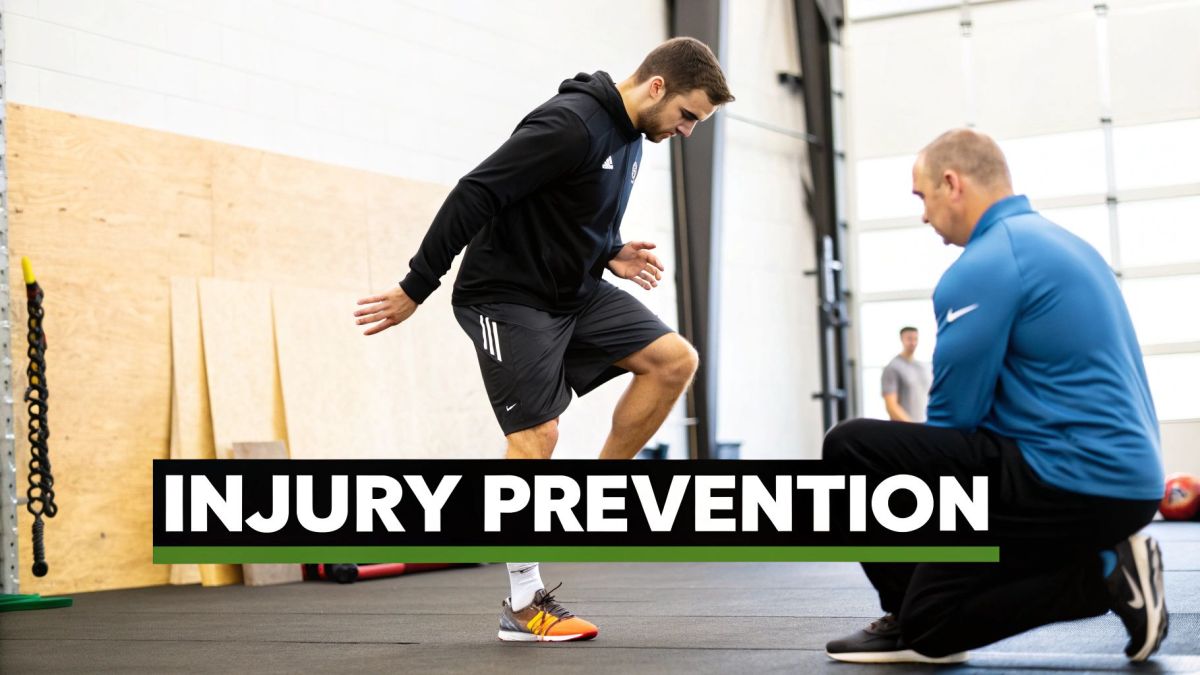
The best athletes aren't always the fastest or the most powerful. They’re the ones who can consistently show up, train hard, and compete without being sidelined. Availability is a top-tier skill, and this is where biomechanics in sports becomes an athlete's best friend. It’s the science of building durability and extending careers.
Think of it like this: every tiny, inefficient movement adds a little bit of stress to the body. A slightly off-kilter landing in netball or a poor lifting form might not seem like a big deal today. But repeat that flawed movement thousands of times, and that hidden stress builds up like a debt.
Eventually, that debt gets called in, often in the form of debilitating injuries like ACL tears, shin splints, or chronic back pain. Biomechanics gives us the tools to spot these problems long before they become a full-blown crisis.
The Body's Early Warning System
Think of biomechanical analysis as an early warning system for an athlete's body. It gives coaches and sports scientists a way to spot risky movement patterns well before they cause pain or an injury. Using tools like motion capture and force plates, we can see and measure the exact forces being put on specific joints and muscles.
This process can pinpoint potential issues with incredible precision. For example, an analysis might show a runner's knee collapsing inward every time their foot hits the ground—a classic sign linked to future knee injuries. Or it might reveal a volleyball player landing with stiff legs, jarring their joints instead of letting their muscles absorb the impact.
Identifying these subtle mechanical flaws is the first step. It lets us move from a reactive approach—treating injuries after they happen—to a proactive one where we stop them from ever occurring.
It's all about building more resilient athletes from the ground up, not just trying to patch them up after they break down.
From Data to Durable Performance
Once we've flagged a risky movement, the real work begins. Biomechanical data gives us a clear roadmap for fixing the problem. We can design targeted training programs that correct poor habits and strengthen weak links, which is far more effective than just following a generic workout plan.
These proactive fixes can look like a few different things:
- Targeted Strengthening: If weak glutes are causing poor landing mechanics, we can prescribe specific exercises to fire up and strengthen that exact area.
- Technique Adjustment: A coach can use slow-motion video to show a tennis player precisely why their serve is stressing their shoulder, making it easier to make a technical correction.
- Load Management: Biomechanics helps us understand how much training an athlete can safely handle. We can push them hard enough to improve without pushing them past their body's breaking point.
The end goal is to develop athletes who move more efficiently. They learn to produce elite-level power and speed while putting far less stress on their bodies. This evidence-based approach to biomechanics in sports helps them not only reach their peak but stay there for a whole lot longer.
What's Next for Performance Analysis?
The science of movement is always moving forward. The traditional biomechanics lab—with its fixed cameras and force plates—is breaking out of its four walls and spilling onto the field, track, and court. What we're seeing is the future of performance analysis unfolding right now: more integrated, smarter, and tailored to the individual athlete.
We're shifting away from one-off lab check-ups to a constant, dynamic flow of information. This gives us a much richer, more detailed picture of how an athlete’s body actually holds up under the real-world stress of training and competition.
Wearables and Real-Time Feedback
One of the biggest game-changers is the explosion of wearable sensors. Think smart clothing woven with motion sensors, or insoles that measure ground reaction forces on every single step of a training run. This isn't science fiction anymore; it’s technology that delivers a constant stream of data straight from the action.
The beauty of this is immediate feedback. A coach and athlete can look at a tablet and see, right there and then, if running form is breaking down from fatigue or if a landing is putting too much stress on the knee. This allows for on-the-spot adjustments, turning every practice into a powerful session for both performance and injury prevention.
The Rise of Artificial Intelligence
The next piece of the puzzle is Artificial Intelligence (AI). With the sheer volume of data pouring in from wearables, AI algorithms can spot subtle patterns that are simply invisible to the human eye. By crunching thousands of hours of movement data, AI models are getting remarkably good at predicting injury risks.
This predictive ability opens the door to proactive coaching. An AI might flag an athlete whose movement signature shows the early signs of fatigue linked to a hamstring strain, allowing the coaching staff to adjust their training load before an injury ever happens.
A Critical Need for Inclusive Research
As we push into this new era, it’s crucial that these scientific leaps forward benefit everyone. Historically, a lot of the research in biomechanics in sports has been heavily skewed towards male athletes. This has created a massive knowledge gap, because you can't just assume findings from studies on men will apply to female athletes, who have different physiological and biomechanical profiles.
Recent research has thrown a spotlight on a clear gender imbalance in Australian sports biomechanics studies, showing female athletes are seriously under-represented. This is a huge problem, especially with the phenomenal growth of women's elite sport across the country. To build an equitable future in performance, we absolutely must fund and carry out more research focused specifically on female athletes. This will improve everything from their training programs to how we keep them safe from injury. To learn more, you can read the full review of gender representation in Australian sports science.
Answering Your Questions About Biomechanics in Sports
To wrap things up, let's tackle a few common questions that pop up when people first learn about biomechanics. These are the things people often wonder, and the answers should help solidify what we've covered.
What Is the Main Goal of Sports Biomechanics?
At its core, it’s about two key things: making athletes better and keeping them safer. It’s all about boosting performance while minimising the risk of injury.
By looking at the physics of how an athlete moves, we can pinpoint little hitches in their technique that are holding them back. Fixing those flaws can unlock more power, speed, or accuracy. At the same time, this analysis shines a light on movements that put too much strain on the body, helping us make changes to prevent injuries before they happen.
Can Amateur Athletes Benefit from Biomechanics?
Absolutely. You don't need a multi-million dollar lab to see real benefits. While the pros get the high-tech treatment, anyone can apply the basic principles.
These days, many physios and specialised coaches offer affordable video analysis for everyday sports like running, golf, or swimming. Even just filming yourself on your phone and comparing your technique to a professional’s can reveal a lot. Focusing on the fundamentals—like a stable core or using your body's levers properly—can make a huge difference to your performance and help you stay off the sidelines.
The point of biomechanics isn't to force every athlete into the same cookie-cutter mould. It’s about understanding how you move, so you can make smart, personalised changes that actually work.
Is Biomechanics Only for Individual Sports?
Not in the slightest. While it’s easy to picture a single tennis serve or golf swing under the microscope, the principles are just as vital in team sports. Think about basketball or netball—biomechanics is crucial for perfecting jumping and landing techniques to avoid devastating knee injuries like ACL tears.
In sports like rugby or AFL, analysts break down tackling mechanics to make them safer and more effective. It can even shape a team's strategy by analysing how players move across the field and when they start to fatigue, giving coaches the data they need to make game-winning decisions.
What Is the Difference Between Biomechanics and Kinesiology?
It's a common point of confusion, but the distinction is pretty simple. Think of Kinesiology as the big-picture study of human movement. It’s a broad field that covers anatomy, physiology, and how we learn to move.
Biomechanics, on the other hand, is a specific tool within kinesiology. It zeroes in on the physics and engineering side of things, analysing the forces that act on the body. So, while all biomechanics is a part of kinesiology, not all kinesiology is biomechanics. It’s the specialised lens we use to understand the how and why of movement from a mechanical point of view.
At Innoflight International, we live by these same principles of precision and performance. Just as biomechanics refines an athlete's movement for peak results, we engineer our advanced aerial systems for maximum efficiency and accuracy in critical missions. See our range of versatile drone solutions at the official Innoflight International website.