If you're searching for "drone companies Australia," you've probably realized you're not just buying a product off a shelf. You're entering a complex and fast-moving industry. The trick is to find a partner who does more than just sell hardware; you need a specialist who can turn that advanced tech into real-world results that give your business an edge.
Understanding The Australian Drone Market
The commercial drone industry in Australia has well and truly gone mainstream. It’s not a niche hobby anymore—it’s a powerful economic engine. From farms and mine sites to construction projects and emergency services, businesses are quickly learning that drones are essential for boosting efficiency, improving safety, and gathering better data. This shift is opening up huge opportunities for anyone ready to bring aerial intelligence into their day-to-day work.
But this isn't just about more drones buzzing around. It's about having access to highly specialized tools. The market has matured far beyond simple aerial photos. Success now comes from using drones built for specific, demanding jobs, whether that means carrying heavy LiDAR sensors for detailed mapping or staying in the air for hours to inspect remote pipelines.
Market Growth and Future Projections
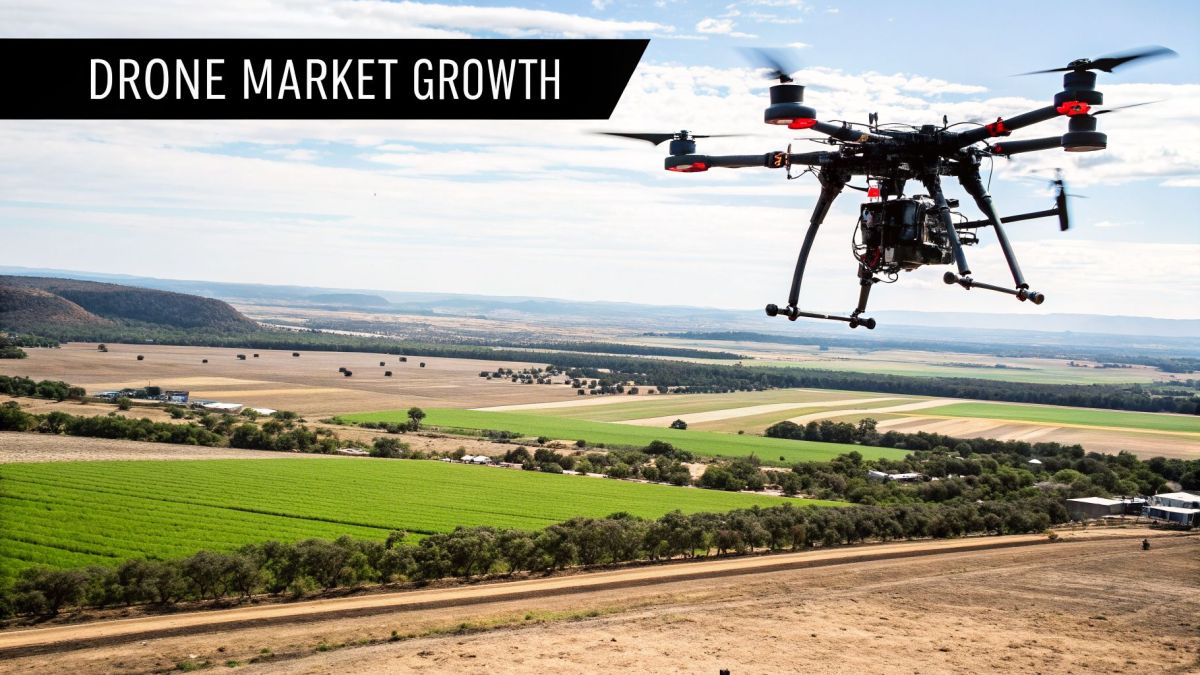
The numbers tell a pretty compelling story. The Australian drone market hit USD 606.2 million in 2024 and is on track to reach USD 759.5 million by 2025. And it’s not slowing down. Forecasts show the market rocketing to an incredible USD 1,753.8 million by 2030, which is a compound annual growth rate (CAGR) of 18.22%. You can dig deeper into these powerful market trends to see what’s driving this growth.
This chart gives you a clear look at that powerful growth, showing where we are now and where we're headed.

This isn't just numbers on a page; it shows how much confidence businesses have in drones to solve very real, and often very expensive, problems.
The number of drones in the field is growing just as fast. In 2024, there were 58.47 thousand units in operation, and that’s expected to jump to 76.21 thousand by 2025. By 2030, we're looking at 215.17 thousand units—a volume CAGR of 23.07%. What’s behind this surge? It’s a direct response to the high costs and inefficiencies of doing things the old way.
Think about it: sending a crew to manually inspect hundreds of kilometres of power lines or walk massive agricultural fields is slow, costly, and puts people in harm's way. A specialised drone can cover the same ground in a fraction of the time, delivering more accurate data without the safety risks. That's a tangible business outcome.
Key Sectors Driving Drone Adoption
This growth isn't happening everywhere at once. A few key sectors are really pushing the industry forward, each with its own set of problems that drones are uniquely equipped to solve.
- Mining and Resources: Drones are a game-changer for conducting pit surveys, calculating stockpile volumes, and monitoring tailings dams, making operations safer and far more accurate.
- Agriculture: This is the heartland of precision agriculture. Drones help monitor crop health, manage irrigation, and optimise yields, which means less waste and more profit.
- Energy and Utilities: Inspecting power lines, wind turbines, and pipelines with drones is now standard practice. It slashes asset downtime and keeps workers out of dangerous situations.
- Infrastructure and Construction: From monitoring site progress to creating digital twins for planning, drones help keep massive projects on schedule and on budget.
This demand has given rise to a new breed of specialised drone companies in Australia, like Evolution Flight. We're not just selling drones; we're solving specific industry problems. For instance, a mining company getting inaccurate haul road surveys has a serious operational headache. This is where a solution like the Evolution Flight Sky-Jib X4 comes in. Its 7 kg payload capacity isn't just a technical spec—it's what allows it to carry a survey-grade LiDAR scanner. That scanner delivers the precise topographic data needed to design better roads and keep vehicles safe.
That’s how you connect a drone's capability directly to a crucial business outcome: safer, more efficient mine-site operations.
Getting Your Head Around Australian Drone Rules
Before you can get a drone in the air and working for your business, you have to navigate the rules of the sky. Here in Australia, that’s the domain of the Civil Aviation Safety Authority (CASA). Let’s be honest, for anyone new to the industry, the regulations can look like a maze.
I've seen it time and again: a business has a genuine, valuable use for a drone but gets stuck in operational paralysis. They're so worried about accidentally breaking a rule that they never even get started. This isn't just about avoiding a fine; it's the fear of sinking thousands into a piece of equipment only to have it grounded by a compliance issue you didn't see coming.
The first step out of this maze is understanding the certifications you'll need. A good drone partner won’t just hand you a box; they’ll guide you through this from day one.
The Two Must-Have Commercial Certifications
For any commercial operation using a drone that weighs over 2kg, CASA requires two key certifications. I like to think of them as your driver's licence and your business registration for the sky.
- Remote Pilot Licence (RePL): This one belongs to the individual pilot. It's the official ticket that says you have the training and knowledge to fly a drone (or what CASA calls a remotely piloted aircraft, RPA) safely and by the book.
- RPA Operator’s Certificate (ReOC): This certification is for the business itself. It gives your organisation the authority to run commercial drone missions and manage your team of licensed pilots under a set of approved procedures.
Securing a ReOC is a major milestone. It signals that your organisation is serious about safety and professionalism, separating you from casual flyers and opening the door to more complex and valuable work.
Understanding Your Flight Boundaries
Once you're certified, the rules aren't over. Your operations are governed by different flight categories that dictate where and how you can fly. These categories directly impact the kind of jobs you can take on.
VLOS (Visual Line of Sight): This is the most basic category. The pilot has to be able to physically see the drone with their own eyes the entire time it’s in the air. It’s perfect for smaller, contained jobs like inspecting a single building site or spraying a small paddock.
EVLOS (Extended Visual Line of Sight): A step up from VLOS, this lets you fly a bit further by using a trained spotter. The spotter keeps their eyes on the drone and communicates back to the pilot, extending the operational range. Think of inspecting a few kilometres of pipeline or a larger farm.
BVLOS (Beyond Visual Line of Sight): This is the holy grail for large-scale industrial work. BVLOS allows the drone to fly far beyond the pilot's natural view, relying entirely on instruments and advanced systems for flight. It's the only practical way to handle massive projects like mapping a huge mine lease or inspecting hundreds of kilometres of power lines.
The ability to fly BVLOS is what transforms a drone from a useful tool into a game-changing asset for big industry. Without it, inspecting something long and linear like a railway becomes a slow, costly nightmare of launching, landing, and redeploying over and over again.
Finding a Partner Who Can Cut Through the Red Tape
Navigating the CASA rulebook is one thing. But for many organisations, especially in government and critical infrastructure, there's another, even bigger hurdle: procurement security. You simply cannot risk using hardware with potential data backdoors or insecure supply chains.
This is a huge pain point for asset managers who need to rapidly inspect remote infrastructure but are blocked by internal security protocols on unvetted technology. The delay means relying on slower, more expensive inspection methods while critical assets degrade. This is where the Evolution Flight Peregrine VTOL, with its Green UAS certification, becomes essential. Its AES-256 encryption is a technical spec that directly translates to a secure, auditable data chain, allowing procurement teams to fast-track approval. The business outcome is faster deployment, reduced inspection costs, and assured data integrity for critical infrastructure assessments.
How Specialized Drones Solve Industrial Problems
Think about it this way: you wouldn't use a family sedan to haul a ton of bricks. It’s simply the wrong tool for the job. You might get a little way down the road, but you’ll probably damage the car and you definitely won’t get the project finished. The exact same logic applies when it comes to commercial drones. Success hangs on matching the right aircraft to the specific problem you're trying to solve.
Far too many businesses learn this the hard way. They invest in an off-the-shelf drone only to find it can't carry the sensor they need, fly long enough to cover their site, or handle the wind and dust of a real-world industrial environment. It's a frustrating and expensive mistake that leaves them with inaccurate data and a pricey drone collecting dust on a shelf.
The Australian drone market is a perfect example of this shift in thinking. While the market is thriving—expected to grow from USD 1,051.3 million in 2024 to a projected USD 2,708.5 million by 2030—the real story isn’t just about hardware. The fastest-growing segment is actually services. Industries need more than just a drone; they need a complete operational solution, which is why data processing, custom integrations, and expert support are in such high demand. You can explore the data behind this trend in the full market report from Grand View Research.
The Problem With Using The Wrong Tool
When there’s a mismatch between a drone's capabilities and the job's requirements, the fallout is immediate. In fact, this disconnect is one of the biggest reasons early drone programs fail to show any real return on investment.
A classic mistake is trying to conduct a large-scale survey with a drone built for aerial photography. It might have a great camera, but it’s missing the two things that truly matter for industrial mapping: payload capacity and flight endurance.
- Inadequate Payload: It can't lift a high-end LiDAR scanner or multiple sensors at once. The data you get back just won’t be accurate enough for serious engineering or resource management.
- Limited Endurance: Short flight times turn a single survey into a logistical nightmare. Your team will spend most of their day on the ground, swapping batteries and relaunching, instead of in the air collecting data.
The end result is poor-quality data you can’t trust for making critical decisions, which can lead to even more expensive mistakes down the track.
Connecting Specs to Business Outcomes
This is where purpose-built drones from specialist drone companies in Australia completely change the game. A specialized platform isn’t just about impressive specs on a datasheet; it's about translating those technical capabilities into real-world business results.
The real pain point for industrial users isn't just buying the wrong drone—it's buying a tool that fails to deliver the business outcome they need. Success isn't measured by flight time or camera specs alone. It's measured by the drone's ability to generate reliable, actionable intelligence that makes your operations safer, more efficient, and more profitable.
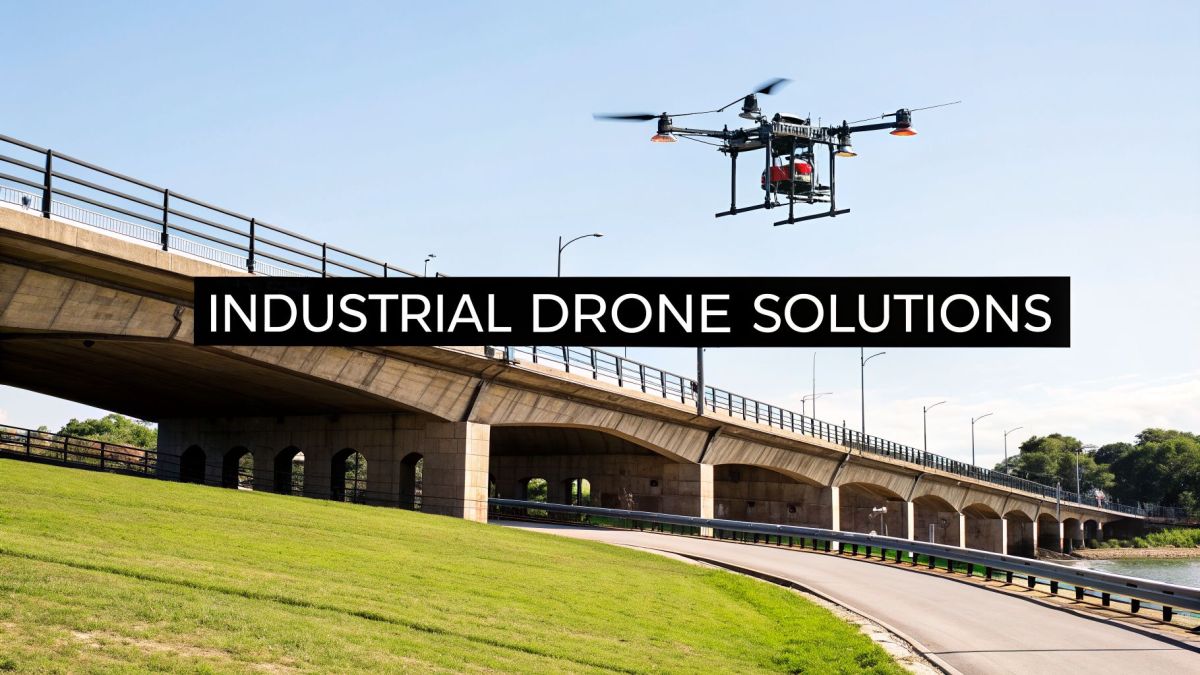
To show you what I mean, let's look at a common industrial challenge. Imagine you're an infrastructure manager responsible for a critical bridge. Traditional ground surveys are slow, costly, and can’t give you a complete picture of the asset’s condition. Your goal is to create a highly accurate digital twin for detailed structural analysis.
This job requires a heavy-lift drone. A standard consumer model just won't cut it, because the outcome you need—millimeter-accurate survey data—is only possible with a survey-grade LiDAR scanner. The problem is, these scanners are heavy and draw a lot of power.
This is precisely the kind of problem the Evolution Flight Sky-Jib X4 was built to solve. Its 7 kg payload capacity isn't just an abstract number; it's the key that unlocks the entire solution.
- The Spec: 7 kg payload capacity.
- The Link: This allows the drone to carry a premium, survey-grade scanner like the RIEGL VUX-120.
- The Business Outcome: You can generate millimeter-accurate 3D point clouds of the entire bridge. This data provides an incredible level of detail for structural analysis, predictive maintenance, and long-term asset management—something completely out of reach for a standard drone.
By drawing a straight line from a technical specification to a clear business outcome, the value of a specialized drone becomes obvious. You’re not just buying a piece of hardware; you’re investing in a capability that solves a specific, high-value problem and delivers a measurable return from day one.
Matching Drone Technology to Industrial Pain Points
To help you connect the dots, this table shows how specific drone capabilities directly address common challenges across different industries. It’s designed to help you identify what features you really need to solve your particular problem.
| Industrial Pain Point | Required Drone Capability | Evolution Flight Solution Example | Business Outcome |
|---|---|---|---|
| Inability to inspect confined or GPS-denied spaces (tanks, tunnels) | GPS-denied navigation and a compact, rugged airframe. | Evolution Flight Pegasus-S: A tough, collision-tolerant drone designed for internal inspections. | Safe, rapid, and complete visual data from hazardous environments without human entry, reducing downtime and risk. |
| Need for high-accuracy 3D models for engineering and construction. | Heavy payload capacity to carry survey-grade LiDAR scanners. | Evolution Flight Sky-Jib X4: With a 7 kg payload, it can carry top-tier sensors for high-fidelity data. | Creation of millimeter-accurate digital twins for BIM, quality assurance, and asset management. |
| Requirement for long-duration surveillance or large-area monitoring. | Extended flight endurance and multi-sensor integration. | Evolution Flight Nova-H2: A hydrogen-powered drone with 4+ hours of flight time. | Continuous aerial oversight for security, environmental monitoring, or emergency response over vast areas in a single flight. |
| Securing sensitive data from cyber threats during transmission. | Onboard data encryption and secure, closed-loop communication links. | All Evolution Platforms: Feature AES-256 encryption and are Blue UAS compliant. | Protection of critical infrastructure data, ensuring operational security and data integrity. |
As you can see, the most effective drone solutions start with the problem, not the platform. By understanding your core business challenge first, you can pinpoint the exact technical capabilities required to overcome it, ensuring your investment pays off.
Real-World Drone Applications In Australian Industries
The best way to understand the value of a specialized drone is to see it in action, solving real problems out in the field. Across Australia, we're seeing a major shift from slow, ground-based work to fast, intelligent aerial data. This isn't just a trend; it's a practical response to the need for better information, safer worksites, and smarter spending.
These examples show how pairing the right drone with experienced drone companies in Australia moves beyond the buzzwords. It’s about getting tangible results that keep projects moving and, most importantly, keep people out of harm's way.
The growth here is incredible. We're looking at a jump from an estimated 1.5 million commercial drone flights in 2023 to a projected 60.4 million annually by 2043. Industries like mining and frontline policing are leading the charge, expected to account for nearly half a million and over 310,000 flights respectively by that year. You can dig into these forecasts and see what they signal for the future of the Australian drone industry.
Mining From The Air
A major pain point for mine managers is the difficulty of conducting safe and frequent inspections of hazardous, GPS-denied environments like underground stopes or processing vessels. Sending personnel into these spaces is a high-risk activity that often requires significant operational shutdowns. This leads to production delays and potential safety incidents. This is the precise problem the Evolution Flight Pegasus-S is designed to solve. Its collision-tolerant frame and GPS-denied navigation system are not just features; they are the technical enablers that allow the drone to enter and map these hazardous areas without human entry. The business outcome is a dramatic reduction in inspection risk and downtime, providing asset managers with complete visual data to make faster, safer operational decisions.
On the ground, you're dealing with slow, expensive stockpile measurements that make resource reconciliation a headache for the finance team. From the air, a drone with LiDAR gives you a rapid, highly accurate, and auditable "digital snapshot" of the entire site. This sharpens up inventory management and makes operational planning far more precise.
Energy And Infrastructure Inspection
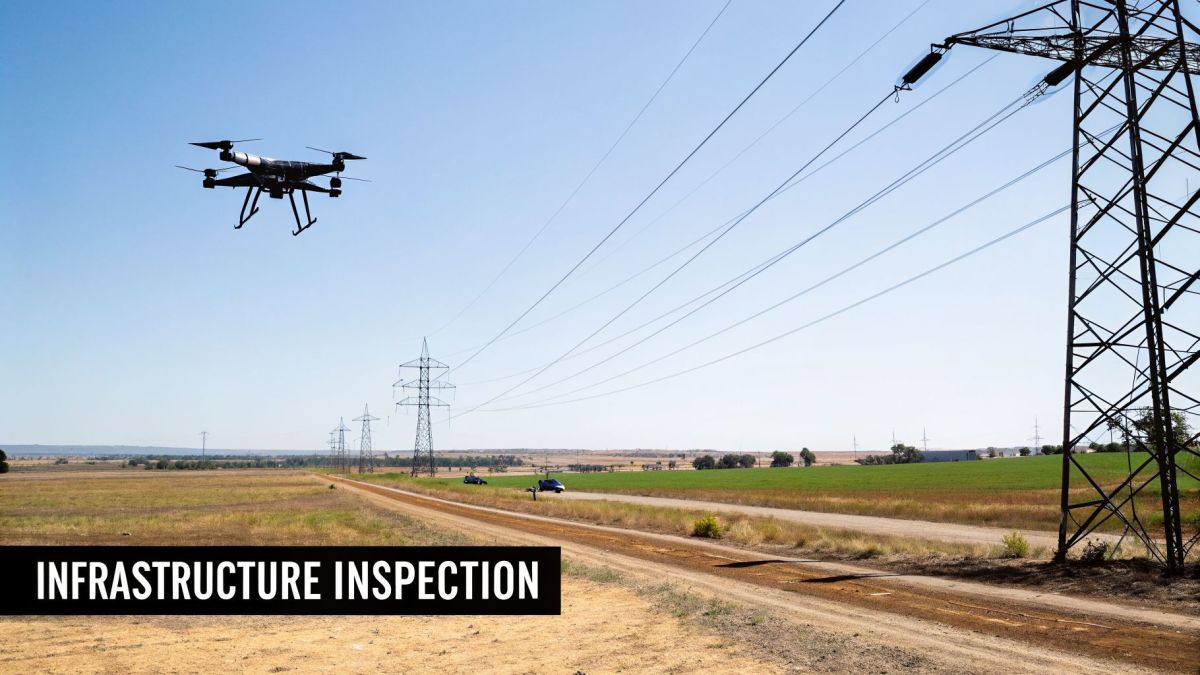
For energy providers, maintaining thousands of kilometres of power lines across remote, rugged country is a massive undertaking. The industrial pain point is clear: the huge cost, risk, and time sink of chartering helicopters or sending out ground crews for manual inspections. This conventional approach makes it nearly impossible to conduct frequent, proactive maintenance. This is where a long-endurance aircraft like the Evolution Flight Peregrine VTOL creates a new paradigm. Its technical specification of 4-hour flight endurance directly addresses the challenge of scale. This allows a single flight to cover vast stretches of the grid, gathering high-resolution visual and thermal data. The business outcome is a massive reduction in inspection costs, the removal of personnel from high-risk situations, and the ability to spot faults predictively, leading to less downtime and a more reliable energy network.
Emergency Services And Disaster Response
When a bushfire or flood hits, getting a clear picture of the situation is everything. First responders need to know the extent of the damage, find active fire fronts, and locate people who need help. But on the ground, in the chaos, that's often impossible. A significant pain point is the inability to maintain continuous aerial surveillance over a dynamic disaster zone for extended periods. This is where the Evolution Flight Nova-H2 provides a unique capability. Its hydrogen fuel-cell powertrain delivers over 4 hours of flight time, a technical specification that directly translates into persistent situational awareness. The business outcome is that incident commanders receive an unbroken stream of live data, allowing them to track fire fronts, allocate resources more effectively, and improve the safety of frontline crews.
In these high-stakes moments, a drone is far more than a data tool—it's a lifeline. By providing accurate, real-time intelligence, drones empower crews to respond faster and more safely when every second counts.
Your Checklist For Choosing An Enterprise Drone Partner
Picking the right drone is one thing, but choosing the right partner is everything. An enterprise drone isn't just a product off a shelf; it's a complex system. Get this wrong, and you end up with the most frustrating problem in our industry: the 'shelf-sitter'.
We’ve all seen it. That expensive, high-spec drone that becomes a very costly paperweight, sitting unused in a storeroom. It happens because the integration was botched, the team never got proper training, or there was no one to call when things went wrong. To avoid this, you need a partner who delivers a complete operational ecosystem, not just a drone in a box.
Assess Their Support and Maintenance Structure
Your drone is a working asset. It will need maintenance, software updates, and the occasional repair. A breakdown during a critical job can cost you thousands in downtime, which is why having local support from Australian drone companies is a game-changer.
Ask any potential vendor these direct questions:
- Where is your technical support team based? An automated reply from an international call centre at 2 AM is useless when your crew is grounded on-site in Western Australia.
- What’s your standard turnaround time for repairs? You need a clear service-level agreement (SLA) that guarantees your drone gets back in the air quickly.
- Do you offer on-site training and integration? A team that knows the system inside and out is a team that will actually use it.
A true partner like Evolution Flight works to prevent the shelf-sitter problem from the start. They offer a whole ecosystem of services, from custom engineering and payload integration to hands-on training and responsive, local tech support. This is how you ensure your investment pays dividends for years to come.
Verify Their Payload Integration Expertise
At its core, a drone is just a flying platform for a sensor. The real value is in the data that sensor collects. If a vendor can’t prove they can successfully integrate the exact payload you need for your job, you’re taking a massive risk.
Don't just take their word for it. Make them show you.
The single most important question you can ask is: "Can you show me a case study where you integrated this specific sensor onto this airframe for a client with a problem like mine?" If they hesitate, it’s a huge red flag.
Let's say your business needs to run detailed vegetation encroachment surveys along a powerline corridor. That job requires a very specific LiDAR and multispectral sensor working in perfect harmony. Your partner has to do more than just sell you the hardware; they need to guarantee the whole system works together to give you the exact data you need.
Question Their Regulatory and Security Credentials
As we've covered, navigating CASA regulations and meeting data security standards are massive hurdles. A good partner doesn't just hand you a rulebook; they give you a clear, compliant path to getting your operations approved and running securely.
Drill down on these points:
- How do you help clients with ReOC applications and BVLOS approvals? They should have a proven track record of getting complex operations off the ground.
- Are your platforms Green UAS certified or NDAA compliant? For any work involving government or critical infrastructure, this is absolutely non-negotiable.
- Where is our operational data stored, and how is it secured? You must have complete clarity on data sovereignty and encryption.
A classic pain point is having a project shut down because of an unforeseen security compliance issue. A drone company that builds its systems around security and compliance from the ground up, like the Evolution Flight platforms, de-risks your investment from day one. This holistic focus on a supported, secure system is your best defence against buying a drone that only ends up gathering dust.
Your Top Questions About Australian Drone Companies, Answered
If you’re starting to look into commercial drones, you’ve probably got a few questions. It's a big investment, and you want to be sure you're making the right call. We get it.
Let's walk through some of the most common questions we hear from organisations just like yours. Our aim is to give you straight, practical answers that connect the tech to the real-world problems you're actually trying to solve.
What’s The Single Most Important Thing To Look For In An Industrial Drone?
Honestly, it’s not about the drone. It’s about whether the entire system—the aircraft, its payload, and the software—is built to solve your specific business problem. It’s incredibly easy to get sidetracked by impressive-looking spec sheets, comparing flight times or camera megapixels. But the most powerful drone is useless if it can’t deliver the result you need.
Always start with your biggest operational headache and work your way back. For example, let's say your mining operation is constantly fighting with inaccurate stockpile volume reports. This creates reconciliation nightmares and hurts the bottom line. The problem isn’t a lack of a drone; it's the lack of consistent, survey-grade accuracy.
To fix that, you need a drone that can carry a high-precision LiDAR sensor and fly a perfectly stable, repeatable path. The technical specs are just what make the business result possible.
This is exactly where a solution like the Evolution Flight Sky-Jib X4 proves its worth. Its 7 kg payload capacity is not just an abstract number—it’s what enables it to carry a top-tier LiDAR scanner. This capability directly leads to the business outcome you're after: millimeter-accurate volume reports that tighten up resource management and boost profitability. Don’t buy specs; buy a solution.
How Can I Be Sure My Drone And Its Data Are Secure?
In today's world, data security isn't just a feature; it’s a non-negotiable requirement. This is especially true for any organisation in government, defence, or critical infrastructure. A major pain point is the risk of having sensitive operational data compromised by insecure hardware or vulnerable data links, which can halt projects and violate compliance standards.
You need to ask potential drone companies in Australia direct questions about their supply chain and data encryption. A partner you can trust will be completely open about where their components come from and how they protect your data. When a company like Evolution Flight offers Green UAS certified platforms, this is a verifiable guarantee. The technical specification of AES-256 encryption on all platforms directly addresses this security pain point. The business outcome is a secure, auditable data chain that protects your operations, satisfies internal security requirements, and ensures the integrity of your critical data from capture to delivery.
Why Should I Choose An Australian Drone Company Over An International One?
Working with a local Australian drone company gives you a powerful home-field advantage that goes well beyond just supporting the local economy. It comes down to practical, on-the-ground benefits that can make or break your drone program.
Here are three key advantages:
Real, Responsive Support: When a technical issue grounds your drone in the middle of a critical job, you need help now. An Australian-based team means fast, responsive support that drastically cuts down on expensive downtime. You get a real person on your time zone, not a support ticket in an international queue.
Deep Regulatory Know-How: Local companies live and breathe CASA regulations and the unique challenges of Australian airspace. They can give you far more effective, practical advice on everything from getting your ReOC to planning a complex BVLOS mission.
Building Sovereign Capability: When you support a local manufacturer, you're helping strengthen Australia's own industrial and tech base. This is vital for our national security and economic stability, ensuring we have the skills and infrastructure to build and maintain our own advanced systems without relying on overseas suppliers.
Choosing an Australian partner means you’re teaming up with someone who is just as invested in our operational, regulatory, and economic ecosystem as you are. It’s a genuine partnership built on shared ground.
Ready to see how a specialised, secure, and locally supported drone system can tackle your biggest operational challenges? The team at Evolution Flight is here to help you build a solution that delivers real results.
Explore our advanced drone platforms and get a custom quote today.