At its core, a drone manufacturing company is simply a business that designs, builds, and sells Uncrewed Aerial Systems (UAS). While the global market leader is China-based DJI, a growing wave of security concerns is creating a new reality. This is especially true in sensitive sectors, fueling the rise of specialized manufacturers in North America and Europe who are laser-focused on secure, compliant aircraft.
Understanding The Global Drone Manufacturing Market
Choosing the right drone manufacturing partner can feel overwhelming. On one side, you have massive, high-volume producers, and on the other, you find specialized, security-focused builders. Getting a handle on this landscape is the first step to finding a platform that actually solves your problems, rather than just buying another generic tool off the shelf.

There’s no denying that manufacturers in Asia, particularly China, currently dominate the market. Their incredible economies of scale allow for the mass production of consumer and "prosumer" drones at incredibly competitive prices. In fact, China is responsible for an estimated 70-80% of global commercial drone production.
This concentration is a major factor in the industry's explosive growth. To put the scale into perspective, the entire worldwide drone market is on track to hit a staggering $53.45 billion by 2026.
To give you a clearer picture of where the industry is heading, here’s a quick snapshot of the key market indicators.
Global Drone Market At A Glance (2026)
| Metric | Value/Projection | Key Takeaway for Buyers |
|---|---|---|
| Total Market Size | $53.45 Billion | The market is huge and still growing fast. This means more options, but also more complexity in your purchasing decision. |
| CAGR (2021-2026) | 25% | Rapid innovation is the norm. The drone you buy today may be outpaced quickly unless it's designed for long-term, specialized use. |
| Dominant Market | Asia-Pacific | While volume comes from Asia, the most secure and specialized solutions are often emerging from North America and Europe. |
| Leading Segments | Construction, Agriculture, Energy | Your industry has specific needs. Look for a manufacturer with proven experience in your sector, not a generalist. |
This table shows that while the market is booming, the most important story for professional buyers isn’t just about volume—it’s about specialization and security. You can find more insights on the drone market’s growth to see where things are headed.
The Rise Of Specialized, Secure Manufacturers
While Asia leads in sheer numbers, a different type of drone company is carving out a critical niche in North America, Europe, and Australia. These manufacturers put security, compliance, and specialized performance ahead of mass-market appeal. They build for industries where data integrity and a transparent supply chain aren’t just preferences—they’re non-negotiable requirements.
This shift is largely driven by regulations like the U.S. National Defense Authorization Act (NDAA), which restricts government and critical infrastructure operators from using certain foreign-made drones. This has exposed a major pain point for many organizations: the very real risk of deploying drones with potential security backdoors.
Think about it this way: using a non-compliant drone to inspect a power grid or a secure military facility introduces an unacceptable level of risk. The issue isn’t just the hardware itself; it’s about protecting mission-critical data from being intercepted or compromised.
Why Your Drone’s Origin Matters
This is exactly where a company like Evolution Flight makes a difference. A classic problem for a utility company is needing to inspect hundreds of miles of powerline corridors without exposing sensitive grid data to security threats. Simply grabbing an off-the-shelf drone from a non-vetted manufacturer creates a massive cybersecurity gap.
The Evolution Flight Patriot tackles this head-on by being built on a secure, transparent, and NDAA-compliant supply chain. This technical foundation isn’t just a bullet point on a spec sheet—it’s a direct solution to the business risk of data compromise.
- For a utility company: This means you can confidently run LiDAR scans to check for vegetation encroachment, knowing your grid data is completely locked down.
- For a defense contractor: This provides the assurance that your intelligence, surveillance, and reconnaissance (ISR) missions are being flown on a platform free from foreign exploits.
- For a public safety agency: This ensures that the live video feed from an emergency scene is protected, reliable, and for your team’s eyes only.
Ultimately, choosing between drone manufacturing companies boils down to this fundamental question: Are you looking for a mass-produced tool, or do you need a specialized, secure instrument built for a mission-critical job? For anyone in industrial, government, or defense sectors, the origin and security of your drone is everything.
Matching the Right Drone Type to Your Job
When you’re looking at what drone manufacturing companies have to offer, it’s easy to get fixated on the most powerful or feature-packed models. But that’s not the right approach. The real secret is matching the aircraft’s design to the specific job you need it to do. Every drone type—multi-rotor, single-rotor, and fixed-wing—is a specialized tool, and knowing how they differ is the first step to making a smart purchase.
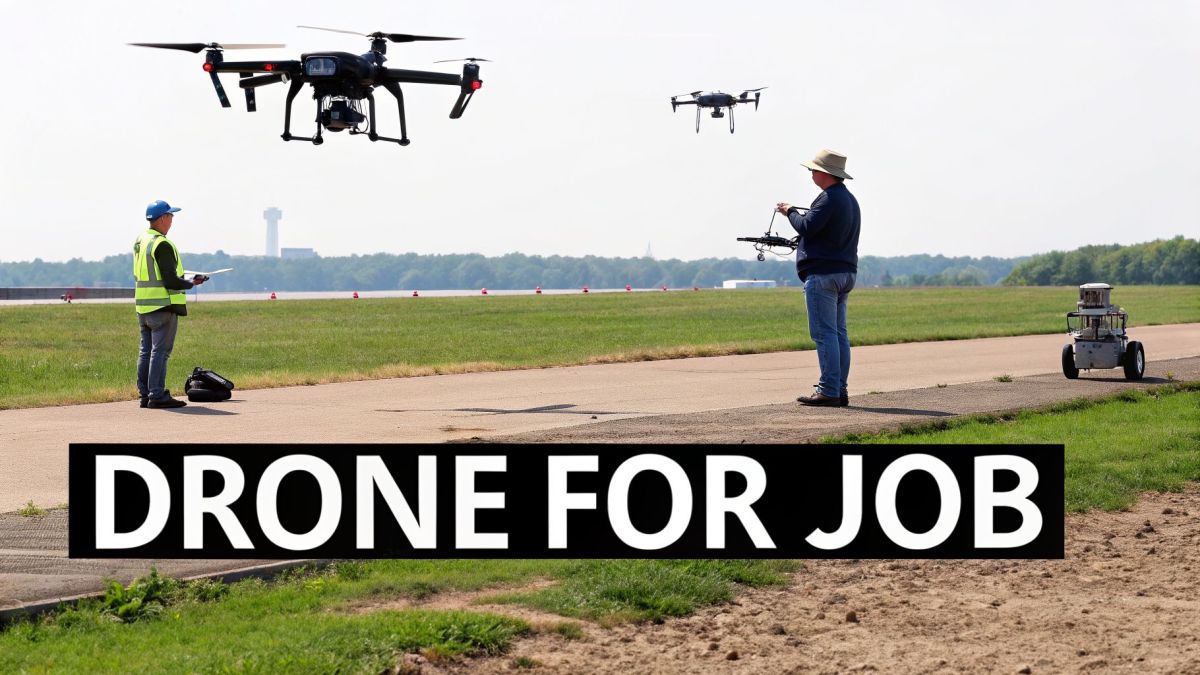
Think of it like this: you wouldn’t use a sports car to haul lumber, and you wouldn’t enter a dump truck in a street race. Drones are no different. An aircraft built for cinematic video is a world away from one designed to inspect a 50-mile pipeline.
Multi-Rotor Drones: The Versatile Workhorses
These are the drones most people picture—quadcopters, Quadcopters, and the like. Their superpower is incredible stability and maneuverability. Because they can take off and land vertically (VTOL) and just hang in the air, they are perfect for any job that requires precision in tight spaces.
This makes them the obvious choice for tasks like:
- Detailed Asset Inspection: Getting up close to capture high-resolution photos of a wind turbine blade or a small crack in a bridge.
- 3D Modeling: Flying slow, steady patterns over a construction site to build a precise digital twin.
- Public Safety: Serving as an “eye in the sky” over an incident, providing a steady live feed to ground crews.
The catch? All those rotors working to keep the drone stable burn a lot of energy. Multi-rotors typically have shorter flight times and are less efficient for covering long distances. They excel at depth, not distance.
Single-Rotor Drones: The Heavy-Lift Specialists
A single-rotor drone is built like a traditional helicopter, with one large main rotor providing lift and a smaller tail rotor for control. This design is the industrial powerlifter of the drone world, offering a fantastic mix of heavy payload capacity and long flight endurance that most multi-rotors simply can’t match.
These are the platforms you turn to when the mission demands both muscle and stamina.
For example, imagine a geospatial firm trying to map a dense, overgrown powerline corridor. They don’t just need a drone; they need an aircraft that can carry a heavy, survey-grade LiDAR scanner and stay in the air for hours. A standard multi-rotor would force them to land, swap batteries, and re-launch constantly, driving up time and costs.
This is exactly the problem that a platform like the Evolution Flight Patriot solves. Its ability to carry a 8kg payload for extended durations means you can complete huge mapping projects in a single flight. That payload capacity translates directly to a better business outcome: less time in the field, richer data from survey-grade sensors, and lower operational costs.
Fixed-Wing Drones: The Endurance Champions
Fixed-wing drones are essentially small airplanes. They use their wings to generate lift, which is incredibly efficient for forward flight. This design allows them to stay airborne for hours and cover immense distances. They are built for endurance and scale.
You’ll see them used for missions covering huge areas or long, linear assets:
- Agriculture: Mapping hundreds of acres of farmland to check on crop health.
- Pipeline and Corridor Monitoring: Flying for miles to inspect pipelines, railways, or power lines from above.
- Large-Scale Surveying: Creating detailed maps of entire regions for environmental studies or land management.
The trade-off is that they can’t hover. Most models also need a runway or a catapult to get into the air and a clear area for landing. While they can’t do the up-close, hovering work of a multi-rotor, they are unbeatable when the mission is all about covering ground. Your choice really comes down to whether your job needs an aerial crane, a transport helicopter, or a long-distance reconnaissance plane.
How Technical Specs Solve Real Business Problems
It’s easy to get lost in the weeds of a drone’s technical spec sheet. When you’re staring at a long list of numbers, it can feel overwhelming. But here’s the secret: those numbers aren’t just for engineers. They’re a direct line to business outcomes—to saving money, finishing projects faster, and keeping your people safe.
Think of a spec sheet as a performance contract. It tells you exactly how a drone will solve the expensive, complicated, and often dangerous problems you face in the field every single day. The key is learning to translate those metrics into real-world value.
From Flight Time To Financial Savings
Let’s start with a big one: flight endurance. On paper, it’s just a number in minutes or hours. On the job site, it can be the difference between a smooth operation and a logistical nightmare. For anyone surveying large areas, flight time has a direct impact on your labor costs and project timelines.
Imagine your team needs to inspect a 100-kilometer stretch of power lines for overgrown vegetation. A typical multi-rotor drone might fly for 30-40 minutes. This creates a frustrating stop-and-start workflow: fly for 20 minutes, fly back, land, swap the battery, and do it all over again. Every battery swap is downtime, adding up to wasted hours and more risk.
This is exactly the kind of problem where a better spec provides a clear-cut solution.
Think about the massive cost and inefficiency of surveying long, linear assets like pipelines or power corridors. This is where a drone like the Evolution Flight Patriot Drone changes the game with its two-hour flight endurance. For a pipeline operator, that single number means a crew can cover up to 120 km in one flight, cutting out the time, expense, and risk of repeated launches and recoveries.
The business impact couldn’t be clearer. What used to be a multi-day campaign with a huge logistical footprint can now be handled in a single morning. That massive efficiency gain comes directly from one number on a spec sheet.
Payload Capacity Unlocks New Capabilities
Next up is payload capacity. This tells you the maximum weight a drone can carry, but what it really tells you is what’s possible. It’s the spec that decides whether you can use the advanced sensors needed to solve complex jobs or if you’re stuck with just a basic camera.
For example, a common pain point for surveyors is being unable to use high-end LiDAR scanners, which are the gold standard for creating hyper-accurate digital models of infrastructure but are often too heavy for typical drones. A drone with a low payload capacity can’t even get them off the ground, making it useless for serious survey work. A higher payload capacity opens the door to:
- Deploying Survey-Grade LiDAR: You can capture the rich point cloud data needed for detailed vegetation analysis, stockpile volume calculations, or verifying that a project was built to spec.
- Using Multiple Sensors at Once: You can combine a thermal camera with a high-resolution RGB camera in a single flight to get a more complete picture of an asset’s condition.
- Integrating Specialized Gear: You can carry sensors for detecting gas leaks, measuring magnetic fields, or even conducting hyperspectral imaging for agriculture.
When you choose a drone like the Evolution Flight Patriot Drone with its 9kg payload capacity, you’re not just buying a piece of hardware. You’re getting a versatile platform that can carry the high-value sensors needed to take on a much wider range of complex jobs, both now and in the future.
This kind of strategic thinking is vital, especially with the drone market growing so quickly. Forecasts show the global industry is on track to blow past $53 billion by 2026 and could even exceed $111 billion by 2030, thanks to massive growth in defense, logistics, and commercial services. As the tech gets better, specs like payload capacity will become even more important. You can find more details about the drone market’s upward trend on Investing.com.
So, as you compare different drone manufacturing companies, always look past the raw numbers. Ask yourself how each spec translates into a real benefit for your business—whether it’s less time in the field, lower operating costs, or the power to capture data you could never get before. That’s how you find a true partner, not just another vendor.
Why a Secure Supply Chain Is Non-Negotiable
For a long time, buying a drone was all about the specs: flight time, payload capacity, and camera quality. But now, a much bigger question has entered the picture: where was it made?
For anyone working in government, defense, or critical infrastructure, the answer to that question is everything. Choosing a drone manufacturer is no longer just a technical decision; it’s a security one. A secure, verifiable supply chain isn’t a nice-to-have feature. It’s a core requirement for keeping your operations and your data safe.
This isn’t just about ticking a box for compliance. It’s about tackling a massive industry headache—the very real cybersecurity threat from hardware with a questionable or unknown origin. When an electric utility sends up a drone to inspect a transmission line, that drone is a flying sensor connected to the grid. If its components are compromised, it’s not just a drone; it’s a backdoor.
What is the NDAA and Why Does It Matter So Much?
The National Defense Authorization Act (NDAA) is the U.S. government’s direct answer to this problem. In simple terms, this law bans federal agencies and their contractors from using drones and key components—like cameras, flight controllers, and data links—made in certain foreign countries known to pose a security risk.
While the NDAA is a U.S. law, its impact is global. It has effectively set the gold standard for drone security.
For you, the buyer, seeing that “NDAA Compliant” label gives you solid proof that your sensitive data isn’t being quietly siphoned off to a foreign government or competitor. This is the entire reason security-focused drone manufacturers exist. They build trust by showing you exactly where every part comes from, so you can fly your mission with confidence.
The push for secure manufacturing isn’t just a trend; it’s a fundamental shift in the market. It’s all about creating trust through transparency, giving operators the peace of mind to do their jobs without worrying about data leaks or outside interference.
The Real-World Costs of a Compromised Drone
What actually happens if you use a non-compliant drone? The fallout can be devastating and goes far beyond a single failed flight.
- Data Theft: Imagine high-resolution photos of a military installation or detailed LiDAR scans of a power substation ending up in the hands of an adversary. That’s the risk.
- Operational Sabotage: A compromised drone could be shut down or even hijacked mid-flight during a critical mission, like a search and rescue operation or live surveillance.
- Losing Business: If you’re a government contractor, getting caught with non-compliant equipment can get you blacklisted from valuable contracts and do serious damage to your reputation.
This is why sticking with an NDAA-compliant manufacturer is a crucial risk management decision. It’s about protecting your data, your operations, and your organization’s good name from very real and persistent threats.
How a Secure Supply Chain Solves an Everyday Problem
Let’s get specific. Picture a mining company that relies on regular LiDAR surveys to measure its stockpiles for inventory. That data is commercially sensitive—it’s directly tied to their financial reporting and forecasting. Using a drone with a murky supply chain means that valuable data could be intercepted by a competitor.
This is where a drone like the Evolution Flight Patriot Drone becomes the obvious choice. Its NDAA-compliant supply chain means it’s a secure platform designed from the ground up to handle sensitive information.
The drone’s 8kg payload capacity is perfect for carrying the high-end LiDAR sensors needed for accurate surveys, and its secure build ensures the data it collects stays in the right hands. This combination of heavy-lift capability and ironclad security directly solves the mine’s problem. They get the performance they need and the protection they can’t afford to ignore.
In response to security mandates like the NDAA, drone manufacturers with secure supply chains are growing fast. Some are even setting up new facilities in allied countries to build compliant parts for final assembly in the U.S., opening the door to major defense contracts. You can get a better sense of this industry shift by reading these insights on U.S. drone companies. The takeaway is clear: for any serious operator today, security is just as important as performance.
How to Select a Manufacturer for Your Industry
When you’re in the market for a professional drone, it’s easy to get lost. The sheer number of drone manufacturing companies can be overwhelming, and every single one claims to be the best. But here’s the reality: there’s no single “best” manufacturer. There’s only the best one for your specific mission.
The company that builds the perfect drone for a mining operation is probably the wrong choice for a public safety team. You have to look past the flashy marketing and match your real-world challenges to a manufacturer’s core strengths. Think of it this way: you’re not just buying a drone; you’re investing in a solution for a very specific job.
Electric Utilities and Geospatial Surveying
For anyone in the electric utility space, the job is all about monitoring hundreds, sometimes thousands, of miles of transmission lines. It’s often rugged, remote country, and the constant headache is vegetation getting too close to the lines. You need accurate surveys, but you can’t risk compromising grid security to get them.
This is where a manufacturer’s technical know-how really shows. A drone flying near high-voltage lines has to be built to handle strong electromagnetic fields (EMF) without losing control or dropping its data link. Just as important, it needs enough power to carry a high-quality LiDAR scanner. That’s the only way to get the detailed point cloud data needed to see exactly where the trees are and how fast they’re growing.
Mining and Resource Management
Mining operations are a world away from utility work. The environment is brutal—dusty, dirty, and unforgiving. Here, the name of the game is reliability and repeatability. You need frequent, consistent surveys of stockpiles, pit walls, and haul roads to track inventory and keep the site safe.
A drone manufacturer that truly understands mining will focus on building tough, durable aircraft with high IP ratings for dust and water resistance. They’ll also have perfected automated flight planning, because the real value comes from flying the exact same path week after week. This consistency is what allows you to accurately track changes in stockpile volumes down to the cubic meter. A flimsy drone just won’t last a single season on a mine site.
It all comes down to finding the right tool for the job. A utility company needs EMF shielding. A mine needs dust proofing. A fire department needs to get in the air in under a minute. A defense operator needs encrypted data that can’t be hacked. Matching the manufacturer’s deep-seated expertise to your daily operational needs is the single most important part of the buying process.
Sector-Specific Drone Selection Criteria
To make this clearer, let’s break down how different industries prioritize drone features based on their biggest operational challenges.
This table shows how a single “pain point” can completely change what you should look for in a drone.
| Industry Sector | Primary Pain Point | Key Drone Feature | Example Application |
|---|---|---|---|
| Utilities | Vegetation encroachment along power lines | LiDAR payload capacity & EMF shielding | Conducting corridor mapping to identify hazard trees. |
| Geospatial | Inefficiently mapping large, complex areas | Long flight endurance & survey-grade sensors | Creating high-resolution orthomosaics of a new development. |
| Mining | Inaccurate stockpile volume and inventory tracking | Rugged design (IP rating) & automated flight | Performing weekly volumetric surveys of extracted materials. |
| Oil & Gas | Inspecting hundreds of miles of linear assets | Extreme flight endurance (4+ hours) | Mapping an entire pipeline right-of-way for leak detection. |
| Emergency Response | Need for immediate aerial intel in bad weather | Rapid deployment time & high wind tolerance | Providing overwatch at a structure fire or search and rescue scene. |
| Defense | Risk of data interception by adversaries | Secure, NDAA-compliant supply chain | Gathering reconnaissance imagery in a contested environment. |
Choosing a drone isn’t about getting the most features; it’s about getting the right features that directly solve your most pressing problems.
Defense and Security Operations
For military and security work, the drone itself is almost secondary. What truly matters is the data it gathers and, more importantly, who might be trying to steal it. The biggest fear is that sensitive information could be intercepted or sent to a foreign government.
Because of this, the first and most important question to ask is about the manufacturer’s supply chain. Is it secure? Is it transparent? Is it compliant with government regulations?
This flowchart simplifies that initial decision. It’s the first filter you should apply when looking at drone manufacturing companies for any sensitive application.
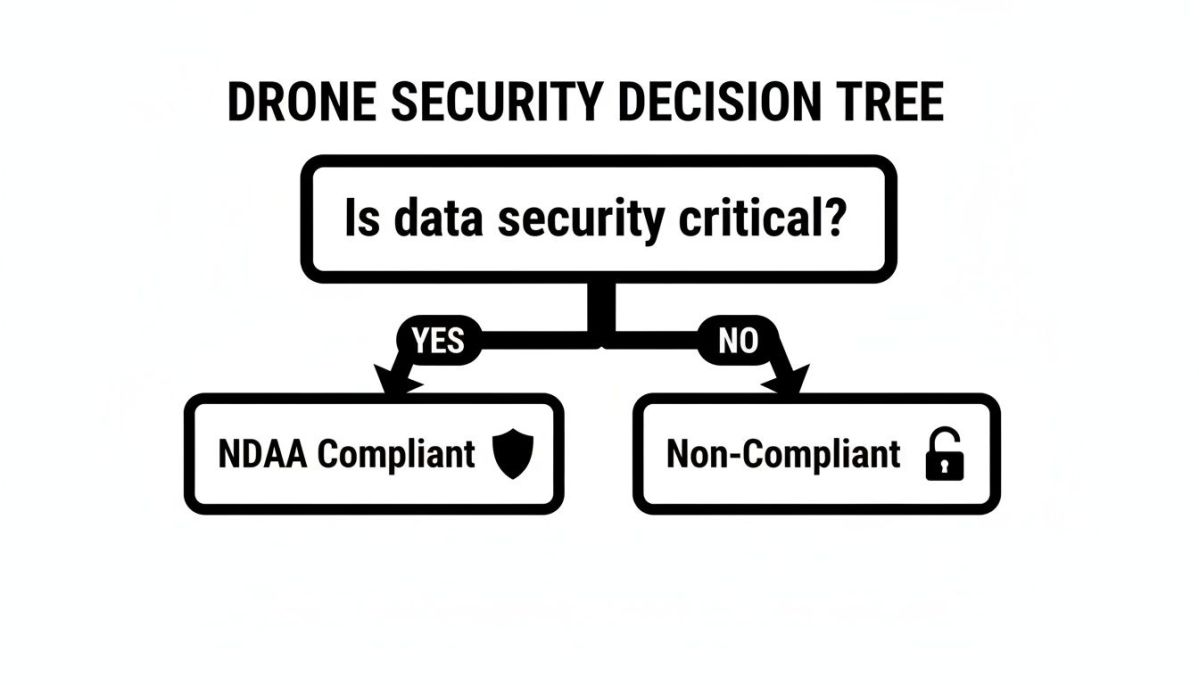
As you can see, if your data is even remotely critical, your only real option is a manufacturer that is fully NDAA compliant. There’s no middle ground.
Let’s put this into practice. Imagine a forestry agency needs to map the damage across a massive wildfire burn scar. The mission is time-sensitive, covers a huge area, and involves collecting official environmental data. The pain point is getting it all done quickly while ensuring the data is secure. A platform like the Evolution Flight Patriot Drone is a perfect match. Its incredible two-hour flight endurance can map a huge area in a single go, while its NDAA-compliant build guarantees the data is safe and sound. It’s a clear example of performance and security coming together to solve a specific problem.
Your Essential Vendor Procurement Checklist
Alright, you’ve seen the glossy brochures and watched the impressive flight demos. Now it’s time to look past the marketing and ask the hard questions that truly matter. This is the final and most important step before you make a major investment in a drone platform.
Think of this as your due diligence guide. The goal isn’t just to buy a drone; it’s to find a real partner who will be there for you long after the sale. The right questions will quickly separate the serious manufacturers from the simple hardware sellers.
Technical Support and Training
An industrial drone sitting on a shelf is worthless. Things inevitably go wrong in the field—whether it’s a software glitch or a hard landing. You need to know that the manufacturer has your back.
- Support Processes: “Walk me through your standard support process. If I have a critical issue in the field, what’s your guaranteed response time?”
- Operator Training: “What does your training for operators and maintenance staff cover? Do you offer on-site training, or is it all remote?”
A manufacturer that offers a clear Service Level Agreement (SLA) with firm timelines isn’t just making a promise; they’re showing you they’re committed to keeping you operational.
Payload Integration and Customization
Your needs will change over time. The sensor you rely on today might be replaced by a new technology next year. That’s why you need a platform built for adaptation, not a closed system that locks you in.
Think about a common scenario: a university research team needs to fly a custom atmospheric sensor that isn’t a standard, off-the-shelf product. This is where a manufacturer’s flexibility on payload integration makes all the difference.
This is precisely why a platform like the Evolution Flight Patriot Drone was designed with an open payload architecture. For the research team, this technical feature directly solves their problem, allowing them to integrate their custom sensor without needing a costly, ground-up redesign. This means they can adapt to new projects or technologies without having to buy a whole new aircraft.
Security and Supply Chain Verification
For any government or serious industrial work, data security and a clean supply chain are completely non-negotiable. Don’t just take a company’s word for it—ask for proof.
- Data Security Protocols: “How do you handle data encryption, both on the drone and during transmission? Can I see the documentation for your security architecture?”
- Supply Chain Transparency: “Are you able to provide a full bill of materials so we can verify the origin of all critical components and confirm NDAA compliance?”
A reputable manufacturer will have these answers ready to go. If you get vague responses or hesitation, consider it a major red flag. It points to a lack of transparency that could expose your entire operation to serious risk.
Your Questions Answered
When you’re navigating the world of professional drone manufacturers, a lot of questions come up. Let’s tackle a few of the most common ones I hear from buyers to give you a clearer path forward.
What Does NDAA Compliant Mean for a Drone?
Simply put, NDAA compliance means the drone and its critical guts—things like the flight controller, camera, and data links—aren’t made in specific foreign countries, especially China.
Think of it as a crucial security check. It ensures the sensitive data your drone gathers isn’t vulnerable to foreign governments. For any work in government, defense, or critical infrastructure, this isn’t just a nice-to-have; it’s an absolute requirement.
Should I Choose a Manufacturer Based on Price or Features?
While everyone has a budget, focusing only on the sticker price is a classic mistake. The smarter play is to look at the total cost of ownership and whether the drone actually solves your problem. A cheap drone that can’t handle the job will end up costing you far more in wasted time, extra labor, and unacceptable risk.
Here’s a real-world example: A utility company needs to inspect remote power lines, which is a costly and time-consuming task. A budget drone with a 30-minute flight time forces the crew to constantly land and swap batteries, driving up labor costs. This is where a platform like the Evolution Flight Patriot Drone makes business sense. Its two-hour flight endurance lets you inspect miles of line in a single trip, drastically cutting operational costs and delivering a much better return.
How Important Is After-Sales Support From a Drone Manufacturer?
I can’t stress this enough: it’s critically important. Industrial drones aren’t consumer toys; they are complex machines operating in tough environments. Great after-sales support—from technical help and maintenance to proper operator training—is what separates a company that just sells hardware from a true operational partner.
This ongoing support is your insurance policy. It’s what guarantees you’ll maximize your drone’s uptime and see a real return on your investment. A manufacturer who stands by their product is a manufacturer who is committed to your success.
Ready to work with a drone manufacturer that delivers both best-in-class performance and security? Evolution Flight builds secure, high-endurance platforms that solve real-world industrial challenges. Discover our solutions and see how we can support your mission.