Choosing a partner from the sea of drone manufacturing companies feels a lot like buying a new vehicle. You wouldn't buy a family sedan to haul construction equipment, and you wouldn't take a heavy-duty truck on a racetrack. It’s all about matching the tool to the job.
The same principle applies to commercial drones. The market is split between giants that pump out consumer-grade models and specialized firms that build high-performance systems for tough industrial work.
Understanding the Drone Manufacturing Landscape
To find the right drone partner, you first need to get a handle on the industry itself—how it's structured, where it's headed, and the real challenges that serious operators face. This isn't one big, uniform market. It’s a sprawling ecosystem filled with everything from global household names to small, mission-focused innovators.
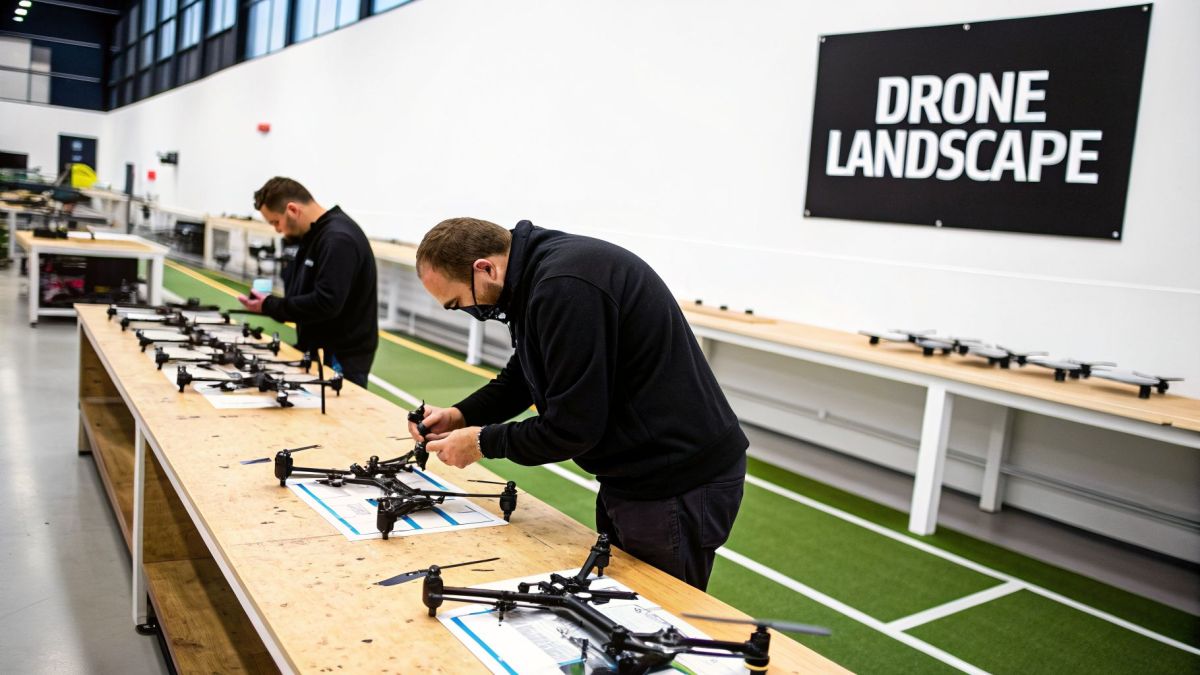
The biggest hurdle for organizations in utilities, mining, or defense isn't a lack of choice; it's that there are almost too many choices. Cutting through the noise to find a manufacturer that truly gets your operational, security, and compliance needs is a massive undertaking.
Think about it: a drone that’s perfect for real estate photography will be useless if you need it to carry a heavy LiDAR sensor over miles of power lines in high winds.
Market Growth and Dominance
The drone industry isn't just growing; it's exploding. To get a quick sense of the scale and speed, just look at the numbers.
Global Drone Market Projections at a Glance
| Year | Projected Market Value | Projected CAGR |
|---|---|---|
| 2025 | $44.3 billion | – |
| 2026 | $53.45 billion | 20.6% (2025-2026) |
| 2036 | $147.8 billion | 10.7% (2026-2036) |
These projections show a market with incredible momentum, driven by widespread adoption in both commercial and government work. You can get a deeper look at the global drone market from 2026-2036 to explore these trends further.
One company, DJI, holds over 74% of the market share, while China as a whole accounts for an estimated 70-80% of the world’s commercial drone production. They’ve built this lead on massive economies of scale and tightly controlled supply chains, which makes it incredibly difficult for anyone else to compete on price.
This market concentration is a major headache for industrial operators. Relying on a few dominant, foreign-based drone manufacturing companies creates serious supply chain vulnerabilities and cybersecurity risks—especially for anyone working in critical infrastructure or national defense.
The Shift Toward Specialization and Security
In response to these risks, a different kind of manufacturer has started to gain ground, one focused on specialized, high-security drone platforms.
For an industrial buyer, the problem is finding a drone that is not only capable but also completely trustworthy. A utility company inspecting the national grid can’t risk its data being stolen or its flight operations being hijacked by an insecure system. This is where making a smart, strategic choice is non-negotiable.
This guide is designed to help you look past the glossy brochures and focus on what really counts:
- Mission-Specific Capabilities: How to match a drone’s specs directly to your operational pain points.
- Security and Compliance: How to verify that a platform meets strict standards like NDAA compliance and has a secure, transparent supply chain.
- Long-Term Partnership: How to find a manufacturer that offers solid support, training, and integration help for the long haul.
Our goal is to give you the insight you need to choose not just a drone, but a true strategic asset that you can count on for reliable performance, data security, and a clear return on your investment.
Understanding Drone Platforms and Payloads
When you're shopping for a commercial drone, it’s easy to get lost in a sea of drone manufacturing companies and flashy marketing. The real starting point, though, isn't the brand—it's the hardware. Think of it like choosing a vehicle for a job. You wouldn't use a sports car to haul lumber, and you wouldn't use a semi-truck for a quick trip to the store.
Matching the drone's physical design, or its platform, to what you need to accomplish is the first and most important step.
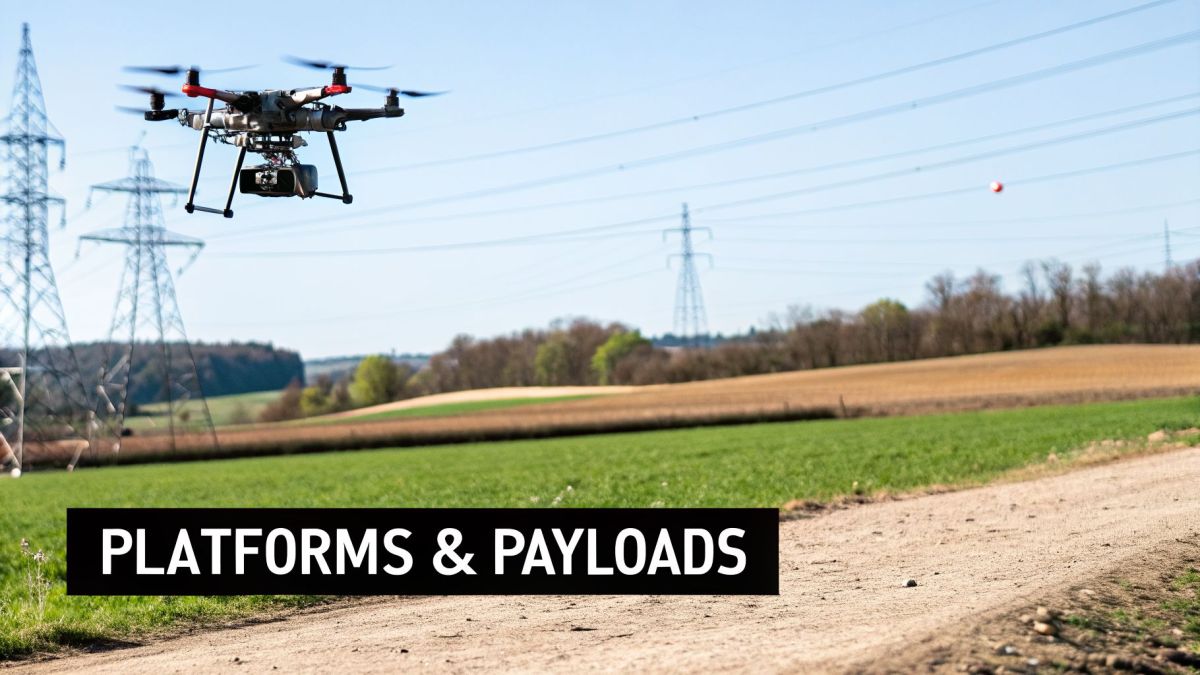
At its core, it’s about understanding what a machine can do and connecting that directly to a problem you need to solve. Industrial drones generally fall into a couple of key categories, each with its own strengths.
Multi-Rotor and Fixed-Wing Platforms
The two most common drone platforms are multi-rotor and fixed-wing. An easy way to think about them is to compare them to manned aircraft.
A multi-rotor drone is essentially a helicopter. Its multiple propellers give it the power to take off and land vertically, even in tight spots. It can also hover perfectly still and make precise, intricate movements. This makes it perfect for getting up close and personal with assets like cell towers, bridges, or wind turbines, where you need stability for detailed inspections.
On the other hand, a fixed-wing drone acts like an airplane. It uses its wings to generate lift, so it needs a bit of a runway or a catapult to get going and more space to land. It’s not as nimble, but its aerodynamic shape makes it incredibly efficient for long-haul flights. This is your go-to for mapping huge agricultural fields or surveying miles of pipelines.
The choice really boils down to a classic trade-off. A multi-rotor gives you precision and hovering for detailed, localized jobs. A fixed-wing gives you endurance and speed for covering large areas. Your mission will always tell you where to start.
From Pain Point to Business Outcome
Of course, a drone platform is only half the story. The other half is the payload—the camera, sensor, or other equipment it carries. The real magic happens when you pair the right payload with the right airframe to solve a real-world business problem.
Let's take a common challenge for electric utilities: inspecting hundreds of miles of power lines. Doing this the old-fashioned way means sending out ground crews or hiring expensive helicopters. It's slow, dangerous, and the data can be inconsistent. The pain point is obvious: high costs, big safety risks, and inefficiency.
This is where a drone's technical specs stop being just numbers on a sheet and start creating real value. The pain of slow, hazardous inspections can be solved with a platform designed for heavy-lift operations.
- The Problem: Manual powerline inspections are slow, put crews in harm's way, and often produce inconsistent data.
- The Spec: The Evolution Flight Galaxy-H7 boasts a 25kg heavy-lift capacity.
- The Outcome: This heavy-lift ability means the drone can carry a high-end LiDAR scanner. Instead of just snapping photos, the system builds a hyper-accurate 3D model of the entire power corridor, pinpointing vegetation overgrowth and equipment flaws with millimeter-level precision. An inspection that once took weeks now takes days. Crews stay safely on the ground, and utilities can use the data for predictive maintenance, stopping outages before they ever happen and saving millions.
This example shows how a single feature—in this case, heavy-lift capacity—directly translates into a powerful return on investment. The goal is never just to "get data." It’s to get the right data that makes your operation safer, more efficient, and more profitable. As you evaluate different drone manufacturing companies, always trace their technical promises back to a concrete business result you're trying to achieve.
How Technical Specs Drive Business Outcomes
When you look at a drone's spec sheet, you’re hit with a wall of numbers—flight time in minutes, payload capacity in kilograms, wind tolerance in miles per hour. It’s easy to get lost in the data. But on their own, these figures are meaningless. They only start to matter when you tie them to a real-world problem you need to solve.
The best drone manufacturing companies understand this. They aren't just selling you features; they're selling you solutions.
This mindset is key to making a smart investment. Instead of just being impressed by a drone’s top speed, you should be asking, "How will this actually reduce my team's survey time on a 500-acre site?" Every number on that sheet should answer one fundamental question: What business problem does this solve for me?
From High Winds to Higher Uptime
Let's put this into practice with a common industrial headache. Imagine you're a mining operator who needs to run frequent pit surveys to track stockpile volumes and check slope stability. These aren't just nice-to-have flights; they're critical for planning, safety, and even your financial reporting.
The big problem? Your mine is in a windy region, and your current drones are grounded more often than not.
Every day a survey gets delayed, you're operating blind. Resources get misallocated, potential safety issues go unnoticed, and you start racking up costly operational downtime. The real pain point isn't "the wind"—it's the direct hit to your bottom line and safety record every time you can't fly.
This is where a specific technical spec becomes a game-changer. The Evolution Flight Jupiter-H2 is engineered with a high wind tolerance of 25 mph, staying stable in gusty conditions that would force other drones back into their cases. This isn't about flying in a hurricane. It's about drastically expanding your operational window on any given day.
For the mining operator, this translates into a powerful business outcome. More flyable days mean more consistent data. That leads to spot-on volume calculations, smarter operational decisions, and a rock-solid safety record. The value isn't the spec itself—it's the uptime and reliability it creates.
The Broader Market Context
Focusing on outcomes over specs is more important than ever, especially with the drone market growing so quickly. The industry is on an incredible trajectory, projected to blow past $53 billion in 2026 and potentially hit $111 billion by 2030. This boom is driven by commercial work like inspections and logistics, with experts forecasting over 9 million new drones shipped by 2036.
As the market gets more competitive, simply owning a drone isn't enough. The real advantage comes from deploying a system that performs consistently under pressure. If you're interested in the numbers, you can explore more about these projections and what's driving this growth in the commercial drone market.
Payload Capacity and Mission Versatility
Payload capacity is another one of those specs that directly impacts your bottom line. A drone's ability to carry heavier, more sophisticated sensors opens up a whole new world of possibilities. A basic drone might only be able to carry a small camera for visual photos, which is useful but provides limited insight.
A true heavy-lift drone, on the other hand, can be a multi-tool. It can be equipped with a whole range of advanced sensors, often at the same time.
- LiDAR Scanners: For building incredibly detailed 3D models of terrain and infrastructure.
- Thermal Cameras: For spotting heat anomalies in electrical substations or finding a missing person at night.
- Multispectral Sensors: For analyzing crop health with a level of detail impossible for the human eye.
A geospatial firm facing the pain point of using multiple, single-purpose drones for different client jobs can solve this inefficiency with a versatile platform. The Evolution Flight Galaxy-H7, with its 25kg payload capacity, can carry a high-end LiDAR scanner, a thermal imager, and an optical zoom camera simultaneously. The business outcome is mission versatility. Instead of needing a different drone for every job, a single, capable platform adapts to various contracts by simply using different sensors on the same flight. This means less money spent on hardware, a simpler fleet to manage, and the confidence to bid on a wider range of projects without buying a whole new system.
When you're talking to drone manufacturers, always push past the spec sheet. Ask them to connect their payload options to your current and future operational goals.
Navigating Compliance and Cybersecurity Requirements
For anyone working in defense, government, or critical infrastructure, security isn't just another feature on a spec sheet—it's everything. When you're looking at drone manufacturers, you can't afford to treat compliance and cybersecurity as an afterthought.
Think of it this way: certifications like the National Defense Authorization Act (NDAA) and the Green UAS program are like a passport for your drone. They prove where it’s from and guarantee the integrity of the data it collects.
Without that stamp of approval, you’re taking a massive gamble. A non-compliant drone can easily become a Trojan horse, opening up backdoors for data theft, spying, or even outright sabotage of your operations. If you're a public safety agency or a utility company managing the power grid, a compromised data stream isn't an inconvenience—it's a potential catastrophe.
The Business Risk of a Compromised Supply Chain
So, what keeps security-conscious buyers up at night? The supply chain. The real threat is having sensitive data siphoned off through a drone’s own components.
When critical parts—like the flight controller, GPS module, or data link—come from untrusted foreign sources, you completely lose control of your data. This isn’t some abstract, far-off problem. It’s a very real threat that can undermine your entire mission and expose highly sensitive information.
This is exactly why a manufacturer's commitment to a secure, transparent supply chain is so crucial. For example, a company like Evolution Flight tackles this head-on with tough cybersecurity assessments and by building its systems using a secure U.S. supply chain. The goal is simple: to provide a platform that’s trustworthy from the ground up.
At the end of the day, what you're really buying is peace of mind. When your drone is built with verified, secure components, you know your operational data is safe, your missions are secure, and you're meeting federal mandates.
Key Certifications to Look For
When you start digging into different drone manufacturers, you'll see a lot of marketing noise. Two key benchmarks will help you cut through it and see which companies are truly serious about security.
NDAA Compliance: This is non-negotiable for any drone used by U.S. federal agencies, especially the Department of Defense. It certifies that the drone is free of critical components made by a specific list of Chinese companies. For commercial operators in fields like energy or transportation, NDAA compliance is quickly becoming the gold standard for managing supply chain risk.
Green UAS Certification: This program, run by the Defense Innovation Unit (DIU), creates a "cleared list" of drones that have passed rigorous cybersecurity and supply chain security checks. Think of it as a trusted seal of approval, confirming a drone is ready for serious government and enterprise work. Evolution Flight's own pursuit of Green UAS certification shows a real dedication to these security principles.
The Tangible Benefits of Compliant Hardware
Choosing a compliant drone isn’t just about dodging risks; it's about unlocking real-world efficiency and proving your program's value. The best manufacturers are already showing how secure, capable drones can deliver a powerful return on investment.
Take Skydio, for example. They used their NDAA-compliant platforms in pilot programs with the Arizona Department of Transportation and cut bridge inspection times by an incredible 40%. That’s a perfect illustration of how secure tech leads to measurable results.
We're seeing this trend across the industry. More manufacturers are moving the production of key parts like printed circuit boards (PCBs) to allied nations to bolster the integrity of U.S. defense products. This is a major shift, and you can read more about how the global drone market is adapting to these new security demands. As you vet your options, make it a point to ask vendors to walk you through their specific processes for keeping their supply chain secure and transparent.
Choosing the Right Drone Manufacturer for Your Sector
When you’re looking at a sea of drone manufacturing companies, it's easy to get lost in feature lists. But picking the right partner isn't about finding the drone with the most bells and whistles. It’s about matching a specific, real-world problem to a specific technical solution.
Your industry’s unique challenges should be the starting point for your entire search. This ensures the drone you buy becomes a core part of your operations, not just another piece of tech collecting dust.
Think of it this way: a company monitoring vast stretches of wilderness has completely different needs than a fire department responding to an urban emergency. The best approach is to identify your main operational headache and work backward to find the manufacturer and aircraft that directly solves it.
This section will give you a roadmap for connecting your industry's demands to the right drone capabilities, helping you make a smart investment that delivers real, measurable results.
Oil and Gas Pipeline Monitoring
For oil and gas companies, the biggest headache is often monitoring thousands of miles of pipeline. Sending crews out on foot or in trucks is slow, expensive, and puts people in harm's way, especially in remote or rugged country. The operational cost is staggering, response times for leaks are slow, and the safety risks are always there.
This is a classic problem that the right kind of drone can solve. An ideal aircraft needs two things above all else: long flight times to cover serious ground and the flexibility to carry multiple sensors at once.
The Pain Point: Inefficient, costly, and dangerous manual pipeline patrols.
The Solution: An aircraft like the Evolution Flight Jupiter-H2, built from the ground up for long endurance and sensor versatility. Its 90-minute flight time is what makes persistent aerial monitoring possible. The drone can be outfitted with high-resolution cameras to map the right-of-way and specialized sensors to sniff out methane leaks, all in the same flight.
The Business Outcome: You dramatically improve safety by getting crews out of the field. You slash operational costs compared to ground patrols or manned helicopters. And you get much faster alerts on potential environmental or safety issues.
Matching Challenges to Capabilities
This simple principle of matching your pain points to technical specs applies across every industry. The best drone manufacturers are the ones who design their systems with these real-world jobs in mind. A simple checklist can help you connect your operational needs with the features that actually matter.
This thought process is a fundamental part of buying a drone and makes sure your investment is both secure and effective.
The flowchart below breaks down a simple decision tree for thinking about drone security—an essential first step before any purchase, especially for mission-critical work.
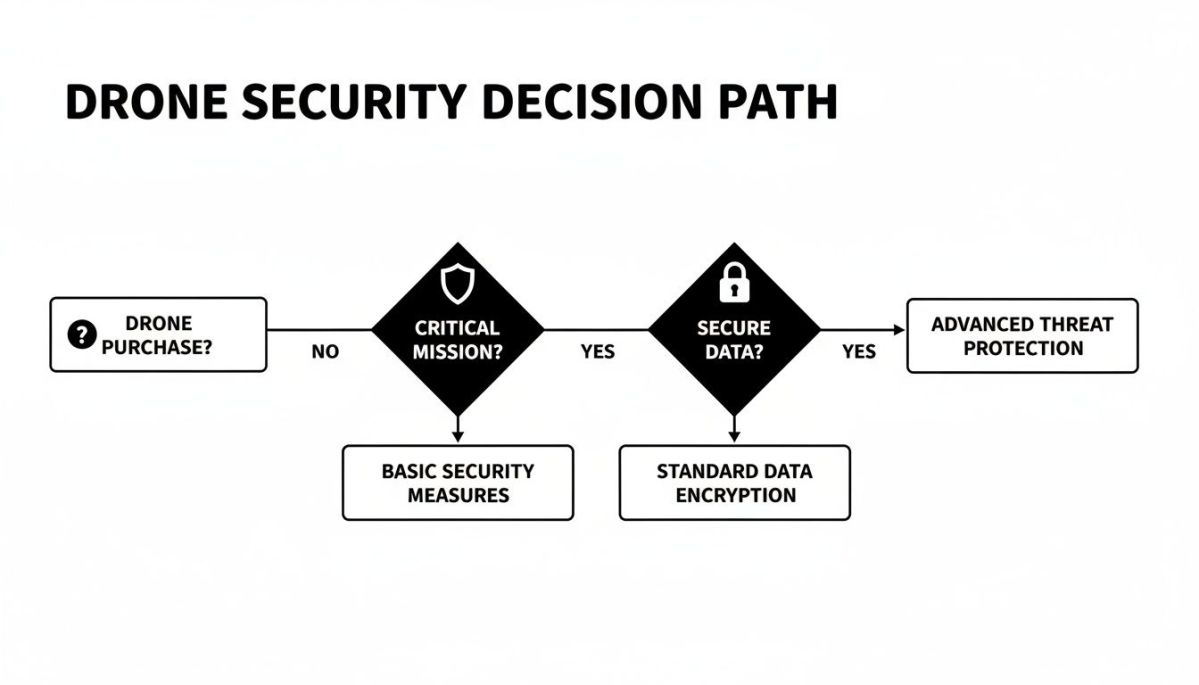
As the chart shows, if you're running a critical mission and your data has to stay safe, a compliant and verified platform is the only way to go.
Sector-Specific Drone Selection Checklist
To make this even simpler, we've put together a quick guide that matches key industries with their biggest challenges and the drone features that address them head-on.
| Industry Sector | Primary Pain Point | Critical Drone Feature | Evolution Flight Solution |
|---|---|---|---|
| Electric Utilities | Slow, hazardous manual inspection of powerline corridors. | Heavy-Lift Capacity for LiDAR & Wind Tolerance for consistent operations. | The Evolution Flight Galaxy-H7 can carry high-end LiDAR scanners with its 25kg payload capacity, allowing it to precisely map vegetation encroachment and asset condition to increase grid reliability. |
| Mining & Resources | Inconsistent survey data due to weather delays, leading to poor planning. | High Wind Tolerance & RTK/PPK Integration for accuracy. | The Evolution Flight Jupiter-H2 expands the operational window with its 25 mph wind tolerance, enabling frequent and repeatable pit surveys for accurate volume calculations and safety compliance. |
| Emergency Response | Lack of real-time situational awareness during large-scale incidents. | Long Flight Endurance & High-Quality Thermal/EO Sensors. | The Evolution Flight Jupiter-H2 provides persistent aerial oversight with its 90-minute flight time, offering live video feeds to command centers for better resource deployment and improved team safety. |
| Geospatial & LiDAR | Inability to fly premium, heavy scanners over large areas efficiently. | Exceptional Payload Capacity & Extended Flight Time. | The Evolution Flight Galaxy-H7 is a heavy-lift system with a 25kg capacity designed to carry top-tier sensors, enabling efficient corridor and terrain mapping without compromising data quality or coverage. |
This table shows exactly how the right technical specs from a skilled drone manufacturer translate into real business benefits, from better safety to lower costs. Before you talk to any vendor, it's a great idea to make your own version of this checklist based on your specific operational goals.
Your Essential Drone Vendor Procurement Checklist
When you're sifting through the many drone manufacturing companies out there, you have to look past the slick marketing materials and flashy taglines. You need a solid game plan to really dig into what a vendor can do for you. It all comes down to asking the right questions—the kind that make them prove their value instead of just talking about it.
Think of it less like a sales pitch and more like a technical deep dive. Instead of just nodding along to their claims, you'll be asking for hard evidence. This checklist will give you the questions you need to separate the true experts from the rest of the pack.
Questions About Hardware and Performance
At the end of the day, it all starts with the drone itself. You have to be sure the aircraft can handle your real-world operating conditions, not just a perfect day in a controlled environment.
- Wind and Weather Tolerance: "Can you show me documented proof or a live demo of how this platform's wind tolerance will give us more flyable days each year here in [Your Region]?"
- Payload Integration: "Walk me through the actual process of integrating and calibrating our [Sensor Name] payload. What specific support will you provide to make sure it works flawlessly?"
- Durability and Maintenance: "What’s the mean time between failure (MTBF) for critical parts like the motors and flight controllers? And what does the standard maintenance schedule look like for the first 1,000 flight hours?"
A common headache like losing workdays to bad weather costs real money. A good manufacturer should be able to show you exactly how their drone's specs fix that problem. The Evolution Flight Jupiter-H2, for example, is built with a 25 mph wind tolerance. A vendor shouldn't just state that; they should be able to show you the data on how that feature means more operational uptime and a better return on your investment.
Questions About Data, Security, and Compliance
For many industries, data security isn't just a nice-to-have; it's a non-negotiable requirement. You absolutely must confirm that a manufacturer has a robust, documented system for protecting their drone's integrity—and your data.
How a vendor answers security questions tells you almost everything you need to know. If they get vague or can’t produce documentation, that’s a major red flag for any organization dealing with sensitive information.
- Supply Chain Security: "Can you provide your documented process for ensuring supply chain security and NDAA compliance? I'd like to see a full bill of materials that traces the origin of all critical components."
- Data Encryption: "How is our data encrypted, both on the data link during flight and when it's stored on the drone? What specific protocols do you use, and have they been audited by a third party?"
- Firmware and Updates: "What's your process for delivering secure firmware updates? How do you prevent malicious code from being introduced when we update the system?"
It’s also worth noting the shifts in where drones are being made. While Asia has long been the manufacturing powerhouse, North American companies are making their mark by focusing on AI and secure, compliant systems. We've seen some impressive results, like U.S. firms helping cut site visits for solar farm surveys in Arizona by 50%. These kinds of global trends highlight why it's so important to understand a company's geographical footprint and its commitment to compliance. You can learn more about drone market opportunities and regional shifts to get a better sense of how these dynamics could influence your decision.
Common Questions Answered
When you're trying to choose a drone manufacturer, it’s easy to get bogged down in technical specs and industry jargon. Let's clear up some of the most common questions we hear from buyers to help you find the right fit for your operation.
Commercial Versus Enterprise Drones
What’s the real difference between a "commercial" drone and an "enterprise" one? It all comes down to the job it was built to do. Commercial drones are often mass-produced for a wide audience, think photographers or real estate agents who need basic aerial shots. They're the generalists.
Enterprise platforms, on the other hand, are specialists. They are high-performance tools designed from the ground up for tough industrial work, whether that's inspecting power lines or supporting a public safety mission. The focus here is on ruggedness, how much it can carry, and airtight security.
For example, imagine trying to survey an active mine where dust and moisture are constant threats—a major pain point that causes frequent equipment failure and project delays. This problem is solved by the IP55 ingress protection rating on a platform like the Evolution Flight Jupiter-H2. That spec isn't just a number; it translates directly into higher reliability and less downtime in harsh field conditions, protecting your investment and keeping your projects on schedule.
The Importance of NDAA Compliance
You’ll see the term "NDAA compliant" a lot, and for good reason. It's a critical security benchmark, confirming that a drone's hardware and software are completely free of components from certain restricted countries, especially China.
For anyone in government, defense, or critical infrastructure, this isn't just a "nice-to-have"—it's a non-negotiable requirement. Using a non-compliant drone opens the door to serious security risks like data interception and espionage, putting your entire operation at risk. Choosing an NDAA-compliant platform is the foundation of data security.
The drone industry is seeing massive growth, with the global market expected to jump from $69 billion in 2026 to over $147 billion by 2036. Much of that growth is driven by sensitive applications where security is everything. You can dig into more about these drone market projections to see where the industry is heading.
The Cost of an Industrial Drone
It's a common question: what should I expect to pay? The price tag on an industrial drone can vary widely depending on its capabilities. A basic consumer drone might run you a few thousand dollars, but that’s not what we’re talking about here.
A professional-grade system built for heavy-lift work or LiDAR mapping can range anywhere from $30,000 to over $150,000. That might seem steep, but it’s an investment in operational efficiency, next-level data quality, and—most importantly—keeping your team safe.
Ready to invest in a drone platform that solves your specific industrial challenges? See how Evolution Flight delivers secure, high-performance solutions for your mission.