If you're a business looking for professional drones in Australia for sale, you’ve probably noticed the market is crowded and, frankly, a bit overwhelming. Making the right choice isn't just about buying a new piece of tech; it's a major investment that needs to solve a real-world problem, whether that's slashing survey costs or keeping your team out of harm's way during inspections.
Finding the Right Drone in a Booming Australian Market
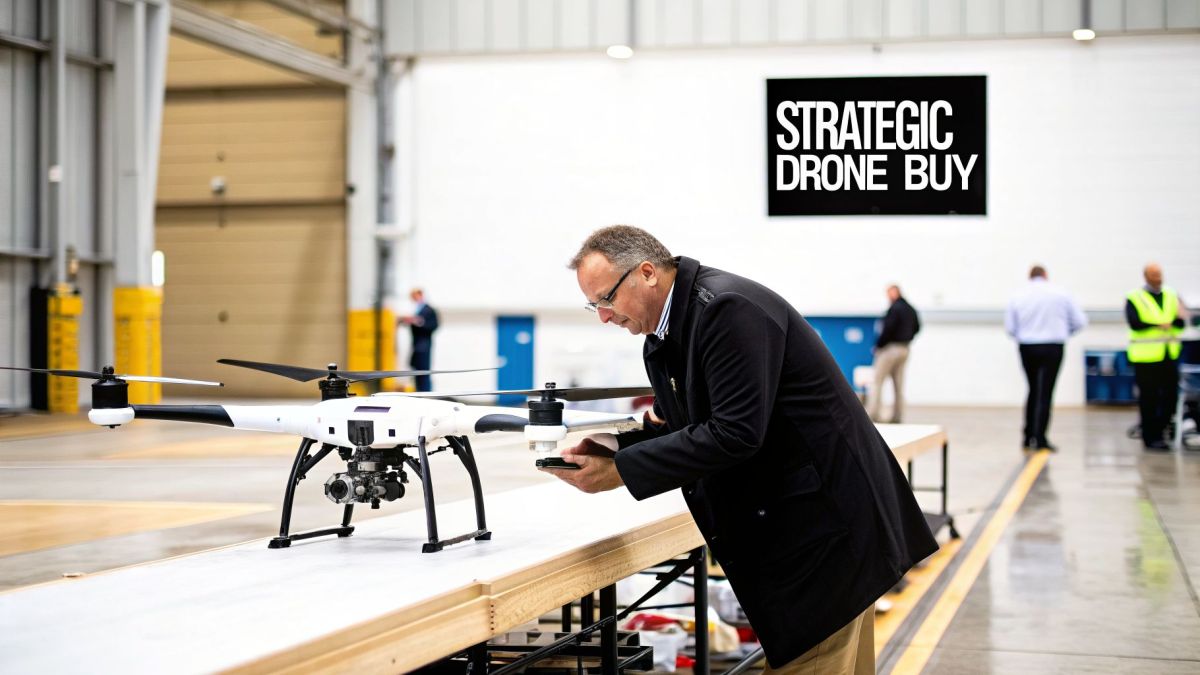
The drone industry here in Australia is growing at an incredible pace. This isn't just about more people flying for fun; it's being driven by serious commercial work in sectors like mining, energy, and infrastructure. These industries are quickly learning that drones are essential for gathering real-time data, cutting down on operational expenses, and dramatically improving safety.
The numbers don't lie. The Australian drone market hit a value of USD 606.2 million in 2024 and is on track to soar to USD 1,753.8 million by 2030. Looking further ahead, Airservices Australia predicts a massive jump in activity, forecasting as many as 60.4 million drone flights every year by 2043. You can dig deeper into these trends in the latest Australian drone market analysis.
Think Problem First, Drone Second
When you first start looking, it's tempting to jump straight into comparing spec sheets and price tags. But the most successful drone programs don't start there. They start by asking one simple question: "What business problem am I actually trying to solve?"
Think of it this way. A mining company isn't just buying a drone; it's buying a way to survey open pits without putting people on the ground. An energy provider isn't just buying a flying camera; it's investing in a tool that can spot vegetation overgrowth on powerlines with centimetre-level accuracy, helping prevent bushfires.
A drone is a tool, plain and simple. Its real value isn't just in the flight time or camera specs, but in how it directly solves an expensive, dangerous, or time-consuming problem you have right now.
Connecting Your Pain Points to the Right Capabilities
This guide is designed to help you think like an enterprise buyer. We’ll show you how to connect your specific operational pain points to the drone capabilities that can fix them. For example, if your business is struggling with the extreme costs and slow progress of inspecting long assets like pipelines or rail lines, your solution is a drone built for long-endurance flights.
This is precisely where a platform like the Evolution Flight EF-S1550 Single-Rotor Helicopter comes into play. It's not just a drone with a long flight time; its endurance of up to 4 hours is the direct answer to the high costs and slow pace of large-scale surveys. This capability lets you cover far more ground in one mission, meaning data is collected faster, projects finish sooner, and operational costs are significantly reduced.
Before you even look at a single model, it's critical to get a handle on the fundamentals of running a successful drone operation in Australia. These include:
- Navigating CASA Regulations: The rules from the Civil Aviation Safety Authority (CASA) are non-negotiable for any commercial work. You have to know them.
- Matching Platforms to Your Needs: Do you need a multi-rotor? A single-rotor helicopter? Understanding which platform fits your specific job is key.
- Choosing the Right Sensors: The sensor is what actually does the work. Whether it's LiDAR, thermal, or high-resolution imagery, the payload has to be right.
- Considering the Entire Ecosystem: This is about more than just the drone itself. You need to think about data security, local support, maintenance plans, and pilot training right from the start.
By focusing on these core areas, you'll be able to navigate the market with confidence and make an investment that delivers real, measurable results. Partnering with an Australian-based manufacturer can make all the difference, giving you the local expertise and support you need to succeed.
Understanding Australian Drone Laws and CASA Rules
It’s easy to get swept up in the technology when you start looking at drones for sale in Australia. But before you even think about getting a drone in the air, you have to get your head around the rules of the sky. Here in Australia, the Civil Aviation Safety Authority, or CASA, sets the legal framework for every single flight. For any business, knowing these rules isn't just a good idea—it's non-negotiable.
Think of CASA’s regulations as the road rules for the sky. Just as you need to know speed limits, stop signs, and who has the right of way, a drone operator needs to understand flight altitudes, no-fly zones, and certification. Getting it wrong isn't just about a potential fine; it can put people and property in real danger.
At first glance, the rulebook can look a little intimidating. But it’s all built on a pretty logical, risk-based approach. The more complex your operation, the stricter the requirements become.
The Starting Point: Excluded Category Operations
For really simple, low-risk commercial jobs, you might be able to fly under what’s called the "excluded category." This lets you operate a small drone (under 2kg) for business purposes without needing a full-blown operator's certificate.
But here’s the catch: this category comes with some serious limitations. You still need to register your drone with CASA and stick to the standard operating conditions.
These include:
- Keeping the drone within your Visual Line of Sight (VLOS) at all times—no exceptions.
- Flying only during the day, in clear weather.
- Staying below 120 metres (400 feet) above the ground.
- Keeping at least 30 metres away from anyone not involved in the operation.
- Never flying over or above people.
This is fine for basic tasks, like quick real estate photos or a simple site observation where you can easily keep an eye on the drone. For most serious industrial work, however, you'll hit these limits very quickly.
When You Need a Remote Operator's Certificate (ReOC)
This is where things get serious. If your business needs to do anything more advanced, you’ll need a Remote Operator's Certificate (ReOC). A ReOC is an organisational-level certification from CASA. It proves your business is set up to manage drone operations safely and professionally, allowing you to fly drones heavier than 2kg or operate outside the standard, restrictive conditions.
A ReOC is your ticket to unlocking a drone's true commercial power. It tells your clients and the regulators that you operate to a professional standard, opening the door to bigger, more valuable projects.
With a ReOC in hand, your organisation can then apply for special approvals for the kinds of advanced flights that deliver real business value.
VLOS, EVLOS, and BVLOS: The Keys to Industrial Scale
Understanding the different flight categories is critical because they dictate how far you can fly and what you need to do to stay compliant.
- Visual Line of Sight (VLOS): This is the baseline. The remote pilot has to be able to see the drone with their own eyes, without binoculars, for the entire flight.
- Extended Visual Line of Sight (EVLOS): This gives you a bit more range. It involves using a trained spotter who stays in constant communication with the pilot, helping them keep eyes on the aircraft as it flies further away.
- Beyond Visual Line of Sight (BVLOS): This is the game-changer for industrial operations. BVLOS allows the pilot to fly the drone using instruments, telemetry, and sensors, well beyond what the human eye can see.
The industrial pain point of inspecting vast, linear assets like powerlines or pipelines is the sheer time and cost of sending out ground crews or using manned aircraft. It's a slow, expensive, and often dangerous process that limits how frequently inspections can be done.
This is where BVLOS operations completely change the equation. A platform like the Evolution Flight EF-S1550 Single-Rotor Helicopter, which boasts up to 4 hours of flight endurance, directly addresses this pain point. That long flight time, when combined with a BVLOS approval, allows an operator to inspect vast stretches of pipeline or transmission lines in a single flight. This capability dramatically cuts inspection costs, reduces risk to personnel, and delivers critical data faster than ever before.
Choosing the Right Drone Platform for Your Industry
Alright, now that we’ve covered the basic rules of the sky, let's talk hardware. When you start looking at drones for sale in Australia, it’s easy to get lost in the specs. The most important thing to remember is this: a drone isn't a gadget; it's a tool. The real difference between a successful investment and an expensive paperweight is matching the right aircraft to the job you need it to do.
At a high level, industrial drones mostly fall into two camps: multi-rotor and single-rotor. Think of a multi-rotor drone as a helicopter's incredibly nimble cousin. Its multiple propellers give it amazing stability, allowing it to hover perfectly still for close-up inspections of things like bridges, wind turbines, or building facades.
On the other hand, a single-rotor platform is built for the long haul. It operates more like a traditional helicopter, flying for hours and covering huge distances efficiently. This makes it perfect for large-scale mapping jobs, like surveying vast farming properties or long infrastructure corridors.
From Consumer Toys to Enterprise Tools
Not all drones are built the same. You'll generally find three tiers: consumer, prosumer, and enterprise-grade. While a consumer drone from a big box store is fun for a hobbyist, it simply won't survive a professional worksite. They lack the durability, payload muscle, and data security needed for serious work. Prosumer models are a step up, but they can still struggle in the harsh Australian heat and dust.
Enterprise-grade drones are a different breed altogether. They’re purpose-built for tough industrial environments, designed for rock-solid reliability with redundant systems for safety, and they can carry the high-end sensors that deliver truly valuable data. Choosing an enterprise platform is a commitment to getting the job done, day in and day out.
And the demand for these professional tools is growing fast. The commercial drone market in Australia hit USD 772 million in 2023 and is expected to climb to an incredible USD 2,091.33 million by 2032. This isn't just hype; it's driven by real companies solving real problems. We're seeing power utilities use drones for safer vegetation monitoring, mining companies getting precise LiDAR scans, and emergency services deploying rugged, wind-tolerant models for disaster mapping. You can dig deeper into these numbers in the latest Australian commercial drone market report.
The flight rules set by CASA are a huge part of this. This chart breaks down the main categories: Visual Line of Sight (VLOS), Extended Visual Line of Sight (EVLOS), and Beyond Visual Line of Sight (BVLOS).
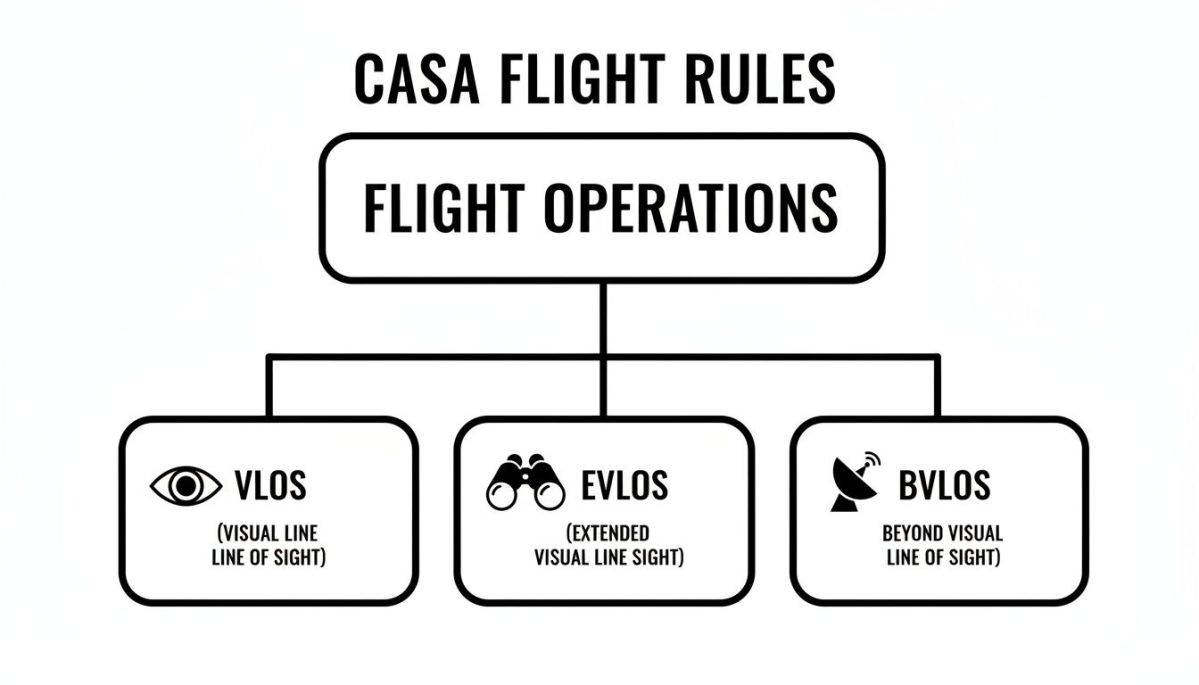
Understanding these is critical because the type of flying you need to do directly shapes your choice of drone and the licences you’ll need to hold.
Matching the Drone to Your Industrial Pain Point
Let's make this practical. A spec sheet is meaningless unless those numbers solve a real-world business problem. Your biggest operational headache should be the compass that guides you to the right drone.
Take the mining industry. A huge pain point is surveying open-cut pits and tailings dams. It's traditionally slow, expensive, and puts surveyors in potentially hazardous situations. Because it's so costly, surveys happen infrequently, meaning operational plans are often based on outdated information. This is a classic problem just waiting for a drone solution.
This is exactly where a heavy-lift multi-rotor platform proves its worth. Take our Patriot Heavy-Lift, for example. It was engineered to solve these exact challenges. Here’s how its features translate into a business outcome:
- The Problem: Slow, hazardous manual surveys and the need for frequent, consistent data.
- The Drone's Feature: A payload capacity of up to 12 kg combined with an advanced flight controller for repeatable mission planning.
- The Outcome: This heavy-lift muscle allows the Patriot Heavy-Lift to carry an advanced LiDAR scanner, capturing millions of data points in hours instead of days. The repeatable mission planning means you can fly the exact same path every week, or even every day. This creates a stunningly accurate digital twin of the site and provides consistent datasets to track stockpile volumes and monitor dam wall stability, completely removing human risk and enabling proactive, data-driven planning that boosts both safety and profitability.
By directly connecting your industrial challenge to a drone’s capabilities, you can be sure your investment is going to deliver a real return. The right platform doesn't just fly—it solves problems.
To make this easier, here’s a quick-reference table to help you match a drone type to your specific industry need.
Matching Drone Type to Industrial Application
| Drone Type | Best For (Industrial Pain Point) | Example Business Outcome | Recommended Evolution Flight Platform |
|---|---|---|---|
| Heavy-Lift Multi-Rotor | Slow, hazardous manual surveys of complex sites (mines, construction) where high-end sensors are needed. | Faster, safer data collection with LiDAR for creating digital twins and enabling repeatable, consistent monitoring. | Patriot Heavy-Lift |
| Surveying & Mapping Drone | Large-scale land surveying where endurance and accuracy are key, but manual methods are too slow. | Efficiently create high-resolution maps and topographic models for agriculture or infrastructure, optimising land use and planning. | Evolution Flight Patriot Survey |
| Single-Rotor Helicopter | Long-range inspection or mapping over vast, linear assets (pipelines, power lines) where frequent stops are impractical and costly. | Extended flight times cover massive areas in a single mission, dramatically reducing deployment costs and time on site. | Galaxy 950 Gas Helicopter |
This table should give you a solid starting point for thinking about which platform category is the best fit for the outcomes you're trying to achieve.
A Deep Dive into Payloads and Sensors
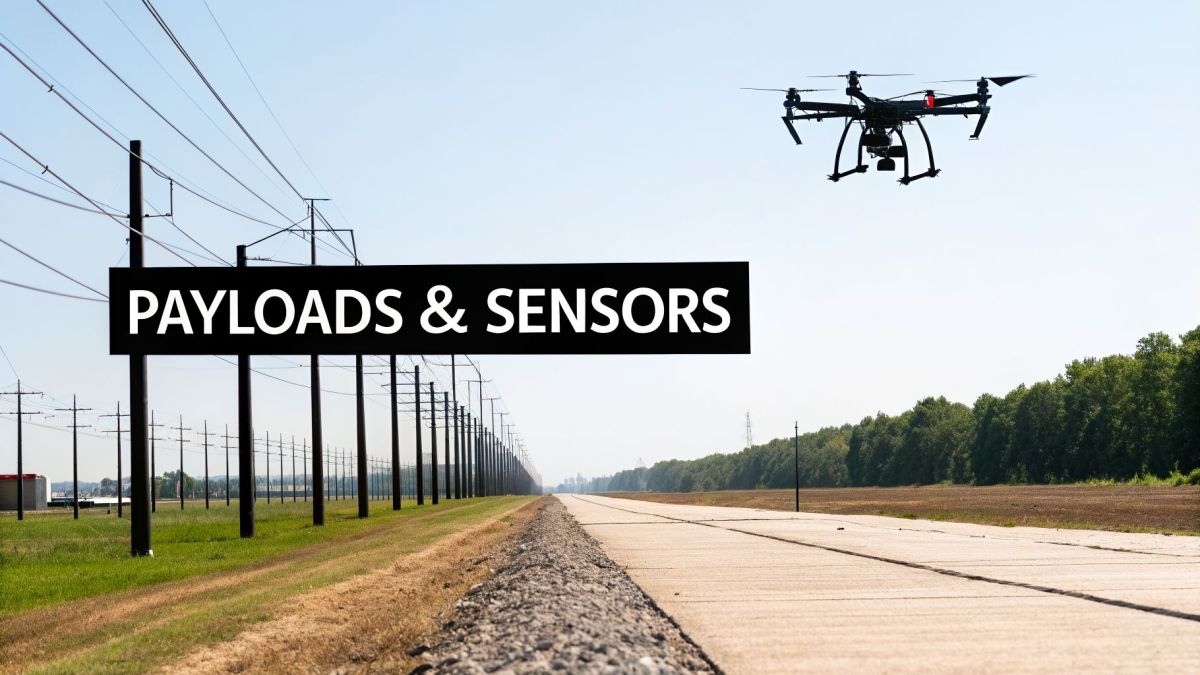
When you're looking at professional drones in Australia for sale, it's easy to get lost in the specs of the aircraft itself. But here's a helpful way to think about it: the drone is the truck, and the payload is the valuable cargo it carries. The drone gets you to the worksite, but it’s the sensor—the payload—that actually does the job.
Without the right tool for the job, you just have a very expensive toy. The payload is what transforms that flying machine into a genuine problem-solver, turning raw data into real-world business intelligence. So, choosing the right sensor is every bit as critical as picking the right aircraft.
For instance, a high-resolution camera isn't just for taking nice photos. For a construction firm, it's a powerful tool for building detailed orthomosaic maps to track site progress, spot issues early, and avoid costly rework. Those images become data that feeds directly into project management and financial forecasting.
Connecting Sensors to Business Outcomes
Every advanced sensor is built to solve a specific—and often very expensive—industrial problem. The real trick is to draw a straight line from the sensor's technical specs to the tangible business result it delivers. This shifts the conversation away from jargon and puts the focus squarely on value.
Let's take a common headache for Australian electric utilities: vegetation management. Trees growing too close to powerlines are a massive operational challenge and a serious bushfire risk. This leads to enormous preventative pruning costs and the constant threat of non-compliance fines.
This is where the right payload can completely change the game, turning a logistical nightmare into a manageable, data-driven process. The goal isn’t just to see the trees; it’s to predict their growth with incredible accuracy.
A standard camera simply can't provide the detail needed to solve this problem effectively. The answer lies in a far more advanced technology: Light Detection and Ranging (LiDAR).
LiDAR: The Solution for Large-Scale Mapping
So, what is LiDAR? In simple terms, a LiDAR sensor fires out thousands of laser pulses every second and measures the time they take to bounce back. This creates a "point cloud"—an incredibly detailed 3D model of the environment, often with centimetre-level accuracy.
For the utility company, this technology provides a perfect digital twin of their entire powerline network and all the surrounding vegetation. Suddenly, they have clear answers to critical questions:
- How close is that specific branch to the powerline right now?
- Based on the tree species, how fast will it grow over the next few months?
- Where exactly do our pruning crews need to go to prevent a safety breach?
This completely changes vegetation management from a reactive, brute-force activity to a proactive, surgical one. It enables predictive pruning, which directly cuts fire risk, prevents expensive fines, and lets you spend your maintenance budget only where it's needed most.
Of course, this kind of work requires a drone that can carry a heavy, high-end LiDAR scanner and stay in the air for a long time. The industrial pain point here is the huge cost and complexity of surveying hundreds of kilometres of powerlines, railways, or pipelines. If you have to stop and swap batteries every 30 minutes, the costs add up fast.
This is precisely the challenge the Evolution Flight EF-S1550 Single-Rotor Helicopter was designed to solve. Its features are directly tied to delivering a business outcome:
- The Drone's Feature: An exceptional flight endurance of up to 4 hours and a payload capacity of up to 10 kg.
- The Business Outcome: This powerful combination means the EF-S1550 can carry a top-tier LiDAR scanner, like a Riegl VUX-series unit, over huge distances in a single mission. Instead of multiple short flights, an operator can map an entire corridor in one go. This dramatically lowers the cost per kilometre of data acquisition, making large-scale LiDAR surveys a smart, affordable option for asset managers.
Your Enterprise Drone Procurement Checklist
Picking the right drone is a huge step, but I've seen too many organisations learn the hard way that it's just the start. A successful drone program is about so much more than the hardware. To make sure your investment actually pays off, you need a plan that covers the entire life of the system.
Failing to think through these details is a common and expensive mistake. You could end up with a high-spec drone that's permanently grounded because of a compliance headache, a lack of local support, or pilots who aren't properly trained. This checklist will walk you through the essential questions every enterprise buyer needs to answer before signing on the dotted line.
Data Security and Supply Chain Integrity
In today's world, especially if you work in government or critical infrastructure, data security isn't just a buzzword—it's everything. You have to ask: where is our data being sent and stored? Do we know where the components inside this drone actually came from? These are no longer optional questions.
The pain point here is very real: procurement uncertainty and massive security risks. Many organisations are rightly worried about sensitive data ending up on offshore servers or using drones built with parts from non-allied nations. This risk alone can make a drone completely useless for a sensitive project, no matter how good its cameras are.
A key thing to look for is compliance with the National Defense Authorization Act (NDAA). While it's an American standard, it's quickly becoming the global benchmark for secure tech. Choosing a drone that is already NDAA-compliant or has a clear plan to get there is one of the smartest ways to de-risk your purchase.
Local Maintenance and Support
When a drone is a core part of your daily operations, you simply can't afford to have it sitting on a shelf waiting for repairs. What’s the plan when you need a spare part or some expert advice? If you have to wait weeks for a component to ship from overseas, projects grind to a halt and your return on investment evaporates.
This is where having a local manufacturer makes a world of difference. When you partner with an Australian-based company like Innoflight, you get a direct line to the very engineers who designed and built the aircraft.
Having Brisbane-based support means faster turnaround times, direct communication, and a team that understands the unique operational conditions in Australia. It transforms your drone from a simple product into a fully supported operational system.
Training and Certification Assistance
Just owning a professional drone doesn’t automatically make someone a professional pilot. Your team needs solid training, not just to fly safely, but to actually master the platform and its advanced payloads. Does the company you're buying from offer real, hands-on training?
Even more importantly, can they help you navigate the CASA certification process? Getting a Remote Operator’s Certificate (ReOC) can be a confusing and time-consuming process. A partner who can guide you through that regulatory maze is invaluable—they'll help get your whole operation in the air faster and with far fewer headaches.
A Clear Advantage for Australian Enterprises
Let’s tie all this together with a real-world example. Imagine a government agency that needs to inspect sensitive coastal infrastructure. They're struggling to find a drone that's not only technically capable but also meets their strict data security and supply chain rules.
This is where a platform from Innoflight becomes the obvious solution. The company’s commitment to a Green UAS Certification pathway directly solves the security problem. This demanding process involves a deep dive into cybersecurity and verifies a secure, transparent supply chain, making it a low-risk choice for government and critical enterprise clients.
- The Problem: Procurement teams face uncertainty and security risks when dealing with offshore drone manufacturers.
- The Feature: Innoflight’s manufacturing in the USA and Australia and its commitment to the Green UAS Certification process.
- The Business Outcome: This provides a secure, verifiable supply chain and local Australian support, completely de-risking the investment for critical infrastructure and government work. It ensures the drone is compliant, secure, and ready for sensitive Australian projects, building confidence and long-term value.
Why Choose an Australian Drone Manufacturer
So, you've waded through the technical specs, untangled the regulations, and sketched out a plan for your drone program. Now for the big question that ties it all together: where do you actually source your equipment?
With a global market full of drones in Australia for sale, the options can seem endless. But there's a powerful case to be made for looking closer to home and choosing a local, Australian-based manufacturer.
This isn't just about flying the flag. It's a savvy business decision that helps protect your investment and sets you up for long-term success. It means having a direct line to the people who designed the machine, getting back in the air faster after maintenance, and using a platform built for Australia's unique and often tough conditions.
A Partnership for Critical Operations
For anyone in high-stakes industries like mining, energy, or emergency services, buying a drone is never just a simple purchase. The biggest headache is the need for absolute reliability and proven security, especially when you're flying over sensitive sites and critical infrastructure. Relying on an offshore supplier can open the door to all sorts of risks, from worrying data security gaps to excruciatingly long waits for critical repairs.
This is exactly where a local specialist in heavy-lift and LiDAR platforms changes the game. An Australia manufacturer lives and breathes the same operational environment you do. They understand the strict compliance standards inside and out because they're subject to them, too. It’s less of a transaction and more of a partnership built on shared turf.
Choosing an Australian drone manufacturer means investing in a responsive, secure, and collaborative relationship. You're not just buying a product; you're gaining a partner who is accountable, accessible, and invested in your operational success from day one.
The Advantage of Local Expertise and Support
Just imagine: you're on a critical surveying mission, the clock is ticking, and a technical fault grounds your drone. If you're dealing with an overseas company, you could be staring down weeks of downtime, waiting for parts to clear customs or for support from a team on the other side of the world. That delay costs real money and puts your entire project at risk.
A local partner completely flips that scenario around.
Take Evolution Flight, with design in Australia and manufacturing in the USA and Australia. Their entire support system is designed to crush that operational downtime. Let's say your Patriot Heavy-Lift needs a specific part or a firmware tweak. Instead of a faceless helpdesk, you have a direct line to the design and manufacturing team behind it.
This localised, expert support isn't just a nice-to-have feature; it's a core benefit that delivers maximised operational uptime and reduced project risk. Forget waiting on international shipping or battling time-zone differences. You get quick, effective solutions that keep your assets flying and your projects on track.
Ultimately, choosing a manufacturer with Australian design and manufacturing in the USA and Australia, like Evolution Flight is an investment in your own capability and peace of mind. It ensures your drone program is not only compliant and secure but also backed by a team that truly gets your challenges and is right here to help you solve them. If you’re ready to build a drone program on a foundation of local expertise and trust, start a conversation with our team today.
Of course. Here is the rewritten section, designed to sound completely human-written and natural, following all your specified requirements.
Frequently Asked Questions About Drones for Sale in Australia
When businesses start looking to buy a commercial drone in Australia, a few questions always come up. Let's tackle the big ones right here, with some straightforward answers to help you get started.
How Much Does a Commercial Drone Cost in Australia?
This is usually the first question on everyone's mind, and the honest answer is: it depends entirely on the job you need it to do. You might see high-end "prosumer" drones starting around the $5,000 mark, but for serious commercial work, that's really just the price of entry.
Once you get into enterprise-grade systems built for tough industrial jobs like surveying or critical inspections, you're looking at a much bigger investment. A complete package—the aircraft itself, plus the advanced sensors and software needed to make it work—can easily range from $50,000 to well over $250,000.
Think of it less like buying a gadget and more like purchasing specialised industrial equipment. The price tag reflects its ability to fly in harsh conditions, carry valuable payloads, and deliver the high-quality data that gives you a real return on your investment.
Do I Need a Licence for My Business?
For almost any kind of professional work, yes, you absolutely do. While there are some very limited exceptions for flying tiny drones (under 2kg) in what's called the "excluded category," any serious commercial operation falls squarely under the rules of the Civil Aviation Safety Authority (CASA).
Getting properly certified involves two key parts:
- A Remote Operator's Certificate (ReOC) for your business entity.
- A Remote Pilot Licence (RPL) for every person who will be flying the drone.
Trying to get around these regulations is a huge risk. It not only exposes your business to serious fines but can also void your insurance. It’s just not worth it.
How Long Does It Take to Get an Operation Running?
Getting a professional drone program off the ground isn't an overnight process. Once you have the drone, the clock starts on the regulatory side of things. The application for your business's ReOC can take several months to process as CASA needs to review all your procedures and manuals.
On top of that, each pilot needs to complete their RPL training, which can take a few weeks. All told, a realistic timeline from the day you purchase your equipment to your first fully compliant flight is typically somewhere between 3 and 6 months. This is where working with an experienced Australian supplier can be a real advantage, as they can help guide you through the whole process.