If you’re searching for drones in Australia for sale, you’ve probably noticed the market is flooded with everything from cheap toys to seriously specialised industrial gear. The secret to making a smart investment is to stop thinking about the drone and start thinking about the problem you need to solve. A commercial drone isn't a gadget; it's a new capability for your business, one that should pay for itself through better data, safer work, or just getting things done faster.
Your Guide to Buying the Right Drone in Australia
So, where do you begin? This guide is your no-nonsense roadmap to making a smart drone investment in Australia. It’s not a shopping list. It’s a plan to help commercial and enterprise operators figure out exactly what they need. Buying the right drone is about much more than the hardware—it's about finding a tool that genuinely fixes a problem and delivers real-world results.
We'll cut through the noise, breaking down everything from CASA regulations to matching the technical specs with what you actually need to do on the job. We'll also look at why working with an Australian drone manufacturer can be a game-changer, especially when your requirements are complex.
From Hardware Specs to Business Results
Let’s take a common headache for many industries: surveying large, remote, or heavily vegetated areas. Think about forestry or environmental agencies trying to get a clear picture of canopy health or ground elevation. Sending in ground crews is slow, expensive, and can be dangerous. It’s a classic bottleneck.
This is where a specialised platform comes in. A system designed for high-accuracy LiDAR mapping, for example, is built to solve this exact problem.
When a drone system can achieve millimetre-level accuracy, that’s not just a fancy number on a spec sheet. It means you can create incredibly detailed 3D models of terrain and vegetation from the air. That single capability translates directly into a massive business advantage: you can survey huge areas in a fraction of the time, keep your people out of harm’s way, and get data quality you couldn’t dream of before. The result is smarter planning and better resource management.
Before you spend a dollar, it's crucial to map out these needs. To help you get started, here is a quick overview of the main factors to consider.
Quick Guide to Buying Commercial Drones in Australia
This table summarises the critical factors Australian businesses must evaluate before purchasing a drone.
| Consideration Area | Why It Matters for Your Business | Key Question to Ask |
|---|---|---|
| Business Case & ROI | A drone is a tool, not a toy. It must solve a problem and provide a measurable return through efficiency, safety, or data quality. | "What specific problem will this drone solve, and how will we measure its financial or operational impact?" |
| CASA Regulations | Australia has strict rules for commercial drone use. Non-compliance can lead to heavy fines and operational shutdowns. | "What licences (RePL, ReOC), registrations, and flight permissions do we need for our intended operations?" |
| Operational Environment | The drone must be able to perform reliably in your specific work environment—be it windy coastlines, remote bushland, or dense urban areas. | "Can this drone handle the typical weather, distances, and potential signal interference in our work zones?" |
| Payload & Sensors | The sensor (camera, LiDAR, thermal) is what does the work. The drone is just the vehicle to carry it. The right payload determines data quality. | "What specific data do we need to capture, and which sensor provides the required accuracy and format?" |
| Software & Data Security | How you process, store, and secure your data is just as important as how you collect it. Data sovereignty can be a critical issue. | "Where is our data stored? Who has access to it? Does the software workflow fit our existing systems?" |
| Local Support & Training | When a critical piece of equipment goes down, you need fast, accessible support. Local training ensures your team is competent and safe. | "Is there local support for maintenance, repairs, and spare parts? What training is included or available?" |
Taking the time to think through these areas will save you from making a costly mistake and ensure your investment delivers real value from day one.
What to Expect in This Guide
We’ll walk you through the entire process, step by step, so you can make a confident decision that delivers a genuine return. Here's what we'll cover:
- Australian Drone Laws: A simple breakdown of the CASA rules that matter for commercial operators.
- Platform Categories: How to decide between different drone types like multi-rotor, single-rotor, and heavy-lift models.
- Payload Selection: Choosing the right sensors for the job, from LiDAR to thermal and multispectral cameras.
- Procurement Checklist: The key details to check off, from data security and maintenance to local support.
- The Australian Advantage: A look at why local manufacturing and support are so important for serious enterprise work.
By the time you're done, you'll have a solid framework for choosing the right drone and a much clearer picture of how to integrate it into your operations for the best results.
Understanding Australian Drone Laws and CASA Rules
Before you even start window shopping for drones in Australia, the first thing you need to get your head around is the rulebook. The legal side of flying drones can feel a bit daunting, but it’s the most important first step. Getting this wrong can put a quick end to your operations and your investment.
In Australia, the Civil Aviation Safety Authority (CASA) is the governing body. I always tell clients to think of CASA's rules as the road rules for the sky. You don't need a special license to ride a bicycle, but you absolutely need one to drive a semi-trailer. Drones work the same way—the rules depend on the drone’s weight and, more importantly, why you're flying it.
This simple chart is a great way to start mapping out how regulations, your goals, and your budget all fit together.

Notice how regulations are the first checkpoint? That’s because they dictate what's even possible before you start thinking about specific drones or budgets.
Recreational vs. Commercial Drone Operations
The first line CASA draws in the sand is between flying for fun and flying for work. If you’re just flying for sport or as a hobby, the rules are fairly straightforward.
But the moment your drone is used for any business-related reason—even something as simple as taking photos for your company website—you’ve crossed into commercial territory. That changes everything. Commercial drone use falls under a much stricter set of rules designed to keep the public safe.
And make no mistake, commercial use is booming. The Australian drone market was pegged at USD 606.2 million in 2024 and is expected to explode to USD 1,753.8 million by 2030. This growth is all about businesses using drones for serious work, which is why understanding the rules is non-negotiable. You can dig deeper into data on this market growth and its drivers.
The Sub-2kg Category: A Popular Starting Point
For many businesses dipping their toes into drone operations, the "excluded category" is the go-to entry point. It lets you fly a drone under 2 kilograms commercially without needing a full Remote Pilot Licence (RePL) or a Remote Operator’s Certificate (ReOC).
Of course, there are strings attached. You have to stick to the standard operating conditions, often called the "drone safety rules." These include:
- Flying only during the day and keeping the drone in your direct line of sight.
- Staying at least 30 metres away from other people.
- Not flying over busy places like beaches, parks, or active sports ovals.
- Staying below an altitude of 120 metres (400 feet).
This is a great, low-cost way to get started, but the limitations quickly become a bottleneck for serious work. Imagine a land surveyor trying to map a huge, thickly forested property. The need to always see the drone and stay below 120 metres would make the job practically impossible.
This is a classic example of an industrial pain point. The job requires efficient, large-area surveying, but the regulations for the simplest operational category just don't allow for it.
Advanced Operations: Beyond Visual Line of Sight
When the standard rules are holding your business back, it’s time to get certified. This is how you unlock the true power of a professional drone system.
A major challenge for industries like utilities or mining is conducting long-distance inspections, like checking hundreds of kilometres of power lines or pipelines. You simply can’t do that while keeping the drone in sight. This type of work requires flying Beyond Visual Line of Sight (BVLOS), which is strictly forbidden under the standard rules.
To pull this off, your organisation needs to earn a Remote Operator’s Certificate (ReOC) from CASA. A ReOC is proof that you have the robust safety systems, documented procedures, and properly trained staff to handle complex and higher-risk flights.
For instance, a utility company facing the pain point of inspecting vast, remote power grids can't use a standard drone. This is where a purpose-built platform like the Evolution Flight EF-H8 Hybrid Heavy Lift becomes essential. Its up to 4 hours of flight time directly solves this problem by enabling inspections of hundreds of kilometres of assets in a single flight, drastically cutting down on operational time and the need for multiple launch sites. This long-endurance capability turns a multi-day job into a single-day operation, boosting efficiency and reducing costs.
Matching Drone Models to Your Business Needs
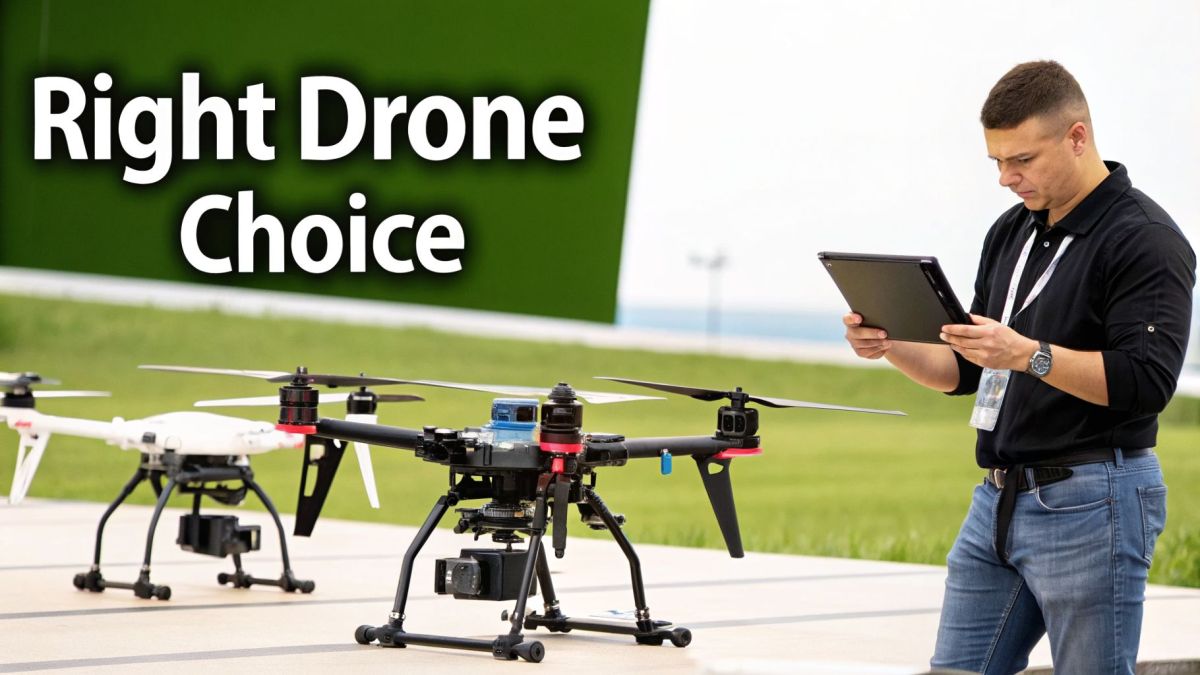
Once you've got your head around the CASA regulations for your business, the real fun begins: picking the right aircraft. When you start searching for drones in Australia for sale, it's easy to feel overwhelmed. Many models look similar, but their actual capabilities are often worlds apart.
I always tell clients to think of it like choosing a work vehicle. You wouldn't use a small ute to haul a tonne of bricks, and you wouldn't fire up a road train for a quick delivery across town. It’s the same with drones. The airframe has to be right for the job.
Let’s move past the consumer-grade drones you see in parks and look at the main categories of professional platforms available here in Australia. We'll connect each one to the kind of problems they're built to solve.
Multi-Rotor Drones: The Agile Workhorses
When you picture a drone, you’re probably thinking of a multi-rotor—usually a quadcopter with four propellers. They're the most common commercial drones out there, and for good reason. Their ability to take off vertically, hover perfectly still, and zip around with incredible precision makes them true all-rounders.
Multi-rotors are your go-to for any task that needs a close-up look.
- Inspecting infrastructure: Getting right up to a bridge pylon to check for cracks or looking for rust on a remote comms tower.
- Real estate photography: Capturing those stunning, dynamic aerial shots that really sell a property.
- Site safety monitoring: Acting as an eye-in-the-sky over a busy construction or mine site.
Their main limitation, however, is flight time. Most commercial multi-rotors can stay in the air for about 25 to 45 minutes. That’s plenty for focused, local jobs, but it becomes a real bottleneck for missions that need to cover long distances, like inspecting hundreds of kilometres of pipeline.
Heavy-Lift Drones: The Industrial Problem Solvers
For many industrial jobs, it's all about what the drone can carry. High-end sensors like survey-grade LiDAR scanners or advanced multispectral cameras are heavy, and a standard drone just doesn’t have the muscle. This is a huge pain point for companies needing the best possible data.
This is exactly where heavy-lift platforms shine. These drones are built from the ground up to carry serious payloads, opening the door to advanced sensing that would otherwise be impossible.
Picture this common industrial challenge: A mining company needs to frequently and accurately survey its open-cut pits and tailings dams. Their current drones can't lift the high-end LiDAR scanner required for precise volume calculations, so they're stuck with slow, expensive ground crews.
A purpose-built system like the Evolution Flight EF-H8 Hybrid Heavy Lift is the perfect solution. Its up to 25 kg payload capacity isn't just a number on a spec sheet; it's the key that unlocks a new capability. This grunt allows the company to fly a top-tier LiDAR scanner over the site, capturing incredibly accurate data much faster than before. The result is better production planning and rock-solid safety compliance.
Single-Rotor Drones: The Endurance Champions
For long-distance missions where you just need to stay in the air, single-rotor drones are in a class of their own. Looking like miniature helicopters, these machines are often powered by gas engines or hybrid systems, allowing them to fly for hours at a time—far beyond what any battery-powered multi-rotor can manage.
This incredible endurance makes them the perfect choice for covering vast areas.
- Agriculture: Surveying thousands of hectares of farmland to monitor crop health.
- Emergency Services: Providing a constant watch over a large bushfire or flood zone.
- Asset Management: Inspecting hundreds of kilometres of remote power lines or pipelines in a single flight.
The trade-off for all that power and endurance is complexity. Single-rotor systems are mechanically more involved and demand more specialised maintenance and pilot training. But for large-scale operations, their efficiency is simply unbeatable.
The Growing Australian Market
The sheer variety of drones now available is a great sign that the industry is maturing. Valued at USD 772 million in 2023, Australia's commercial drone market is set to climb to USD 2,091.33 million by 2032, growing at a staggering 15.3% each year. We're seeing innovations all the time, with new industrial drones boasting advanced autonomous flight and better anti-interference features, all designed to solve real-world problems for Australian businesses. You can find more details in this Australia commercial drone market report.
Choosing the right platform is one of the most important decisions you'll make. It’s about drawing a straight line from your business problem to a hardware solution. Whether you need the nimble agility of a multi-rotor, the raw power of a heavy-lift drone, or the persistence of a single-rotor, the goal is always the same: match the machine to the mission.
Choosing the Right Payloads and Sensors
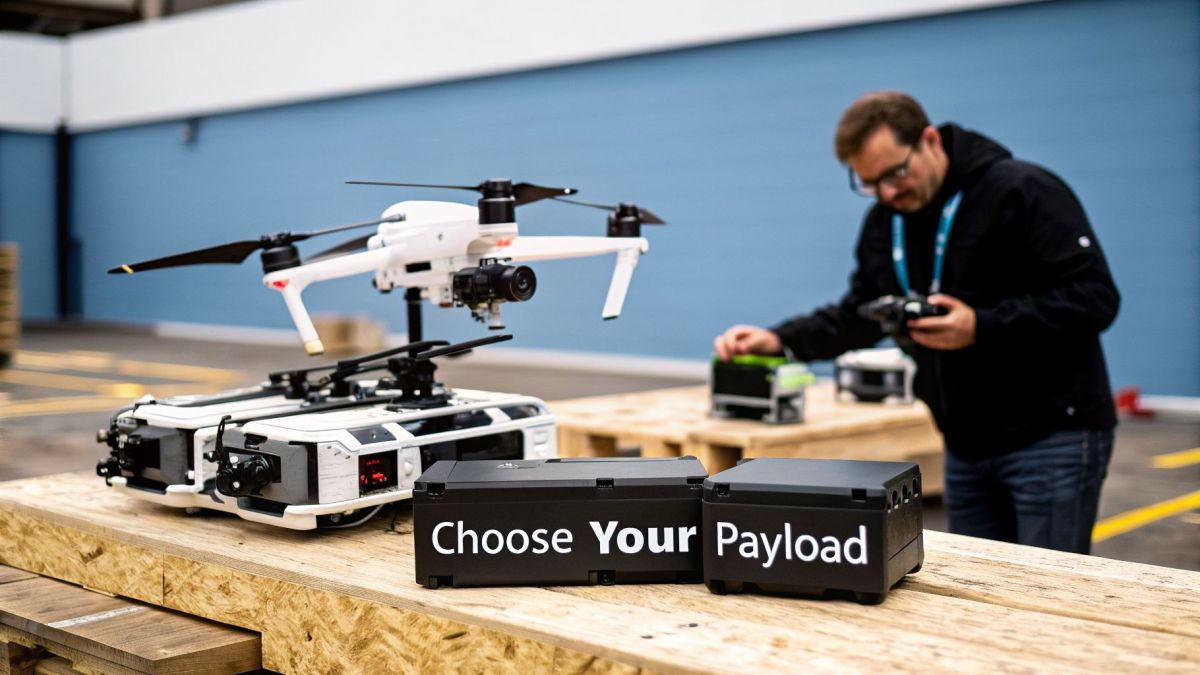
When organisations first start looking at drones in Australia for sale, the focus often lands on the aircraft—its flight time, speed, or range. But that’s a bit like buying a high-performance truck and only thinking about the engine. The drone is just the vehicle; the real workhorse is the payload it carries.
The sensor is what collects the data you actually need. So, a powerful industrial drone is just an expensive toy until you bolt on the right tool for the job.
The key is to work backward from your objective. What problem are you trying to solve? Are you looking for hairline cracks in a wind turbine, measuring stockpile volumes in a quarry, or tracking vegetation growth near power lines? Each mission demands a totally different sensor.
From Visuals to Data With RGB Cameras
The most common starting point is a high-resolution RGB (Red, Green, Blue) camera. Think of it as the drone's digital eyes, capturing rich visual information just like the camera on your phone, but with far more detail. They’re perfect for any task that needs a clear visual record.
Construction firms, for instance, use them to create weekly progress reports that are impossible to get from the ground. Asset inspectors fly them around buildings, bridges, and mobile towers to find defects without ever needing to put up scaffolding or send a crew up on ropes. The result is safer, faster, and more frequent inspections.
Seeing Beyond the Visible With Thermal Sensors
Where RGB cameras show you what the world looks like, thermal sensors show you what it feels like. These specialised cameras measure infrared radiation, turning invisible heat signatures into clear images. For many industries, this is an absolute game-changer.
Utilities fly thermal drones over substations and power lines to instantly find overheating components—a classic sign of a pending failure. On a solar farm, a quick thermal scan can pinpoint faulty panels that are dragging down an entire string and costing the business money. The sensor helps you find the problem long before it causes a blackout or a major loss in revenue.
Precision Mapping With LiDAR Technology
When you need uncompromising accuracy, LiDAR (Light Detection and Ranging) is the ultimate payload. A LiDAR sensor fires out thousands of laser pulses every second, measuring the time it takes for each one to bounce back. This process creates a stunningly detailed 3D map of an environment, often called a point cloud.
This is where drones solve a massive industrial headache.
Across Australia, utility companies fight a constant and expensive battle against vegetation encroachment. Trees growing too close to power lines are a leading cause of bushfires and blackouts, but sending ground crews to check hundreds of kilometres of remote terrain is slow, dangerous, and wildly inefficient.
This is exactly the problem the Evolution Flight EF-LiDAR Mapping System was built to solve. Its millimetre-level accuracy isn't just a number on a spec sheet; it's the feature that delivers a powerful business outcome. This level of precision lets a utility create a perfect digital twin of its entire network corridor.
With that data, the company can:
- Precisely identify danger trees and measure the exact clearance between a branch and a power line.
- Optimise trimming schedules, sending crews only where they're truly needed and slashing operational costs.
- Prevent expensive outages and improve public safety by managing vegetation risks before they become emergencies.
The LiDAR sensor turns a reactive, costly problem into a proactive, data-driven strategy. It’s no surprise that while hardware sales made up the largest revenue share in 2024, the services segment is set to be the fastest-growing part of the Australian drone market, which is projected to hit USD 2,708.5 million by 2030. You can discover more insights into Australia's drone market trends to see how integrated solutions like these are shaping the industry's future.
Your Drone Procurement and Integration Checklist
Buying a high-performance commercial drone is an exciting step, but it’s only the first one. The real measure of success isn’t the unboxing; it’s how seamlessly that new capability fits into your day-to-day work. From my experience, the smartest buyers aren't just looking at the drone itself. They're thinking three steps ahead to the total cost of ownership over the drone's entire life.
Finding drones in Australia for sale is the easy part. The real work is making sure it delivers a genuine return on investment. This checklist is built for Australian businesses to do just that, moving beyond tech specs to the practical realities of turning a purchase into a reliable, money-making asset.
Data Security and Supply Chain Integrity
These days, where your drone sends its data is just as important as the data itself. For any organisation touching government, defence, or critical infrastructure, data security isn't just a preference—it's a deal-breaker. If your operational data ends up on an overseas server you can't control, you have a serious problem.
You need to ask any potential vendor hard questions about their data policies and the integrity of their supply chain. It’s a major red flag, for instance, that many popular international drone models don't comply with security standards like the US National Defense Authorization Act (NDAA).
Industrial Pain Point: Imagine being a public safety agency during a critical incident. You need reliable eyes in the sky, fast. But using a drone with a questionable supply chain introduces huge risks. You could expose sensitive mission data or, even worse, have the drone remotely disabled by a foreign party right when you need it most.
This is where working with a vetted manufacturer with design in Australia and manufacturing in the USA and Australia makes all the difference. Evolution Flight, for example, is actively pursuing Green UAS compliance. This certification is a rigorous vetting process that confirms a drone platform has a secure, transparent supply chain and is approved for government use. It’s the kind of assurance you need to know your platform and your data are protected.
Local Maintenance and Support
Every piece of hardworking equipment needs a tune-up, and your drone is no different. Think about it: what happens when a critical part fails or it's time for a routine service? Shipping your drone overseas can mean weeks, or even months, of downtime. Your whole operation grinds to a halt.
This is where local support proves its weight in gold. Having access to Australian-based technicians for maintenance, repairs, and spare parts is a massive operational advantage. It keeps downtime to an absolute minimum and ensures your expensive asset spends more time in the air and less time on a workbench.
Operator Training Pathways
A powerful drone in the hands of an untrained pilot is a recipe for disaster. It's not enough to just hand over the controls and hope for the best. To operate safely, efficiently, and in line with CASA rules, your team needs professional training.
Your procurement plan must include a clear path for getting your pilots up to speed. A good supplier won't just give you a quick "how-to" at handover. They should offer thorough training programs that cover everything you'll actually need.
- Basic Flight Competency: Nailing the fundamentals like takeoffs, landings, and knowing what to do in an emergency.
- Advanced Operations: Getting certified for complex missions, such as BVLOS or night flights.
- Payload-Specific Skills: Learning the ins and outs of operating sophisticated sensors like LiDAR or thermal cameras to get the best data.
Understanding Warranties and Total Cost
Finally, you have to look beyond the sticker price. A cheap drone with a weak warranty and no local support can quickly become a money pit, costing you far more in the long run than a premium system backed by a solid guarantee.
Ask direct questions about the warranty. What does it cover? How long does it last? And most importantly, where are claims handled? An Australian warranty processed by a local team gives you peace of mind and faster resolutions. At the end of the day, that’s what ensures your drone program delivers lasting value.
To help tie all this together, here’s a simple checklist that walks you through the key stages of bringing a new drone into your business.
Drone Procurement Checklist for Australian Enterprises
| Checklist Item | Key Action | Business Impact |
|---|---|---|
| 1. Define Mission Requirements | Clearly document what tasks the drone must perform (e.g., survey area, payload weight, flight time). | Avoids purchasing a drone that is under-equipped or over-specified for your actual needs. |
| 2. Verify Data & Supply Chain Security | Ask for proof of data sovereignty and supply chain integrity. Check for compliance like NDAA or Green UAS. | Protects sensitive operational data and ensures the platform can't be compromised by foreign entities. |
| 3. Confirm Local Support & Maintenance | Ensure the vendor has an Australian-based team for repairs, spare parts, and technical support. | Drastically reduces operational downtime and logistics headaches, maximizing the drone's working hours. |
| 4. Plan Operator Training | Budget and schedule CASA-compliant training for basic flight, advanced operations, and specific payloads. | Ensures safe, legal, and efficient operations, reducing the risk of accidents and poor data capture. |
| 5. Scrutinise Warranty & TCO | Analyse the warranty terms (coverage, duration, claim location) and calculate the Total Cost of Ownership. | Provides a realistic view of the long-term investment and protects against unforeseen future costs. |
| 6. Integration with Existing Workflows | Plan how drone data will be processed and integrated with your current software and business processes. | Turns raw data into actionable insights, ensuring the drone program delivers measurable business value. |
Following these steps will help you make a much more informed decision, ensuring your investment pays off for years to come.
The Case for Choosing an Australian Drone Manufacturer
So, you're looking for commercial drones in Australia for sale. By now, you've probably realised it's not as simple as picking a model off a shelf. Getting the right drone is a tough puzzle, trying to fit the right tech with CASA's strict rules, our uniquely harsh environments, and the specific job you need done.
This is exactly why looking at a local, Australia manufacturer makes so much sense. You’re not just getting a drone in a box; you’re getting a partner who understands your world and is right here to help you succeed.
Built for Australian Conditions
Let's be honest, Australia is tough on equipment. Drones designed for a mild European summer can quickly run into trouble in the blistering heat of the Pilbara or the unpredictable coastal winds. When an international model can't cope, you're left with poor performance, shorter flight times, and a machine that just won't last.
An Aussie manufacturer gets this. They build their drones from day one to handle these exact challenges because they live and work in them, too. They know what it takes to operate reliably in mining, agriculture, and emergency services across the country.
Responsive Local Support and Sovereign Capability
What happens when your most important drone goes down? If you have to ship it overseas for repairs, you’re looking at weeks, or even months, of downtime. That’s not just an inconvenience; it’s a huge hit to your operations and your bottom line.
Having an Australian-based team means support is just a local call away. You get faster turnaround on maintenance and repairs, which means your gear spends more time in the air earning its keep and less time stuck in transit.
This idea of sovereign capability is more than just a buzzword. It means your supply chain is secure and your work isn't at the mercy of international shipping delays or politics.
Think about a critical task like re-seeding a huge area of bushland after a major fire. The terrain is often rugged and unsafe for ground crews, and the window to prevent soil erosion is small. You need to act fast.
This is where a locally supported, heavy-lift drone makes all the difference. For example, the Evolution Flight EF-H8 Hybrid Heavy Lift is built for this kind of work, with a 25 kg payload capacity perfect for aerial seeding. In practical terms, that means it can carry and drop thousands of seed pods in a single flight over country you couldn't hope to cover on foot.
A local manufacturer like Evolution Flight provides both the reliable drone and the quick-to-respond support that makes a time-sensitive environmental mission like this possible. You turn a logistical nightmare into a recovery effort you can actually manage. When you choose Australian, you’re choosing a partner whose success is tied directly to your own.
Frequently Asked Questions About Buying Drones
Thinking about bringing a commercial drone into your business? You're not alone, and it's natural to have a few questions. Let's walk through some of the most common ones we get about drones in australia for sale.
How Much Do Commercial Drones Actually Cost?
This is the big one, and the honest answer is: it varies—a lot. You can find basic aerial photography drones for a few thousand dollars. But for serious industrial work, you're looking at a different league.
A reliable mapping drone will typically set you back between $10,000 and $25,000. For more specialised systems built for LiDAR, agricultural surveys, or heavy-lift tasks, prices often start north of $30,000 and can easily exceed $50,000. The final price tag really comes down to the drone's capability—how much it can carry, how long it can fly, and the quality of the sensors and software it comes with.
What’s More Important: The Drone or The Sensor?
It's a classic chicken-and-egg question, but the answer is surprisingly simple: the sensor. Think of the drone as a truck and the sensor as the cargo. The truck is vital for getting the job done, but the real value is in what it's carrying.
Your return on investment comes from the data you collect. Whether that's a high-resolution camera for inspections, a thermal sensor for heat mapping, or a LiDAR unit for precision surveys, the payload is what produces your results. That's why we always advise clients to start with the data they need, which then dictates the right sensor and the drone platform strong enough to carry it.
A perfect example of this is the slow, dangerous work of post-wildfire reforestation. A heavy-lift platform like the Evolution Flight EF-H8 Hybrid Heavy Lift solves this problem head-on. Its up to 25 kg payload capacity isn't just a number on a spec sheet; it's what allows the drone to carry a massive load of seed pods over hazardous terrain. The result? Crews can re-seed huge, inaccessible areas in a fraction of the time, accelerating ecosystem recovery and slashing labour costs.
Do I Need a Licence to Fly a Drone Commercially in Australia?
In most commercial scenarios, yes. CASA has rules you need to follow.
For very basic jobs, you can fly a drone under 2kg in the "excluded category" by following a standard set of safety rules. However, the moment you need to fly a heavier drone, operate at night, or go Beyond Visual Line of Sight (BVLOS), the requirements get more serious. Your business will need a Remote Operator's Certificate (ReOC), and your pilots will need to hold a Remote Pilot Licence (RePL).
Ready to find a drone platform that solves your specific industrial challenges? The team at Evolution Flight has the Australian expertise to guide you toward the right solution, from heavy-lift airframes to high-precision sensor integration. Explore our advanced drone systems and get a quote today.