The demand for skilled drone pilots in Australia is undeniable, but what companies are really hiring for might surprise you. It’s no longer just about getting a drone in the air; it's about what you do with it once it’s up there.
Your Roadmap to a Career in Australia’s UAV Industry
Forget the idea of a drone pilot as just a hobbyist with a license. Across Australia's biggest industries—mining, agriculture, and infrastructure—the real money is in data. Companies need professionals who can fly complex missions, capture high-quality data, and turn it into insights that solve real-world problems.
This guide is your flight plan. We’ll walk through the must-have CASA certifications, the specific technical skills that will put you at the top of the applicant list, and how to build a portfolio that actually gets you in the door for an interview.
The Modern UAV Career Path
The job description for a "drone pilot" has changed dramatically. It's less about aerial photography and more about becoming a specialised data-acquisition expert. Think about a major challenge for a mining company: surveying massive stockpiles or steep pit walls. Doing this on foot is slow, dangerous, and often inaccurate.
This is where a skilled operator comes in. Armed with a heavy-lift drone like the Evolution Flight Patriot, you can fly a mission with a high-end LiDAR scanner. In a few hours, you can deliver a precise 3D model of the entire site—a task that would have taken a ground crew days to complete. That's the value. You're not just flying; you're providing data that leads to better safety, smarter planning, and huge cost savings.
Your real value isn't flying the drone. It's understanding the business problem and using the drone as a tool to solve it, directly impacting the company's bottom line.
To get started, it helps to see the main components of a successful career laid out. The table below gives you a quick snapshot of the essentials you'll need to focus on.
Quick Guide to Australian UAV Career Essentials
This table breaks down the key licenses, skills, and earning potential you can expect as you begin your journey in the Australian UAV sector.
| Component | Description | Example/Details |
|---|---|---|
| Core License | The foundational CASA certification needed to fly a drone for any commercial pay. | A Remote Pilot Licence (RePL) is the absolute minimum requirement. |
| Business Certification | A must-have if you're starting your own drone business or working as a contractor. | Remotely Piloted Aircraft Operator's Certificate (ReOC). |
| In-Demand Skills | The technical expertise that makes you more valuable than a standard pilot. | Proficiency with LiDAR, photogrammetry, and thermal sensors. |
| Key Growth Sectors | Industries with the biggest and most immediate need for skilled operators. | Mining, Agriculture, Construction, and Emergency Services. |
| Average Salary | A realistic starting salary for a certified pilot with solid foundational skills. | Expect between $65,000 and $85,000 AUD for most entry-level roles. |
These are the building blocks of your career. Getting the licenses is just the first step; developing those in-demand technical skills is what will truly set you apart and open doors to more advanced, higher-paying opportunities.
Getting Your CASA Wings: The Licences You Actually Need
So, you want to fly drones for a living in Australia? Fantastic. Before we dive into the exciting jobs, we need to cover the essentials—the licenses. In Australia, the sky is regulated by the Civil Aviation Safety Authority (CASA), and if you want to get paid to fly, you have to play by their rules.
Think of it this way: these certifications aren't just bureaucratic hurdles. They're your professional foundation, proving you can operate safely and legally. Without them, you're not a commercial pilot; you're a hobbyist.
The path from enthusiast to paid professional is pretty straightforward. You get certified, you build your technical skills, and then you show off what you can do.
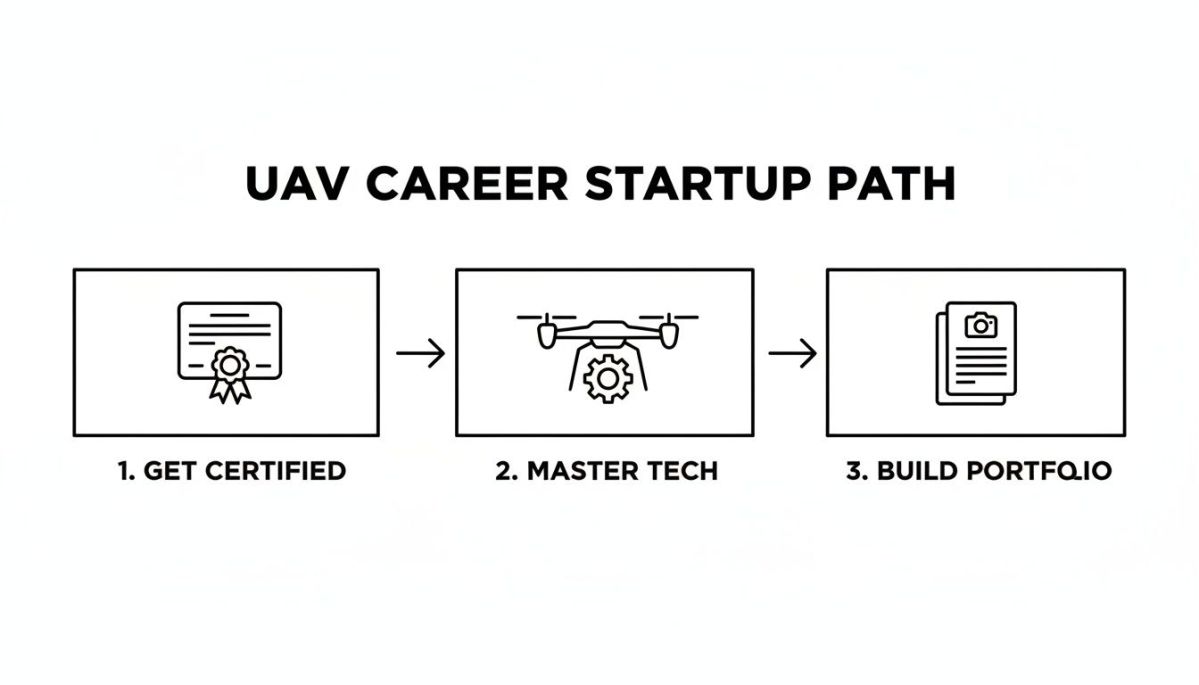
As you can see, it all begins with getting properly licensed. Let's break down exactly what that involves.
Your Starting Point: The Remote Pilot Licence (RePL)
The first thing you absolutely must have is a Remote Pilot Licence (RePL). This is your personal ticket to operate a drone commercially. It’s the drone equivalent of a driver's licence—it confirms you’ve been trained on the rules of the sky and have the practical skills to fly safely.
To earn your RePL, you'll need to sign up for a course with a CASA-certified training provider. These intensive courses usually last about five to seven days and are packed with crucial information.
You’ll cover everything from the ground up:
- Aviation Law: Getting to grips with airspace rules, where you can and can't fly, and your legal obligations as a pilot.
- Meteorology: Learning to read weather charts and make smart go/no-go decisions based on flight conditions.
- Navigation & Aerodynamics: Understanding flight planning, GPS systems, and the basic physics of how your drone actually flies.
- Hands-On Flying: This is where you prove you can handle the aircraft, from basic manoeuvres to responding calmly in an emergency.
Once you pass the theory exams and the practical flight test, the training school handles the paperwork with CASA for you. Soon after, you'll have your RePL in hand.
The Key to Serious Work: The ReOC
While the RePL licenses you as a pilot, it comes with some pretty big restrictions if you're working for yourself. For almost any serious commercial job, you'll need to either work for a company that holds a Remotely Piloted Aircraft Operator's Certificate (ReOC), or get one for your own business.
A ReOC is a certification for an organisation. It proves to CASA that the business has rock-solid procedures for safe drone operations. This is what allows a company to hire pilots, take on complex projects, and operate outside the most basic rules.
If you only have a RePL and no ReOC, you’re stuck in the 'Excluded Category.' That means you can only fly a drone under 2kg, and you’re severely limited in where and how you can operate. For any real commercial work, a ReOC is non-negotiable.
For example, a common job in the resources sector is inspecting assets in remote locations with no phone service. An individual with just a RePL can't legally do this. A company with a ReOC, however, can get the necessary approvals to conduct these more complex and valuable missions.
Unlocking Top-Tier Jobs: Specialist Certifications
Once you have the basics down, a couple of extra certifications will make your CV stand out and open up the door to higher-paying, specialised UAV jobs in Australia.
Aeronautical Radio Operator Certificate (AROC)
If you plan on flying anywhere near an airport or in controlled airspace, this is mandatory. An AROC qualifies you to communicate with air traffic control using professional aviation radio protocols. Many employers, especially those in urban areas, won't even look at a CV without it.Beyond Visual Line of Sight (BVLOS) Training
This is the big one. A BVLOS rating allows you to fly a drone beyond where you can physically see it, and it's a game-changer for large-scale projects. Think long-distance pipeline surveys, massive agricultural mapping missions, or asset inspections that cover hundreds of kilometres.
Pilots with BVLOS qualifications are in hot demand because they can tackle jobs that are simply impossible for others. For a client, the efficiency gains are enormous.
Imagine a mining company needing to inspect a 100km-long access road. A BVLOS pilot can do that in a single, efficient mission. This is where advanced drones like the Evolution Flight Patriot truly excel. Its incredible endurance is built for these exact scenarios, letting an operator cover huge distances without constantly stopping to swap batteries. That capability translates directly into saving clients time and money—a powerful selling point.
Go Beyond Flying: The Technical Skills That Get You Hired
Getting your CASA licence is the first step, but it's just the entry ticket. To land the best UAV jobs in Australia, you need to show you can do more than just fly. The real money and the most interesting work aren't in basic aerial photos; they're in turning raw data from a drone into solutions for real-world business problems.
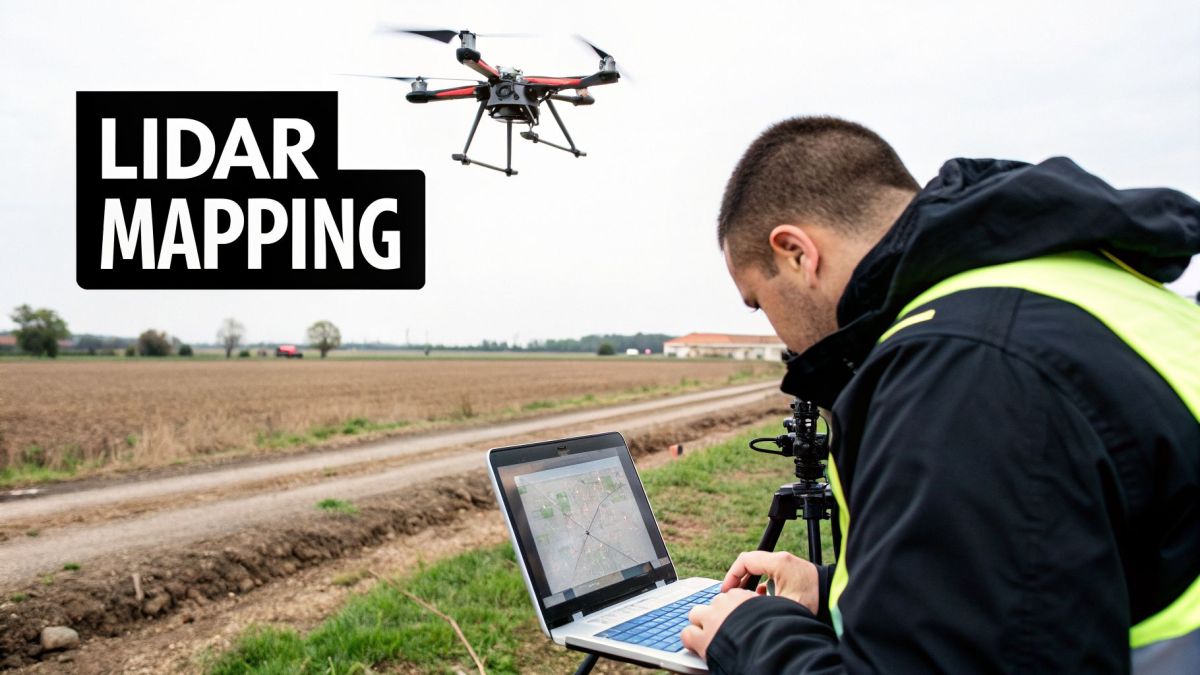
This is where you move from being just a pilot to becoming a valuable data specialist. Employers are looking for people who are comfortable with advanced sensors and know their way around processing software. Two skills that consistently top the list are LiDAR (Light Detection and Ranging) and photogrammetry. Mastering these will set you apart.
Getting a Grip on LiDAR for Surveying and Inspection
Think of LiDAR as a laser tape measure on steroids. It's a sensor that shoots out pulses of laser light to measure distances, and when you mount one on a drone, you can create incredibly precise 3D models of pretty much anything—terrain, buildings, or even vegetation.
Consider a major headache for utility companies: managing tree growth around powerlines. It’s a huge, ongoing expense, and sending crews out on foot is slow, dangerous, and often misses potential risks. This is a problem a skilled LiDAR operator can solve.
With a heavy-lift drone like the Evolution Flight Patriot, which is specifically designed for such missions, you can offer a direct solution. Its significant flight endurance allows it to survey long powerline corridors without constant battery changes, a common limitation that increases operational time and costs for other platforms. This extended time-on-station is the key to covering vast areas efficiently.
You can fly a mission along a powerline corridor and capture a massive amount of data, creating a detailed 3D "digital twin" of the network. This model shows exactly where branches are getting too close to the wires. The company can then send out their maintenance teams to the exact spots that need work, saving a fortune in labour and massively cutting down on fire risk.
This is the key. You’re not just flying a drone; you’re providing a clear return on investment. That's who the top companies want to hire.
The Art and Science of Photogrammetry
While LiDAR is fantastic for its 3D accuracy, photogrammetry is the craft of creating maps and models from photographs. By flying a grid pattern and taking hundreds or even thousands of overlapping photos, you can use specialised software to stitch them together into incredibly useful assets.
This skill is a cornerstone of drone work in several industries:
- Construction: Monitoring a site's progress, calculating how much dirt has been moved, and creating final "as-built" models.
- Mining: Measuring stockpiles for accurate inventory or checking the stability of pit walls.
- Agriculture: Creating detailed crop health maps to find problem areas and use water or fertiliser more efficiently.
To be a pro, you need to deliver survey-grade accuracy. This usually involves Post-Processed Kinematic (PPK) or Real-Time Kinematic (RTK) methods. RTK is great but needs a constant data link to a ground station, which can be a pain in remote areas.
That's why PPK is often a better fit for Australian conditions. The drone records satellite data during the flight, and you later process it against data from a ground station. This post-flight correction fine-tunes the position of every photo, giving you centimetre-level accuracy without needing a perfect connection in the field.
You're a Data Processor, Too
Here's something many new pilots miss: flying is only part of the job. You have to know what to do with the data once you land. If you can't process it, it’s useless. Being proficient with industry-standard software is non-negotiable.
Key Software to Know
- Photogrammetry Suites: You'll need to be handy with programs like DJI Terra, Agisoft Metashape, or Pix4D to turn your images into maps and 3D models.
- LiDAR Processing: Get familiar with tools that let you clean up, classify, and analyse point cloud data to deliver a final, usable product.
- GIS Software: Skills in platforms like QGIS or ArcGIS are vital for analysing the spatial data you create and integrating it with other business systems.
Don’t just focus on your flight hours. A huge chunk of many UAV jobs in Australia is spent in front of a computer, processing data and creating reports that the client can actually use. An employer wants to hire someone who can handle the entire workflow—from planning the mission to delivering the final data. That's how you become an indispensable part of the team.
Building a Portfolio That Gets You Hired
Getting your licenses and building your skills is just the ticket to enter the game. But what actually wins you the job? A killer portfolio. When companies are hiring for UAV jobs in Australia, they aren't just looking for a pilot. They need to see solid proof that you can deliver high-quality, reliable results that actually solve their problems.
Think of your portfolio as your visual resume. It’s where you stop saying, "I can fly a drone," and start showing, "Here's how I create value with a drone."
Beyond the Basic CV
A standard resume that just lists your RePL and a bit of work history simply won't cut it. In the drone industry, you need a far more comprehensive CV and a portfolio that backs it up with tangible proof of your hands-on experience.
Here’s what you need to include to really stand out:
- A Detailed Flight Log: Don't just give a total number of hours. Break it down. Show how many hours you have on different aircraft types (multi-rotor vs. fixed-wing), in tough conditions like high winds or remote locations, and using specific payloads like LiDAR, photogrammetry, or thermal sensors. This immediately shows an employer your versatility.
- Systems and Software Fluency: List the drone platforms you’ve actually operated. Even more important, name the software you know inside and out. This includes mission planning tools like DJI Pilot 2, data processing software like Agisoft Metashape or Pix4D, and analysis platforms like QGIS.
- Real Project Examples: This is the heart and soul of your portfolio. For every major project you’ve worked on, write a quick summary. What was the client's goal? What methods did you use? What was the final deliverable?
A portfolio isn't just a gallery of your best aerial photos. It's a collection of case studies proving you understand the entire workflow—from mission planning and risk assessment right through to data processing and delivering the final product.
Showcasing Your Value with Project Examples
Your project examples need to tell a story. Don't just show a pretty orthomosaic map; explain the problem it solved. A strong example connects your technical work to a clear business outcome.
Let's take a common challenge in Australia: reforestation after a bushfire. Trying to plant seedlings by hand across huge, often inaccessible burn scars is incredibly slow, expensive, and sometimes dangerous. This is a perfect opportunity to show your value.
You could describe a project using a heavy-lift drone like the Evolution Flight Patriot to run an autonomous aerial seeding mission. With its significant payload capacity, it can carry custom seed pod dispensers and cover dozens of hectares in a single day. The business case is clear: you’re offering a solution that’s faster, cheaper, and safer than a ground crew, helping land managers restore the environment at a scale that was previously impossible.
Nailing the UAV Job Interview
Once your portfolio lands you an interview, your next job is to prove you’re a professional, not just a hobbyist. Most drone job interviews will dig deep into safety, your problem-solving abilities, and whether you grasp the commercial realities of the industry.
Get ready to talk about these things with confidence:
- Your Safety Mindset: They will ask about safety. Be ready for questions like, "Walk me through your process for a Job Safety Assessment (JSA) on a new site." You should be able to talk them through your exact steps, from checking airspace and weather to identifying ground hazards.
- Field-Based Problem Solving: An interviewer might throw a scenario at you: "You get to the site, and the wind is much stronger than forecasted. What's your plan?" Your answer needs to show good judgment, a commitment to following procedures, and how you would communicate the situation to the client.
- Connecting Your Skills to Their Needs: Be prepared to explain exactly how your photogrammetry or LiDAR skills will benefit their company. Don't just say you can do it; explain how centimetre-accurate survey data helps them make smarter decisions, improve site safety, or save money.
By having these elements dialled in, you show you're not just looking for stick time. You’re a solutions-focused professional ready to add real value, making you a top contender for any serious UAV job in Australia.
Finding Your Niche in Top Industries

When you're starting your hunt for UAV jobs in Australia, knowing where to point your compass is everything. While you’ll find drone roles popping up in surprising places, a few key sectors are absolutely powering the industry's growth.
Why? Because they have an undeniable need for the safety, data, and efficiency that drones bring to the table. If you focus your efforts on these high-demand industries, you're not just looking for a job; you're putting yourself right where the action is.
You'll generally find two types of employers. There are the big players—think major mining companies or national construction firms—that have their own in-house drone teams. Then you have the specialised drone service providers, the companies that live and breathe this work, who are hired by clients from all sorts of industries for their specific expertise.
Mining and Resources
It's no secret that Australia's mining and resources sector is probably the single biggest employer of professional drone pilots. The sheer size of mine sites and the inherent dangers of the work make it a perfect fit for remote technology.
In this field, pilots aren't just flying for pretty pictures. They are essential to the daily workflow.
- Mine Surveyors are out there every day using photogrammetry and LiDAR to map pits, measure stockpile volumes, and check the stability of tailings dams.
- Geotechnical Engineers depend on thermal and visual data from drones to inspect high walls for weaknesses that could lead to dangerous rockfalls.
- Exploration Teams send drones into rugged, remote country to get the first lay of the land, mapping areas that would be almost impossible to access on foot.
Agriculture and Environmental Management
Precision agriculture is another field that's exploding. Farmers and agronomists are finally getting the data they need to boost crop yields and slash waste, and it's coming from drones.
A typical role here is the UAV Agronomist. Using multispectral cameras, they generate detailed crop health maps that pinpoint stress from pests, irrigation failures, or disease. This means farmers can apply treatments exactly where they're needed instead of blanketing entire fields.
Environmental work also presents huge opportunities. Just think about the challenge of reforesting an area after a major bushfire. Manually planting seedlings across vast, scorched, and often inaccessible terrain is painfully slow and expensive.
This is where a skilled operator with the right gear becomes invaluable. Imagine an environmental agency hiring you to fly aerial seeding missions. With a heavy-lift drone like the Evolution Flight Patriot, its significant payload capacity allows it to carry large, custom seed dispensers. This means you can cover dozens of hectares in a single day, a scale that is simply unachievable with ground crews, drastically lowering costs and accelerating ecological recovery.
Construction and Infrastructure
On any major construction site today, drones are a familiar sight. They're used right from the project's start for initial site surveys all the way through to tracking progress and conducting final inspections. That bird's-eye view is a game-changer for project managers trying to keep things on schedule, on budget, and safe.
Managing long-form infrastructure like railways, roads, and pipelines is another massive growth area. You might be hired to fly hundreds of kilometres of a rail line, inspecting the track for defects or checking for overgrown vegetation. It's a task that would take a ground crew weeks to complete.
Your Earning Potential in Australian UAV Jobs
So, what can you expect to make? Salaries for UAV jobs in Australia really hinge on your experience, what you specialise in, and which industry you’re in. It’s simple: roles demanding advanced skills like LiDAR data processing or BVLOS qualifications will always pay more.
This table gives you a solid idea of what to expect out in the real world.
Australian UAV Pilot Salary Expectations 2026
| Experience Level / Role | Typical Annual Salary Range (AUD) |
|---|---|
| Entry-Level Pilot (RePL Certified) | $65,000 – $85,000 |
| Experienced Pilot (2-4 Years, multiple skills) | $85,000 – $115,000 |
| Senior/Lead Pilot (5+ Years) | $110,000 – $140,000+ |
| Specialist (LiDAR/BVLOS Qualified) | $120,000 – $160,000+ |
| UAV Program Manager/Chief Pilot | $150,000 – $200,000+ |
A quick note: These are just estimates. Your actual pay can shift based on your location, the size of the company, and how complex the projects are. FIFO (Fly-In, Fly-Out) jobs in mining often come with extra allowances on top.
As you can see, the fastest way to boost your income is by getting specialised. Employers will happily pay a premium for a pilot who can deliver survey-grade data or handle complex missions that directly improve their bottom line. By aiming for these high-growth industries and constantly sharpening your skills, you can build a seriously rewarding and well-paid career in Australia's drone industry.
Your Top Questions About UAV Jobs in Australia
As you start exploring a career in drones, you're bound to have a few questions. That's completely normal. The world of UAV jobs in Australia is exciting, but it can feel a bit overwhelming when you're just getting started.
To clear things up, I've pulled together some of the most common questions I hear from aspiring pilots. Here are the straight-up answers you need.
Do I Need to Own a Drone to Get a Job?
Not always, but it definitely helps. Big companies in mining, construction, or agriculture will have their own fleet of specialised, high-end drones. No one expects you to show up for an interview with your own $50,000 LiDAR-equipped machine.
That said, owning a basic drone is a massive advantage for practice. It’s your personal training tool. You can use it to master flight controls, learn mission planning software, and build a portfolio of small projects. An employer will see this as a sign of genuine passion and hands-on initiative, which can set you apart.
How Long Does It Take to Get My RePL?
Getting your Remote Pilot Licence (RePL) is surprisingly quick. Most accredited training providers run intensive courses that will get you certified in just five to seven days of full-time training.
This covers all the theory—things like airspace regulations, meteorology, and flight principles—along with the hands-on flight test. The exact time can vary a bit between schools, but it's a very achievable first step into the commercial drone world.
The RePL is your licence to fly, but true skill comes from experience. Your flight hours and the complexity of the projects you've worked on are what will really open doors to the best UAV jobs in Australia.
Should I Be a Freelancer or Work for a Company?
This really boils down to your personality and what you want from your career. Both routes have their own pros and cons.
- Full-Time Employment: This path offers a steady paycheck, benefits, and the chance to work with seriously advanced equipment you couldn't afford on your own. It's a fantastic way to get your foot in the door and learn on major projects.
- Freelancing: If you value flexibility and being your own boss, this is for you. The potential for higher hourly earnings is there, but you’re also responsible for everything—finding clients, marketing, insurance, and buying your own gear.
A common and smart approach is to start with a company, build your network and skills for a few years, and then consider going out on your own.
What Is the Most Profitable UAV Specialization?
Right now, the big money is in specialised sensor operations. Pilots who are experts with LiDAR, thermal, or hyperspectral sensors for complex surveying and asset inspections are in huge demand and can command premium salaries.
Beyond Visual Line of Sight (BVLOS) qualifications are another game-changer. Pilots with a BVLOS rating can tackle massive projects that are simply out of reach for others. Think about a major utility company needing to inspect hundreds of kilometres of remote powerlines for vegetation overgrowth. A BVLOS-rated pilot using a long-endurance drone like the Evolution Flight Patriot can survey that entire corridor safely and efficiently, delivering huge cost savings and risk reduction. That’s a skill set clients will pay top dollar for.
At Evolution Flight, we design and manufacture the advanced, reliable drone platforms that professionals depend on for these high-value missions. If you're looking to equip yourself for the most demanding and rewarding UAV jobs in Australia, it’s time to explore our enterprise systems. Learn more about our solutions and see what’s possible.