
At its core, an anti-jamming device is a sophisticated system built to shield radio receivers from deliberate interference. A good way to think about it is like having a pair of intelligent noise-cancelling headphones. They don't just block all sound; they specifically identify and filter out disruptive background noise, letting you focus on what you actually want to hear.
This technology does the same thing for radio signals, making sure that crucial data links stay stable and reliable, even when someone is actively trying to disrupt them.
What's the Point of an Anti-Jamming Device?
Imagine you're relying on your car's GPS to navigate through an unfamiliar city, and right at a critical turn, the signal just disappears. Or think about a military drone losing its connection to the operator mid-flight. That’s the reality of signal jamming—a malicious act designed to flood a receiver with so much radio "noise" that the real signal gets lost in the chaos.
The goal of a jammer is simple: to deny access to vital communication or navigation data.
This is where an anti-jamming device comes in. It acts as a digital bodyguard for your signal. Its primary job isn't to block the jamming signal itself, but to cleverly outmanoeuvre it. It might filter the noise, cancel it out, or simply find a way to ignore it so that the original, intended signal gets through loud and clear. This ensures things keep running smoothly for any operation that depends on an uninterrupted radio frequency (RF) link.

Differentiating the Threat from the Solution
It’s really important to separate the malicious tool (the jammer) from the protective technology (the anti-jammer). A jammer is an offensive piece of kit designed to cause disruption. An anti-jammer, on the other hand, is a purely defensive system built to maintain signal integrity.
To make this crystal clear, here's a quick breakdown of how they stack up against each other.
Jamming vs. Anti-Jamming at a Glance
| Concept | Jamming Device (The Threat) | Anti-Jamming Device (The Solution) |
|---|---|---|
| Primary Goal | Overwhelm a receiver with noise to block the original signal. | Preserve the original signal by mitigating the effects of noise. |
| Mode of Operation | Transmits powerful, disruptive RF signals. | Receives and processes signals, using smart tech to filter interference. |
| Outcome | Loss of communication, navigation, or timing data. | Continuity of operations and reliable signal reception. |
| Legality (in Australia) | Illegal to operate due to public safety risks. | Essential, legal technology for protecting critical systems. |
As you can see, they are two sides of the same coin—one creating a problem, the other providing the solution.
Jamming causes Global Navigation Satellite System (GNSS) receivers to fail through overwhelming interference. An anti-jamming device ensures they continue to function by neutralising that interference, maintaining a clear line of communication.
This distinction matters. While jammers are illegal to use in Australia because of the danger they pose, robust anti-jamming systems are absolutely vital for protecting everything from national security to essential commercial operations.
Key Applications and Why They Matter
The need for solid anti-jamming capabilities isn't just a niche concern; it's spread across numerous high-stakes sectors. Without this technology, many of the systems we take for granted would be incredibly vulnerable.
- Defence and Military: For aircraft, ships, and ground forces, secure communications, navigation, and targeting systems are non-negotiable. Anti-jamming is fundamental to mission success and, more importantly, to keeping personnel safe.
- Unmanned Aerial Systems (UAS): Whether it's a drone surveying a mine site, inspecting power lines, or monitoring crops, it needs a constant link for command, control, and GPS navigation. Losing that link means losing the drone.
- Critical Infrastructure: Think about aviation, maritime shipping, and even our telecommunications networks. They all rely on incredibly precise timing signals from GNSS. Interference could trigger widespread chaos and significant economic damage.
How Anti Jamming Technology Actually Works
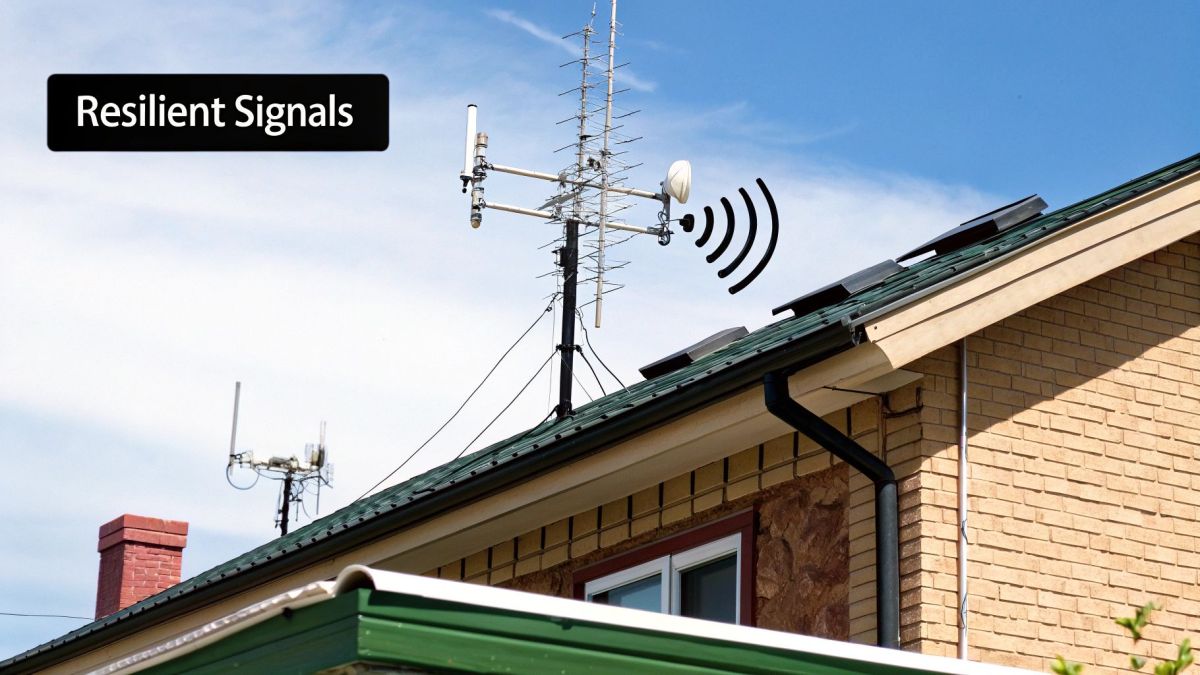
To get your head around how an anti-jamming device wins the battle for a clear signal, you first need to understand the battlefield itself. Signals travel through the air across what we call the radio spectrum, and jammers are designed to flood this space with overwhelming noise. To really dig into this, it’s worth brushing up on the fundamentals of how the radio spectrum works and how these signals get from A to B.
Now, anti-jamming technology doesn't just try to shout louder than the noise. That would be a losing game. Instead, it uses a whole bag of clever tricks to sidestep, filter, or outright cancel the interference. Think of it less like a brute-force shield and more like a skilled martial artist, gracefully redirecting the attacker's energy.
Frequency Hopping Spread Spectrum (FHSS)
One of the classic and still incredibly effective techniques is Frequency Hopping Spread Spectrum (FHSS).
Picture this: you're trying to have a conversation with a friend in a packed, noisy room. A loud group keeps moving around, deliberately trying to stand next to you and drown you out. So, you and your friend come up with a plan. You agree on a secret sequence of quiet corners in the room and quickly hop between them every few seconds. The noisy group simply can't keep up.
That's precisely what FHSS does for radio signals. The transmitter and receiver rapidly jump between dozens or even hundreds of different frequency channels, following a synchronised, pseudo-random pattern that only they know. A jammer might manage to blast one channel with noise, but by then, the signal has already hopped to another, keeping the connection stable.
An anti jamming device using FHSS essentially turns the signal into a constantly moving target. The communication has already moved on long before a jammer can lock onto its frequency, making the interference useless.
Spatial Processing and Nulling
Another powerful tool in the arsenal is using smart antennas to pinpoint where the interference is coming from and then simply ignore it. This is the domain of spatial processing, and the star player here is often a Controlled Reception Pattern Antenna (CRPA).
A CRPA is like having multiple, highly-sensitive ears instead of just one. By comparing the tiny differences in the time it takes for a signal to arrive at each of its antenna elements, the system can calculate the exact direction of any incoming signal—friend or foe.
It works in a few steps:
- Direction Finding: First, the system scans the sky and identifies the physical location of the jamming source.
- Null Generation: Next, it electronically creates a "deaf spot," or a null, in that specific direction.
- Signal Preservation: All the while, the antenna stays perfectly tuned to listen for the real signals coming from every other direction, especially the faint ones from satellites high above.
This technique, called nulling, is remarkably effective. The system basically puts a digital hand up to block the shouting from the jammer, allowing it to focus on the quiet whisper of the legitimate satellite signal. It’s all part of a broader strategy for managing electronic noise, and you can learn more about this by reading our guide on https://evolutionflight.com/what-is-electromagnetic-interference/.
By combining sophisticated strategies like these, an anti jamming device builds a layered, resilient defence. It ensures that the critical navigation and communication links your drone relies on stay clean and reliable, even when facing a direct electronic attack.
The Growing Importance of Anti-Jamming in Australia
It’s easy to forget just how much of modern Australian life runs on satellite signals. From coordinating logistics across the vast Outback to keeping planes in the sky and managing our critical infrastructure, Global Navigation Satellite System (GNSS) technology is the invisible thread holding it all together.
But this deep reliance has a flip side—it creates a massive vulnerability. A targeted attack on these signals could throw supply chains into chaos, weaken border security, or bring precision agriculture to a grinding halt. This isn't just a hypothetical problem; it's a real and growing concern that makes anti-jamming technology a national priority.
A Cornerstone of National Security
For the Australian defence force, there’s no room for error when it comes to navigation. With geopolitical tensions on the rise and the threat of sophisticated electronic warfare looming larger, our military assets must be able to operate without signal interference.
An effective anti-jamming device is the first line of defence. This technology ensures our aircraft, ships, and ground troops can maintain accurate positioning, navigation, and timing (PNT) data, even when facing a direct electronic attack. It’s simply a foundational part of modern defence.
Fuelling Economic Stability and Growth
The risk extends far beyond the military. Australia’s commercial sectors are just as exposed. Take the booming drone industry, for example, where unmanned aerial systems (UAS) handle everything from surveying mines to inspecting powerlines. If a drone loses its GNSS signal, the operator loses control. That’s a recipe for financial loss and a serious safety hazard.
This widespread dependence is fuelling major investment. The Australian anti-jamming market is predicted to explode from USD 820 million in 2025 to USD 2.1 billion by 2031, which is a compound annual growth rate of 16.8%. You can explore more data on the Australian anti-jamming market growth to see just how quickly this field is expanding across defence, security, and commercial industries.
Anti-jamming is no longer just a specialised military tool; it's becoming essential for our national resilience. Protecting GNSS signals is now fundamental to safeguarding both Australia's economy and its security in an increasingly complex world.
As technology gets smarter, so do the methods used to disrupt it. This reality cements the role of the anti-jamming device not as an optional extra, but as a critical layer of protection for Australia’s future.
Protecting Critical Infrastructure from Signal Interference

It’s easy to overlook just how much Australia’s essential services lean on Global Navigation Satellite System (GNSS) signals. We're not just talking about military tech; this reliance is woven deep into the fabric of our daily lives. Our most critical infrastructure—from the national power grid and financial markets to aviation and shipping—all depend on the incredibly precise timing and location data beamed down from these satellites.
Think of GNSS as the nation’s invisible clock and compass. It’s what keeps our telecommunications networks in sync, guides planes safely through the sky, and coordinates the complex dance of machinery at our busiest ports. But this dependence creates a massive weak spot, one that malicious actors are all too aware of.
The Real-World Dangers of GNSS Jamming
When these essential signals are intentionally blocked, the fallout can be fast, severe, and widespread. A cheap, illegal GNSS jammer could set off a domino effect with devastating real-world consequences.
- Aviation: Air traffic control could suddenly lose sight of aircraft, forcing widespread flight delays or, in a worst-case scenario, creating incredibly dangerous mid-air situations.
- Maritime Shipping: Operations at our ports could grind to a halt. Container cranes and logistics systems would lose their positioning data, causing chaos in our supply chains.
- Financial Networks: Stock market trades and even simple ATM transactions rely on precise timestamps to function. If they fail, it could trigger serious economic instability.
- Energy Grids: The delicate systems that balance our national power load could fall out of sync, putting entire regions at risk of blackouts.
The ability to protect this infrastructure directly impacts vital services like professional security systems monitoring, where immediate threat detection is paramount. It’s clear that safeguarding these signals isn’t just a technical problem—it’s a matter of national security.
Australian Mitigation Strategies
Fortunately, Australian authorities are well aware of these risks and are actively working on building resilience. The Cyber and Infrastructure Security Centre (CISC) has flagged the dangers these jamming devices pose, particularly for infrastructure operators who need uninterrupted GNSS timing. Australia has a strict ban on GNSS jamming devices, which can interfere with the vital positioning, navigation, and timing services our nation relies on.
A key strategy for resilience is redundancy. By having robust backup systems, critical infrastructure can maintain operations even if satellite signals are compromised.
One of the most important recommendations is to use resilient timing sources. The National Measurement Institute (NMI), for example, provides a terrestrial time service that can act as a reliable backup. If satellite signals are ever lost, critical systems can switch over to this ground-based source to maintain stability.
This proactive approach, combined with fitting key receivers with an anti jamming device, creates a multi-layered defence for Australia’s technological backbone.
The Legal and Regulatory Landscape in Australia
Navigating the rules around signal interference technology in Australia can seem complicated, but it all boils down to one simple principle. A defensive anti-jamming device is a legal and essential tool for those authorised to use it. Its offensive counterpart—the jammer—is strictly illegal. This isn't a grey area; the distinction is critical and enforced with zero tolerance.
The Australian government doesn't see signal jammers as harmless gadgets. They are treated as serious threats to public safety and national infrastructure, because their ability to indiscriminately block communications can have dangerous, unforeseen consequences. This tough stance ensures our emergency services, aviation, and critical communication networks stay reliable and secure for everyone.
Why Jammers Are Strictly Illegal
The law doesn't care if it's a small, personal GPS jammer or a more powerful device. The act of interfering with radiocommunications services is illegal, full stop. The Australian Communications and Media Authority (ACMA) is the watchdog enforcing these rules, and the penalties for getting it wrong are severe.
To see why, think about a real-world scenario. A truck driver might use an illegal GPS jammer to hide from their company's tracking system. But that same jammer could easily block the GPS and mobile signals of a nearby motorist who's just been in a car accident. This could stop them from calling for help or prevent emergency services from finding their location.
The core issue is control. An anti-jamming system intelligently protects a specific, legitimate signal. A jammer, in contrast, creates a chaotic blackout zone, disrupting everything in its path without discrimination.
This is exactly the kind of danger jammers pose. Australian law is built to prevent these situations by completely banning their use, possession, or supply.
Understanding the Penalties
The consequences for breaking these laws are no slap on the wrist. In Australia, the supply, possession, and operation of mobile phone jammers are strictly prohibited. Penalties can include fines of up to $412,500 or even two years behind bars. The ACMA enforces these prohibitions to protect the mobile networks millions of us rely on every day for everything from emergency calls to essential communication. You can discover more insights about why mobile phone jammers are prohibited on amta.org.au.
For any organisation that depends on precise navigation and timing, it's vital to ensure all systems are fully compliant. Our guide to compliance with government regulations offers more detail on how to navigate these important legal frameworks. At the end of the day, the law is there to protect the integrity of Australia's communications environment, making sure legitimate, defensive technologies can do their job without the threat of illegal interference.
How to Choose the Right Anti Jamming Device

When it comes to picking an anti-jamming device, there’s no single "best" option. It's all about finding the right fit for your specific mission. A system built for a massive naval ship would be complete overkill—and totally impractical—for a small survey drone. To make a smart choice, you need a clear way to evaluate what you actually need.
The first step is always to take a hard look at your application and the environment you'll be operating in. A drone flying over remote farmland is up against a very different set of threats than one inspecting a power station in the middle of a city. Getting clear on these variables is what helps you define the level of protection you genuinely require.
Key Evaluation Criteria
To start whittling down the options, you need to focus on a few crucial factors. Each one plays a big part in figuring out which system will give you solid protection without causing a whole new set of headaches.
- Application-Specific Needs: What are you actually protecting? Is it a fast-moving drone, a fixed ground station, or a boat? The platform itself will set the ground rules for the size, shape, and performance you’re looking for.
- Threat Assessment: Think about where the interference is likely to come from. Are you worried about cheap, low-power jammers bought online, or are you preparing for more sophisticated, high-power electronic warfare? The device you choose has to be up to the task.
- Existing System Compatibility: The new gadget has to play nice with your current GNSS receivers and communications gear. You absolutely must check for compatibility to avoid a costly and frustrating system overhaul. A huge piece of this puzzle is making sure it works with your existing antenna; for a deeper dive, you can explore the different types of antennas available for UAS to get a better handle on your current setup.
The most powerful anti jamming device is useless if it's too big, heavy, or power-hungry for your platform. Always start your selection process by defining your SWaP constraints.
The Importance of SWaP
For anything that flies, especially drones, SWaP (Size, Weight, and Power) is the holy trinity. Every component you add chips away at flight time, payload capacity, and overall performance.
An ideal anti-jamming solution offers maximum protection with the smallest possible SWaP footprint. This way, it genuinely enhances your security without hamstringing the mission itself. By carefully balancing these factors, you can find a device that delivers the signal protection you need to get the job done.
Frequently Asked Questions
What’s the Main Difference Between Military and Civilian Use?
Think of it like the difference between a military-grade Humvee and a commercial ute. Both get the job done, but one is built for a warzone. The core anti-jamming technology might be similar, but military systems are hardened to survive intense electronic warfare, protecting assets like fighter jets or guided missiles from powerful, state-level threats.
Civilian systems, on the other hand, are designed for reliability in commercial settings. They protect a farmer's drone from accidental interference or a survey drone from a low-level signal disruption, ensuring the job gets done safely without the battlefield-level armour.
Where Are Anti-Jamming Devices Most Commonly Deployed?
You'll find this technology anywhere that losing a signal would be catastrophic. It’s absolutely essential in a few key areas:
- Defence Platforms: This is the big one. Aircraft, naval ships, and ground vehicles all rely on it to defend against electronic attacks.
- Unmanned Systems: Drones and other autonomous vehicles need it to maintain control and find their way, especially when operating beyond visual line of sight.
- Critical Infrastructure: It’s crucial for protecting the precise timing signals that keep our mobile networks, power grids, and financial systems running smoothly.
In short, an anti-jamming device is used wherever the loss of a GNSS or communication signal could cause a mission to fail, cost millions, or put lives at risk.
Why Can't I Buy an Anti-Jamming Device Online?
It's a common question, but it comes down to a simple fact: a legitimate anti-jamming device is a piece of highly specialised, controlled defence technology, not a consumer gadget you can add to your cart. Unlike the illegal jammers you might see online, these systems are deeply integrated into complex platforms like military drones or critical infrastructure.
Because of their sensitive nature and national security implications, their sale is tightly regulated. They are sold directly to government bodies, defence contractors, and vetted commercial companies who can prove a genuine need to protect their critical operations. They just aren't available to the general public.
For robust, secure, and compliant UAS solutions tailored for Australian conditions, trust Innoflight International. Explore our advanced drone platforms at https://evolutionflight.com.