The drone industry is soaring, moving beyond hobbyist gadgets to become an indispensable tool across countless sectors. As technology advances and regulations mature, the opportunities for entrepreneurs in Australia have never been greater. This guide explores seven practical and profitable business ideas for drones, offering a detailed blueprint for turning your passion for flight into a successful commercial venture.
From creative pursuits like aerial photography to technical fields like infrastructure inspection, we'll detail the market opportunities, required equipment, potential challenges, and actionable steps to help you launch. For any new venture, including a drone enterprise, mastering how to fund a startup is a foundational element for success, ensuring you have the capital for high-quality equipment and licensing.
Whether you're considering a heavy-lift platform for logistics or a LiDAR-equipped drone for precision mapping, this is your pre-flight checklist for success in 2025. Leveraging Australian-designed, USA- and Australian-manufactured technology, like the advanced UAS from Innoflight International, can provide a competitive edge in mission-critical applications, ensuring reliability and compliance from the start. We will cover everything from getting your RePL (Remote Pilot Licence) to selecting the right airframe for the job, providing a clear path forward for your enterprise.
1. Aerial Photography and Videography Services
One of the most accessible yet highly profitable business ideas with drones is launching an aerial photography and videography service. This business specialises in capturing stunning, high-resolution images and cinematic video from unique perspectives that are impossible to achieve with traditional ground-based cameras. The core service is providing compelling visual content for a diverse range of clients and industries.

Clients can range from real estate agents wanting to showcase luxury properties to construction firms needing to document project progress. Other key markets include event organisers for weddings and festivals, and marketing agencies creating dynamic content for major brands. Success in this field relies on both piloting skill and artistic vision.
Implementation and Key Considerations
Getting started requires a professional-grade drone equipped with a high-quality camera and gimbal for stable, smooth footage. Companies like Above Summit have built their reputation providing aerial content for global brands like Nike, demonstrating the high-end potential of this market.
To get your business off the ground, follow these actionable steps:
- Build a Strong Portfolio: Before seeking clients, create a diverse portfolio showcasing your skills across different sectors, such as real estate, events, and landscape shots.
- Invest in Insurance: Secure comprehensive liability insurance (a minimum of $1-2 million coverage is often recommended) to protect your business and clients.
- Create Service Packages: Instead of charging by the hour, develop tiered packages. For example, a real estate package could include 15 edited photos and a 60-second video tour, which offers better value perception and higher profit margins.
- Network Strategically: Connect with professionals in target industries like real estate agents, wedding planners, and construction project managers to build a referral network.
- Maintain Your Equipment: Always have backup drones, batteries, and propellers on hand to avoid costly delays or cancellations due to equipment failure on a job. Understanding the technical aspects of your gear is crucial; learn more about drone camera and gimbal technology to make informed purchasing decisions.
Key Insight: Specialising in a niche market, such as luxury real estate or large-scale infrastructure projects, can help you establish a premium brand and command higher prices than a generalist service provider.
2. Drone Delivery Service
One of the most transformative business ideas with drones is launching a drone delivery service. This business focuses on logistics, using autonomous or piloted drones to transport goods like packages, food, or medical supplies directly to customers. The core value is speed and efficiency, slashing delivery times from hours to minutes and overcoming geographical barriers like traffic congestion or remote locations.
This model serves a rapidly growing market, partnering with retailers, restaurants, and healthcare facilities to offer a premium, on-demand last-mile delivery solution. Pioneers like Zipline, delivering critical medical supplies in Africa, and Wing (an Alphabet company), providing consumer goods in Australia and the US, have proven the model's viability and impact. Success requires navigating complex regulations and building a robust, reliable operational system.
Implementation and Key Considerations
Launching a drone delivery business is capital-intensive and requires significant regulatory navigation. It involves specialised delivery drones, sophisticated fleet management software, and rigorous safety protocols. Companies like Flytrex have found success by partnering with major retailers like Walmart to service suburban communities, demonstrating a scalable approach.
To build a viable drone delivery operation, follow these actionable steps:
- Secure Regulatory Approval: Focus on obtaining the necessary certifications from your country's aviation authority, such as the FAA's Part 135 in the US. Prioritise waivers for Beyond Visual Line of Sight (BVLOS) operations, as this is critical for scalability.
- Start with a Niche Market: Begin in a targeted area where the need is greatest and regulatory hurdles may be lower, such as delivering medical supplies to rural clinics or high-value parts to industrial sites.
- Forge Strategic Partnerships: Collaborate with established businesses like local restaurant chains, pharmacies, or e-commerce retailers. This provides an immediate customer base and avoids the cost of building an entire marketplace from scratch.
- Prioritise Community Engagement: Proactively work with local governments and communities to address concerns about noise, privacy, and safety. Run pilot programs in controlled areas to build trust and demonstrate reliability.
- Invest in Redundant Safety Systems: Equip your drones with multiple failsafes, including redundant motors, emergency parachutes, and advanced obstacle avoidance technology. Secure comprehensive insurance coverage (often $5-10 million or more) to protect against potential liabilities.
For a quick reference, the infographic below summarises the typical operational parameters of a modern drone delivery service.
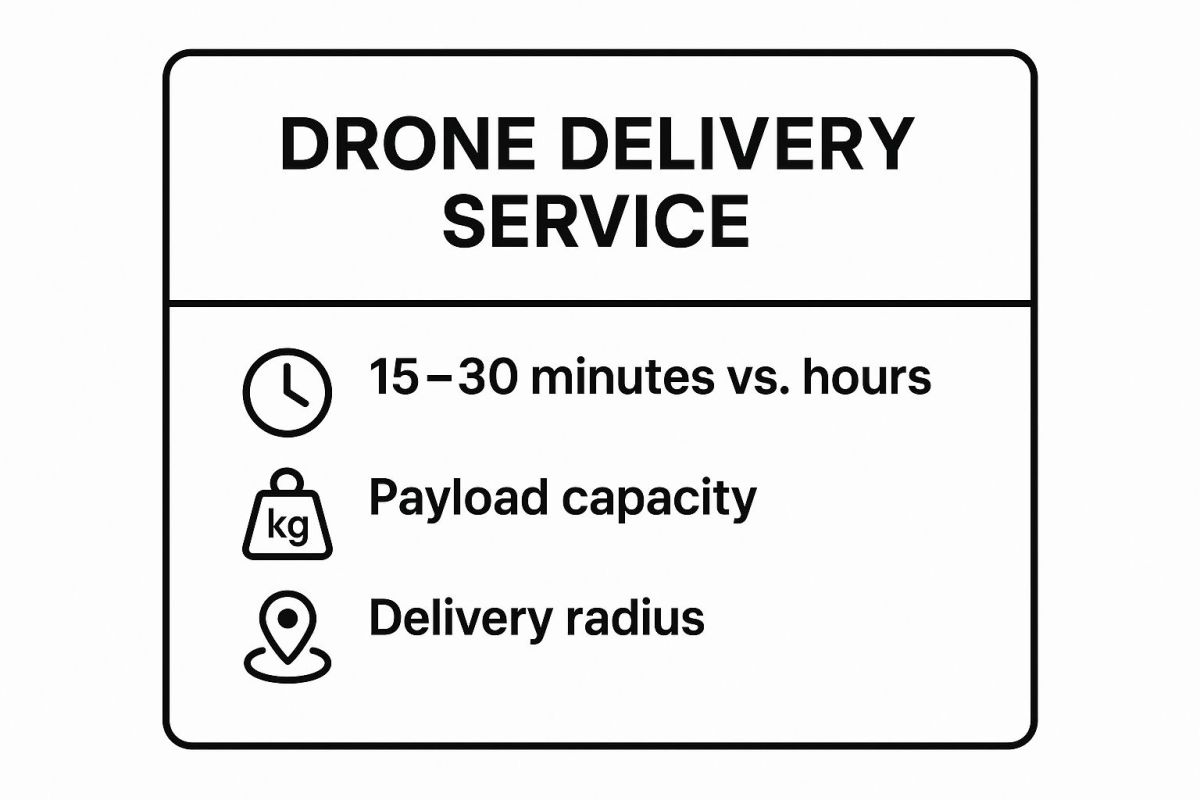
These metrics highlight the service's focus on small, lightweight packages delivered rapidly over short distances, ideal for on-demand convenience.
Key Insight: The most successful drone delivery business ideas initially focus on solving a specific, high-value problem in a controlled environment. Proving safety, reliability, and economic value in a niche market is the most effective pathway to broader expansion and regulatory acceptance.
3. Agricultural Drone Services (Precision Agriculture)
One of the most impactful business ideas with drones involves offering specialised services for precision agriculture. This business model focuses on using advanced drone technology to help farmers and agricultural operations gather critical data, optimise resource use, and ultimately increase crop yields. Services can include crop health monitoring, field mapping, targeted pesticide and fertiliser spraying, and even livestock management, transforming traditional farming practices with data-driven insights.
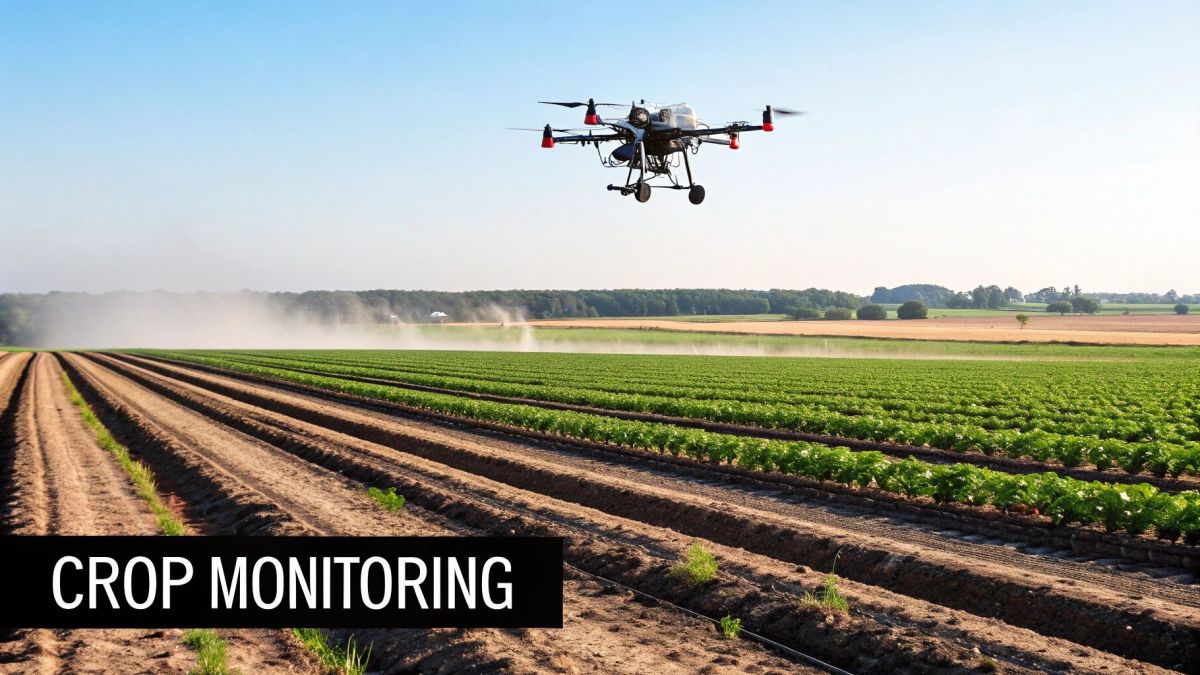
The market for this service is substantial, as farmers increasingly adopt technology to improve efficiency and sustainability. Companies like Rantizo have successfully specialised in drone spraying, while platforms like DroneDeploy Agriculture are used by thousands of operations for advanced mapping. Drones equipped with multispectral and thermal sensors provide invaluable information on soil conditions, irrigation needs, and plant health that is invisible to the naked eye.
Implementation and Key Considerations
Success in this sector requires more than just piloting skills; it demands an understanding of agronomy and data analysis. Starting this business involves investing in specialised agricultural drones, like the DJI Agras series, and powerful software to turn raw data into actionable intelligence for farmers.
Follow these steps to cultivate your agricultural drone business:
- Gain Credibility Through Partnerships: Collaborate with local agricultural extension services, universities, or agronomists. These partnerships will help you build trust and credibility within the farming community.
- Offer Seasonal Service Contracts: Instead of one-off jobs, package your services into seasonal contracts. This provides farmers with ongoing monitoring and gives your business a stable, predictable income stream throughout the growing season.
- Invest in Data Analysis Software: Your value lies in the insights you provide. Use comprehensive platforms like Pix4D or DroneDeploy to process aerial data and generate easy-to-understand reports on crop health, soil variation, and more.
- Specialise to Build Expertise: Focus initially on a specific crop type common in your region (e.g., wheat, corn, or vineyards). This allows you to develop deep expertise and build a strong reputation as the go-to provider for that niche.
- Demonstrate Value Directly: Offer a free or heavily discounted initial field scan for potential clients. Showing a farmer a tangible map of problem areas in their field is the most powerful way to prove your service's worth. Get more details about how precision agriculture with drones can deliver a strong return on investment.
Key Insight: The real value for farmers isn't the drone flight itself, but the actionable data you provide. Partnering with an agronomist to help interpret the data and offer concrete recommendations will set your business apart and justify premium pricing.
4. Drone Inspection Services (Infrastructure and Industrial)
Shifting from creative services to technical solutions, drone inspection represents one of the most impactful business ideas with drones. This business model focuses on using specialised drones to inspect infrastructure and industrial assets that are difficult, dangerous, or expensive to access manually. It replaces hazardous methods like rope access or scaffolding with a safer, faster, and more cost-effective alternative.
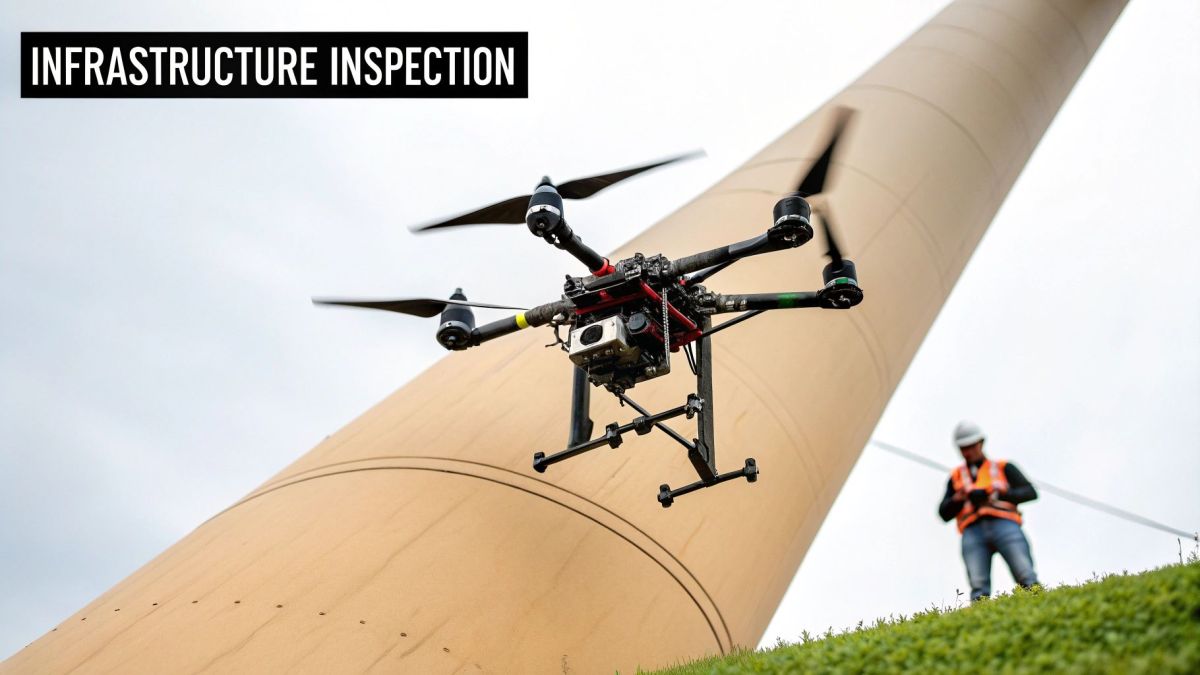
Clients for this service include energy companies needing to inspect wind turbines and power lines, telecommunications firms assessing cell towers, and insurance companies evaluating roof damage. The core value is providing high-resolution visual, thermal, or LiDAR data that helps clients identify structural issues, corrosion, or maintenance needs, ultimately preventing costly failures and enhancing worker safety.
Implementation and Key Considerations
Success in this field requires robust drones equipped with various sensors like thermal and zoom cameras. Companies like Cyberhawk Innovations have become industry leaders by providing critical inspection data for the oil and gas sector, proving the immense market potential.
To establish your inspection business, consider these actionable steps:
- Specialise to Build Expertise: Initially, focus on a single industry, such as energy or telecommunications. This allows you to build deep domain knowledge and credibility, setting you apart from general operators.
- Invest in Multiple Sensors: Offer comprehensive services by equipping your drones with interchangeable payloads, including high-resolution visual cameras, thermal imaging sensors, and even LiDAR scanners for detailed 3D modelling.
- Obtain Industry Certifications: Gain certifications relevant to the industries you serve (e.g., thermal imaging certification or specific safety training). This demonstrates professionalism and a commitment to quality.
- Develop Professional Reporting: Your final product is not just the data but the report. Create detailed, professional reports with annotated images, actionable recommendations, and clear summaries of your findings.
- Network with Asset Managers: Build direct relationships with facility managers, safety directors, and maintenance supervisors at large industrial and utility companies, as they are the key decision-makers for inspection contracts. Exploring the specifics of certain inspections, such as understanding more about drone power line inspection, can provide valuable insights for your marketing efforts.
Key Insight: Partnering with traditional inspection and engineering firms can be a powerful growth strategy. You provide the advanced drone data-capture capabilities, while they bring established client relationships and industry expertise, creating a mutually beneficial arrangement.
5. Drone Training and Education Academy
As the drone industry expands, the demand for qualified and skilled pilots has soared, creating an excellent opportunity for educational business ideas with drones. A Drone Training and Education Academy focuses on providing comprehensive training programs, certification preparation, and ongoing professional development for both aspiring and seasoned drone operators. The core service is equipping pilots with the knowledge and practical skills needed to operate safely, legally, and effectively in commercial settings.
This business can serve a wide audience, from hobbyists looking to become certified professionals to large corporations seeking to train their in-house drone teams. Course offerings can range from basic flight skills and CASA RePL (Remote Pilot Licence) test preparation to advanced specialisations like night flying, thermal imaging, and complex aerial mapping techniques. Success in this field depends on creating a structured, up-to-date curriculum and establishing a reputation for producing competent pilots.
Implementation and Key Considerations
Starting an academy requires certified instructors, a well-defined curriculum, and access to training drones and suitable flight areas. Companies like Drone Pilot Ground School have demonstrated the scalability of online training, serving tens of thousands of students, while DARTdrones has shown the potential of a hybrid model with in-person corporate contracts.
To launch your training academy, follow these actionable steps:
- Develop a Tiered Curriculum: Start by creating an online RePL preparation course to generate initial revenue. Build on this with in-person flight training, specialised workshops, and comprehensive programs that combine theory with practical business skills.
- Establish Strategic Partnerships: Collaborate with community colleges, technical schools, or industry organisations to offer accredited courses, which adds credibility and expands your reach.
- Offer Flexible Learning Models: Provide a mix of online, in-person, and hybrid training options to cater to different learning preferences and schedules. Consider offering corporate training packages for businesses integrating drone operations.
- Use Content Marketing to Build Authority: Create free educational content like webinars, tutorials on YouTube, and blog posts to showcase your expertise, attract potential students, and build a community.
- Stay Ahead of Regulations: The drone industry is heavily regulated and constantly evolving. Maintain a strong understanding of CASA regulations and industry best practices to ensure your curriculum remains current and valuable.
Key Insight: Beyond just teaching flight skills, differentiate your academy by incorporating business development modules. Offering guidance on marketing, client acquisition, and pricing strategies provides immense value and prepares your students for real-world success.
6. Drone Mapping and Surveying Services
One of the most technical yet lucrative business ideas with drones is establishing a drone mapping and surveying service. This business focuses on capturing highly accurate geospatial data to produce detailed topographic maps, 3D models, and volumetric calculations. Using photogrammetry or specialised sensors like LiDAR, drones capture thousands of overlapping images that are processed into precise digital assets. This technology offers survey-grade accuracy far more quickly and cost-effectively than traditional methods.
This service is invaluable for industries such as construction, mining, real estate development, and environmental management. Clients use this data to monitor site progress, calculate stockpile volumes, plan infrastructure, and conduct environmental impact assessments. Success demands technical proficiency in data capture and processing, along with a deep understanding of client-specific needs.
Implementation and Key Considerations
Starting this business requires an investment in specialised drones, often equipped with RTK (Real-Time Kinematic) or PPK (Post-Processed Kinematic) technology for centimetre-level accuracy. Software platforms are equally critical, with companies like DroneDeploy and Propeller Aero offering powerful cloud-based solutions that streamline the workflow from data capture to final deliverable.
To build a reputable mapping and surveying business, follow these actionable steps:
- Master the Software: Become an expert in processing software like Pix4D, DroneDeploy, or Agisoft Metashape. The quality of your final maps and models depends entirely on your ability to process the data correctly.
- Invest in Accuracy: Purchase a drone with RTK capabilities. This technology significantly improves the accuracy of your outputs, which is a non-negotiable requirement for most surveying and construction clients.
- Secure Recurring Revenue: Target construction companies or mine operators with ongoing projects and offer monthly monitoring contracts. This provides a stable and predictable revenue stream.
- Partner with Licensed Surveyors: Collaborate with licensed land surveyors to provide legally certified boundary surveys. This partnership allows you to offer a complete, end-to-end service and access projects that require professional certification.
- Educate Your Clients: Many clients may not know how to fully utilise the data you provide. Offer training sessions or create simple guides to help them interpret and apply the maps, 3D models, and analytics, adding significant value to your service.
Key Insight: Specialising in a specific high-value industry, such as large-scale mining operations, infrastructure development, or solar farm planning, allows you to build deep domain expertise and position your business as an indispensable partner rather than a simple service provider.
7. Drone Retail and Repair Shop
Establishing a Drone Retail and Repair Shop is a powerful business idea that combines product sales with high-demand technical services. This hybrid model positions your business as a one-stop-shop for both hobbyists and commercial pilots, offering everything from the latest drones and accessories to crucial maintenance, upgrades, and repairs. The core of this business is creating a physical hub that provides expertise and support that online-only retailers cannot match.
This model caters to a growing market of drone owners who need reliable technical support, from simple propeller replacements to complex software diagnostics. By offering both sales and service, you capture initial purchases and build long-term customer relationships through ongoing maintenance and support, creating a sustainable and recurring revenue stream. It serves as a community centre for local enthusiasts and a trusted partner for commercial operators.
Implementation and Key Considerations
Success in this niche requires a blend of retail savvy and technical expertise. Your shop should not only stock popular models from brands like DJI and Autel Robotics but also have a well-equipped workshop. Companies like DroneNerds have proven the viability of this model, expanding from a single location to a multi-million dollar business by combining a strong retail presence with expert repair services.
To launch your drone retail and repair business, follow these actionable steps:
- Focus on High-Margin Products: While you need to stock popular drones, prioritise sales of high-margin accessories like batteries, cases, filters, and propellers, as this is where profitability often lies.
- Offer Expert Repair Services: This is your key differentiator. Provide reliable, in-house repair and maintenance services to draw in customers who purchased their drones elsewhere.
- Create Value-Added Bundles: Develop packages that combine a drone with essential accessories like extra batteries, a carrying case, and propeller guards. These bundles offer customers convenience and increase the average transaction value.
- Build a Community: Host weekend workshops on topics like "Flying Your First Drone" or "Introduction to Aerial Photography" to build a loyal local community and establish your shop as an authority.
- Secure B2B Contracts: Network with local businesses that use drones, such as real estate agencies or construction firms, and offer them bulk repair and maintenance contracts for their fleet.
Key Insight: Your physical location is your greatest advantage over online giants. Emphasise hands-on customer service, immediate repairs, and community-building events to create a loyal customer base that cannot be replicated online.
7 Drone Business Ideas Comparison
| Service Type | Implementation Complexity 🔄 | Resource Requirements ⚡ | Expected Outcomes 📊 | Ideal Use Cases 💡 | Key Advantages ⭐ |
|---|---|---|---|---|---|
| Aerial Photography and Videography | Moderate: FAA Part 107 certification, weather-dependent | Moderate: Professional drones, cameras, insurance | High-quality visual content; scalable recurring business | Real estate, weddings, events, marketing | Creative visuals; diverse clients; growing demand |
| Drone Delivery Service | High: FAA Part 135 Certificate, BVLOS waivers, regulatory hurdles | Very High: Drones, software, infrastructure, insurance | Fast deliveries (15-30 mins); cost-effective logistics | Last-mile delivery, medical supplies, food delivery | Faster delivery; lower operational costs; scalable |
| Agricultural Drone Services | High: Specialized agronomy knowledge, seasonal operations | High: Specialized drones, sensors, spraying equipment | Increased yields by 10-25%, reduced chemical use | Crop monitoring, spraying, livestock management | Data-driven farming; premium pricing; large coverage |
| Drone Inspection Services | Very High: Industry certifications, technical expertise | Very High: Industrial drones, thermal/LiDAR sensors, insurance | Cost/time savings; safety improvements; regulatory compliance | Infrastructure, industrial inspections | High-value contracts; safety; fast inspections |
| Drone Training and Education | Moderate: Curriculum development, teaching skills | Low to Moderate: Training drones, platform, marketing | Scalable education; recurring revenue | Aspiring drone pilots, continuing education | High margins; scalable; growing demand |
| Drone Mapping and Surveying | Very High: Surveying knowledge, expensive equipment | Very High: RTK drones, software, computing power | Survey-grade accuracy; faster surveys; recurring projects | Construction, mining, environmental monitoring | Premium service rates; safer than manual surveys |
| Drone Retail and Repair Shop | Moderate: Inventory management, repair expertise | Moderate to High: Inventory, repair tools, retail space | Multiple revenue streams; community hub | Drone sales, repair, accessories | Diverse revenues; customer loyalty; lower risk |
Choosing Your Flight Path: Next Steps for Your Drone Business
The sky is no longer the limit; it's the new frontier for business innovation. We've explored seven distinct business ideas drones can bring to life, from the creative flair of aerial cinematography to the critical precision of industrial inspections and agricultural surveying. Each path offers a unique trajectory into a thriving, high-tech economy. The common thread weaving through all these opportunities is the move beyond generalist services toward specialised, high-value solutions.
Your success will depend on more than just skilled piloting. It demands a laser focus on a specific industry niche, a deep understanding of your target market's complex challenges, and an unwavering commitment to safety and regulatory compliance. Whether you're mapping vast mining sites, monitoring critical infrastructure for energy companies, or providing data for precision agriculture, the value lies in delivering accurate, actionable intelligence that clients cannot obtain through other means.
Turning Your Vision into a Viable Enterprise
The journey from concept to a fully operational drone business requires careful planning and strategic investment. Here are the crucial next steps to guide your launch:
-
Specialise and Define Your Niche: Don't try to be everything to everyone. Select the business idea that best aligns with your existing skills, capital, and regional market demand. Are you targeting large-scale infrastructure projects or local real estate videography? Your answer defines your equipment, training, and marketing strategy.
-
Develop a Robust Business Plan: Outline your target clients, service offerings, pricing structure, and financial projections. This document will be your roadmap, essential for securing funding and measuring your success. As you transition from ideas to reality, researching essential business insurance for contractors is a vital step to protect your drone enterprise from operational risks.
-
Invest in Fit-for-Purpose Technology: Your choice of drone platform is the cornerstone of your business. A heavy-lift drone capable of carrying high-end LiDAR scanners is fundamentally different from a nimble FPV drone used for videography. Investing in a reliable, professional-grade Unmanned Aerial System (UAS) tailored to your niche is non-negotiable for delivering quality results and ensuring operational safety.
-
Achieve Full Certification and Compliance: In Australia, operating a drone commercially requires adherence to Civil Aviation Safety Authority (CASA) regulations. Obtaining your Remote Pilot Licence (RePL) and potentially an RPA Operator's Certificate (ReOC) is a mandatory first step. Staying current with evolving legislation is crucial for long-term success.
By meticulously planning your launch, choosing the right technology partner, and focusing on a specialised service, your venture can achieve new heights. The future of many industries is being shaped from above, and with the right approach, your drone business can be at the forefront of this transformation.
Ready to equip your new venture with industry-leading technology? Innoflight International provides advanced, Australian-designed, USA- and Australian-manufactured UAS platforms designed for the most demanding applications, from heavy-lift LiDAR mapping to long-endurance surveillance. Explore our versatile systems at Innoflight International and find the perfect drone to form the backbone of your enterprise.