When you think about drones, you might picture the small, nimble ones used for photography. But in the world of industrial UAVs, we're talking about a completely different class of machine. At the heart of these workhorses are large drone motors—the powerhouse components that let them carry heavy equipment for specialised jobs like agricultural spraying or LiDAR surveying.
These aren't your average hobby-grade motors. They are serious, high-torque systems built for one primary purpose: lifting a whole lot of weight safely and reliably.
Why Large Motors Are the Backbone of Heavy Lift Drones
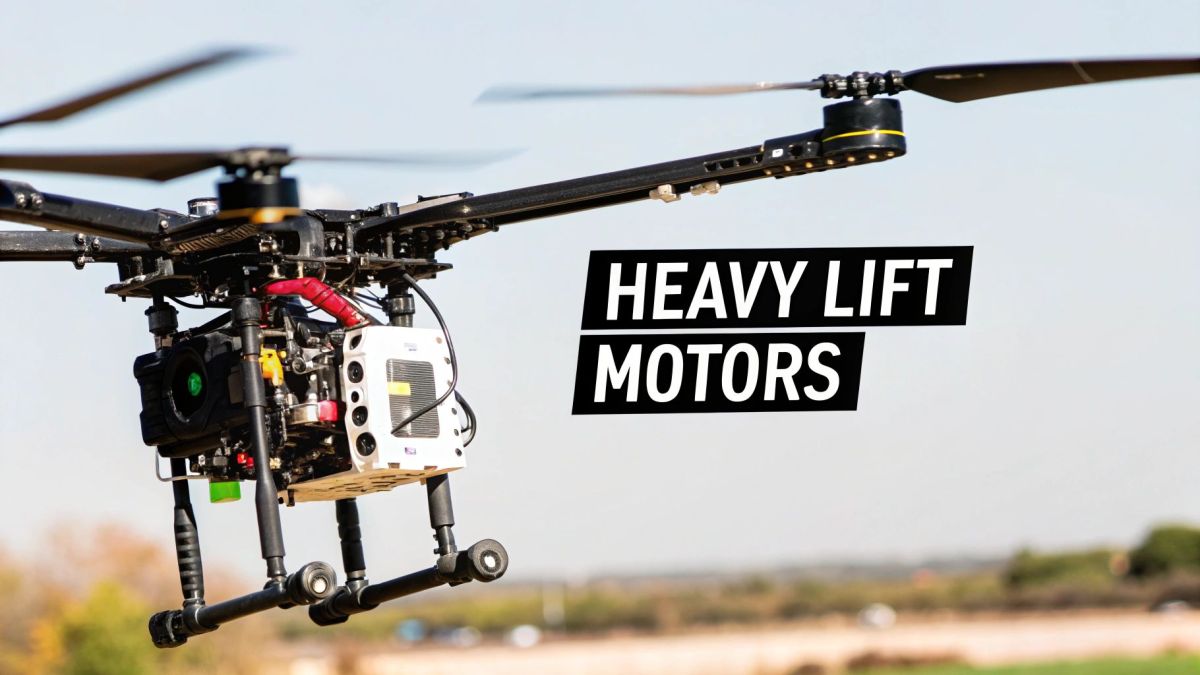
So, what gives a heavy lift drone its muscle? It all comes down to the motors.
A good analogy is thinking of them as the engine in a prime mover. You wouldn't use a sedan's engine to haul a B-double trailer, and the same logic applies here. A drone built for agriculture, logistics, or industrial surveying needs big, beefy motors to get its payload off the ground and keep it stable in the air.
These motors are single-handedly the most critical part of the equation for any demanding job. Getting the motor choice right determines everything—how much the drone can lift, how smoothly it flies, and whether the mission succeeds or fails. Without the right powerplant, a heavy lift drone is grounded before it even starts.
Powering Australia's Growing Drone Industry
The need for these specialised motors is booming, especially here in Australia. The local drone market is already valued at USD 614.0 million and isn't slowing down. Projections show it rocketing to an estimated USD 1,500.7 million by 2033.
As Aussie industries from farming to mining look for smarter ways to work, the demand for drone motors large enough to handle heavy-lift operations has gone through the roof. You can dig into the numbers yourself in IMARC Group's detailed market report.
It's a simple, direct relationship: bigger motor, bigger capability. A larger motor creates more torque, which lets it spin a larger propeller. That combination is the secret sauce for generating the massive thrust needed to lift not only the drone itself but also several kilos of mission-specific gear.
This core principle is what guides the design of any effective heavy lift drone. At the end of the day, these motors are about more than just brute force. They're what enable drones to become genuine, industry-changing tools. Their performance is the bedrock on which every successful heavy-lift mission is built.
How Brushless Motors Get Modern Drones Airborne
At the heart of almost every large drone flying today is a brushless DC (BLDC) motor. So, what makes them tick? Imagine giving a spinning top a perfectly timed magnetic push to keep it going, but without ever physically touching it. That’s the magic behind the incredible efficiency of a brushless motor.
This clever, contactless design is what really sets them apart from the older, clunky brushed motors. Brushed motors use physical carbon brushes to deliver power, which literally grind themselves down over time. This creates friction, wastes energy as heat, and eventually leads to failure. It’s like trying to run a marathon while dragging your feet.
Brushless motors do away with that friction completely. The result is a motor that’s not just more powerful, but also far more reliable and lasts a whole lot longer.
A Look Inside the Motor
Every brushless motor is a tale of two parts working together: the stator and the rotor.
- The Stator: This is the part that stays still. It's built from tightly wound copper coils that become powerful electromagnets when electricity flows through them, thanks to the drone's Electronic Speed Controller (ESC).
- The Rotor: This is the spinning part, and it's studded with strong permanent magnets. As the ESC energises the stator's coils in a specific sequence, it creates a rotating magnetic field that pulls the rotor's magnets along for the ride, spinning the motor and the propeller at incredible speeds.
It’s this elegant dance between electromagnets and permanent magnets that generates the raw torque needed for heavy lifting. The ESC is the choreographer, switching the electromagnets on and off in perfect time to create smooth, powerful rotation. If you want to dive deeper into the physics, many drone motors large use principles you can explore in our guide on permanent magnet synchronous motors.
Why Outrunners are King for Heavy-Lift Drones
You'll find that most large drone motors are a specific type called an "outrunner". In this design, the rotor (with the magnets) spins on the outside of the stationary stator coils. Picture a can spinning around a fixed core.
This outrunner setup is a game-changer because it applies magnetic force further from the motor's centre. This creates a longer lever arm, which in turn generates a huge amount of torque—exactly what you need to spin those big, heavy propellers and generate massive thrust.
This design choice is the secret sauce behind why drone motors large can handle serious payloads. They are built from the ground up for torque and efficiency, not just raw speed, making them the gold standard for any industrial or commercial drone job.
Decoding Motor Specs and Performance Numbers
When you first dive into the world of large drone motors, looking at a spec sheet can feel like trying to read another language. It's a wall of numbers and acronyms that holds the key to a motor's real-world power. But don't worry, once you know what to look for, you can quickly translate that data into practical performance for your heavy-lift drone.
Think of it like checking out a powerful new ute. You wouldn't just look at its top speed; you'd want to know its torque for towing, its fuel efficiency for long trips, and how much it can carry. It's the exact same idea here. Understanding each number helps you build a reliable and effective aerial workhorse.
This diagram shows you the heart of a brushless motor: the relationship between the stationary coils (the stator) and the spinning magnets (the rotor) that creates movement.
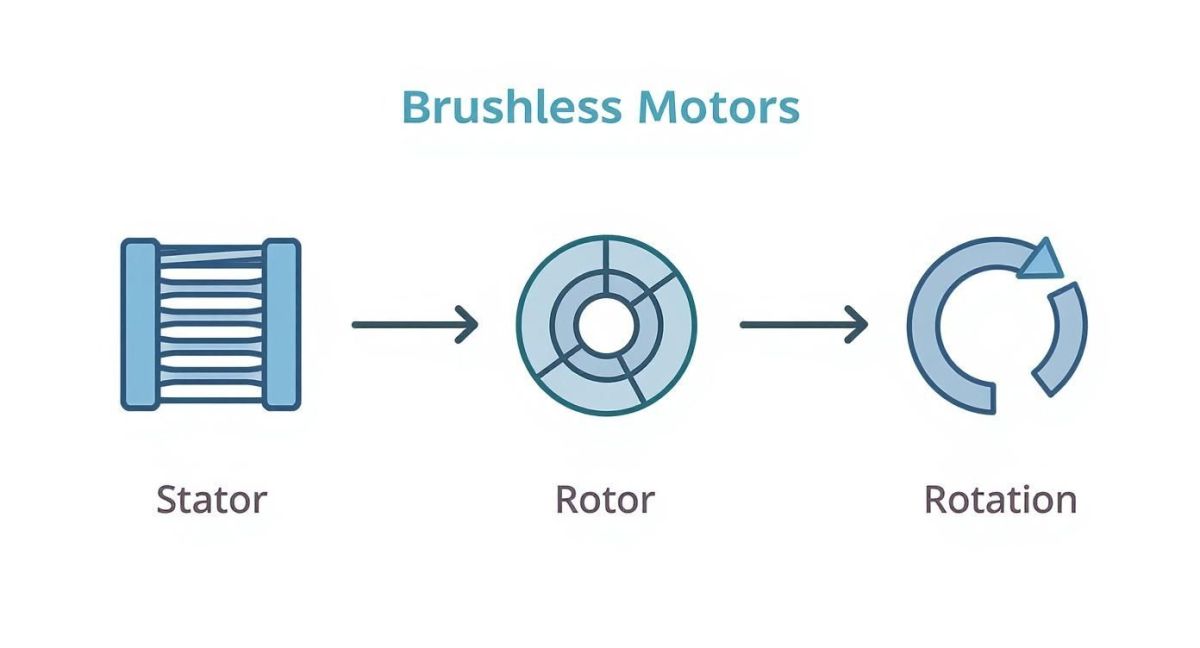
It’s this simple interaction that delivers the incredible power and efficiency that makes brushless technology the only choice for serious drone applications.
Understanding Motor Size and kV Rating
Two of the first numbers you'll spot on any motor are its size and kV rating. These two figures alone tell you a massive amount about what the motor is designed to do.
A motor's size is usually written as a four-digit number, like 5010 or 6215. This isn't just a random model number; it's a direct description of the motor's core, the stator.
- The first two digits (50) tell you the stator’s diameter in millimetres.
- The last two digits (10) tell you the stator’s height in millimetres.
Generally speaking, a wider and taller stator—a bigger number—means the motor can produce more torque. That's exactly what you need to spin large, heavy propellers. Of course, there's a trade-off: more power comes with more weight.
Next up is the kV rating, which is easily one of the most misunderstood specs out there. It simply means "RPM per volt" and tells you how fast the motor wants to spin for every volt you give it, with no propeller attached. For heavy-lift drones, a lower kV rating (think 170kV to 340kV) is almost always what you're after.
Think of kV like the gears on a truck. A low gear (low kV) doesn't give you much top speed, but it delivers massive torque for getting a heavy load moving. A high gear (high kV) is great for zipping along the highway but will struggle to pull a heavy trailer up a steep hill. For large drone motors, we need that low-end grunt to lift heavy payloads efficiently.
Translating Key Performance Metrics
Beyond the basic size and kV, the real gold is in the performance data from bench tests. These numbers give you a clear picture of how a motor will actually behave in the air, bridging the gap between technical specs and a successful flight.
The Australian drone market is booming, with hardware making up a huge 68.11% of an industry that generated over $1 billion. This demand is driven by industries needing to carry heavier payloads, making these performance metrics more critical than ever. You can see the full Australian market projections from Grand View Research.
To help you make sense of it all, here's a quick rundown of the most important specs you'll find on a motor datasheet.
Key Large Drone Motor Specifications Explained
| Specification | What It Means | Impact on Performance |
|---|---|---|
| Thrust (g) | The raw lifting force the motor and a specific propeller can produce, measured in grams. | This is the most direct measure of lifting power. Your drone's total thrust from all motors must significantly exceed its all-up weight. |
| Efficiency (g/W) | How much thrust (grams) the motor generates for every watt of power it consumes. | Higher efficiency is your ticket to longer flight times. It means the motor is doing more work with less energy from your battery. |
| Max Current (A) | The maximum amperage the motor can safely draw when working at full throttle. | This is a critical safety number. It tells you what size Electronic Speed Controller (ESC) you need to avoid burning out your electronics. |
These specifications are the real indicators of how a motor will perform for your specific needs.
Ultimately, the "best" motor isn't always the one with the highest thrust or the lowest kV. It's the one that strikes the perfect balance of these metrics for your drone's weight, purpose, and flight profile. You can dive deeper into this by learning how to calculate propeller thrust and match it to your motor.
How to Choose the Right Large Drone Motor
Alright, now that we've got the technical specs down, let's get into the practical side of things. Picking the right motor for your large drone isn't about grabbing the most powerful one off the shelf. It’s a careful balancing act, a process of matching the right parts to what you actually need your drone to do. Get this right, and you'll have a machine that's not just strong, but also stable, efficient, and reliable.
The whole journey starts with one simple, but absolutely critical, question: what's the total weight of your drone? And I mean everything—the frame, batteries, every last wire, and the heaviest payload you ever plan on lifting.
Start with Your Drone's Total Weight
Before you even browse a single motor catalogue, you need to pin down your drone's All-Up Weight (AUW). This is the total mass your motors will be fighting against gravity to lift.
Be meticulous here. Add up the weight of the frame, the flight controller, batteries, props, wiring, and, crucially, your maximum payload. Once you have that final number, do yourself a favour and add a small safety buffer of about 10-15%. This little bit of extra margin covers any small miscalculations or future additions and gives you a much safer operational window.
Calculate Your Required Thrust
With your AUW sorted, we can figure out the lifting power you need. The key concept here is the thrust-to-weight ratio. For any serious heavy-lift drone, you want your motors to be able to generate at least twice your drone's total weight in thrust.
A 2:1 thrust-to-weight ratio is the bare minimum for safe flying. So, if your drone weighs 15kg, your motors combined need to produce at least 30kg of maximum thrust. This ensures the drone can hover at roughly 50% throttle, leaving you plenty of power to climb, manoeuvre, and handle a bit of wind.
For a drone that feels more responsive and stable in the air, aiming for a 3:1 or even 4:1 ratio is a much better goal. This gives the flight controller more authority to make tiny adjustments, which translates to a smoother, more locked-in flight experience.
Match Your Components Systematically
A motor doesn't work alone. It's the heart of the powertrain, but it needs to be perfectly in sync with the propeller, ESC, and battery. Think of it as a complete system.
-
Motor and Propeller Pairing: Start by looking at the manufacturer's test data. Based on the thrust you need from each motor, find a motor and prop combo that delivers it efficiently. You're looking for a high grams-per-watt (g/W) figure at a throttle level of around 50-70%.
-
Select the Right ESC: Check the motor's datasheet for its maximum current draw (measured in amps, A). Your Electronic Speed Controller (ESC) is the gatekeeper for this power. To avoid burning it out, pick an ESC with a continuous current rating at least 20-30% higher than the motor’s max draw.
-
Choose the Battery Voltage: The motor's kV rating points you to the right battery. Low-kV motors, which are typical for drone motors large, are designed to run on higher voltage batteries (like 8S or 12S LiPo packs) to work at their best.
When you're sourcing these high-power components, you'll often be looking at international suppliers. If that's the case, it's really important to know who's responsible for what during shipping. Taking a few minutes to get your head around understanding DDU DDP Incoterms can save you a lot of headaches and money by clarifying who pays for what and who bears the risk for these expensive parts.
Large Drone Motors at Work in Australian Industries

It’s one thing to pore over datasheets and compare technical specs, but it’s another thing entirely to see these powerhouse motors in the real world. Across Australia, these components aren’t just numbers on a page; they’re the workhorses making things happen in some of our most demanding industries.
From the sprawling Wheatbelt to the rugged Pilbara, large drone motors built for heavy lifting are genuinely changing how we get things done.
The growth has been incredible to watch. The Australian drone industry is forecast to be worth a staggering AUD$14.5 billion by 2040, a figure that makes perfect sense given our unique landscapes and a government keen to innovate. You can read more about this in the Australian Government's analysis. This boom is fuelling massive demand for powerful drone motors, particularly in sectors like agriculture and mining.
Let's dive into a few real-world examples where these motors are making all the difference.
Precision Agriculture in the Wheatbelt
Picture a large agricultural drone hovering over a field, its 20-litre tank filled with fertiliser. To haul that kind of weight while maintaining a perfectly stable and precise flight path, the drone depends entirely on its high-torque, low-kV motors.
- The Challenge: Cover hundreds of hectares with an even spray, doing it quickly without damaging the crops below.
- The Motor's Role: High-torque motors are all about brute force, not speed. They spin large, efficient propellers slowly but with immense power. This generates the lift needed for the heavy payload but avoids creating a chaotic downwash, ensuring the spray lands exactly where it’s intended.
This is a classic case of torque over raw speed. The motors provide the grunt required to carry a heavy liquid payload while giving the pilot the fine control needed for precision work.
Large-Scale Surveying in the Pilbara
Now, let's head over to the vast mining operations of the Pilbara. Drones here are often kitted out with heavy LiDAR scanners to create incredibly detailed 3D maps of mine sites. These missions can take hours, flying over harsh and remote terrain.
For a job like this, endurance and reliability are everything. The motors chosen have to be exceptionally efficient (high g/W) and tough enough to handle dust and extreme heat.
A motor giving out mid-flight is more than just an inconvenience—it could mean losing a LiDAR unit worth tens of thousands of dollars. That’s why mine operators invest in large, robust drone motors with a proven track record for durability and excellent cooling. Better efficiency means longer flight times, which translates to more ground covered on a single battery and less downtime for the operation.
Critical Logistics to Remote Communities
Finally, think about the growing use of heavy-lift drones to deliver vital supplies to remote outback communities. These drones could be carrying anything from urgent medical equipment to food or essential spare parts.
The motors for these workhorses need to strike a perfect balance between power, efficiency, and unwavering reliability. They need the raw strength to lift a hefty cargo, the efficiency to cover vast distances, and the dependability you can count on when the mission is critical. As this technology matures, the performance of these large motors will be the key to connecting isolated parts of Australia in ways we never thought possible.
Common Questions About Large Drone Motors
Getting into heavy-lift drones means you're going to have questions, especially when it comes to the motors. It's completely normal. Whether you're stuck on a specific part of your build or trying to figure out a performance issue, you need clear answers.
Let's run through some of the most common queries we get from builders and operators right here in Australia. Think of this as a way to nail down the key ideas we've covered and tackle those practical, real-world problems.
How Do I Perfectly Match a Propeller to My Motor?
Matching a propeller isn't a dark art; it's all about the data. Your first port of call should always be the motor manufacturer's performance charts. These tables are goldmines of information, showing you exactly how a motor behaves with different prop sizes and pitches, covering thrust, efficiency (g/W), and current draw.
For heavy lifting, you’re hunting for the sweet spot. You want a prop that delivers the thrust you need at around 50-70% throttle without sacrificing efficiency. Sure, a bigger prop or a higher pitch gives you more grunt, but it also sucks more power and works the motor harder. The data sheet is your best mate for finding that perfect balance and avoiding an overloaded system.
What Is the Biggest Mistake People Make During Installation?
By far, the most common—and most damaging—mistake is using motor mounting screws that are too long. It’s a tiny detail with huge consequences. If a screw is even a millimetre too long, it can push right through the base and make contact with the motor’s delicate copper windings.
The result? A dead short that will fry both the motor and the ESC the second you connect the battery. Always check your measurements. Add the thickness of your drone's arm to the thickness of the motor's base and choose screws that are precisely that length. If a screw feels like it's fighting you, stop and check again.
Remember this simple rule: the screw should be long enough for a secure grip, but short enough that it never comes close to the motor's guts. Double-checking this can save you from a very expensive headache.
Do Large Drone Motors Need Special Cooling?
Absolutely. Keeping large drone motors cool is vital, especially when you're hauling heavy gear in the Aussie heat. Many top-tier motors come with built-in fans and heat sinks, but your overall setup is just as important.
Make sure there's plenty of clear airflow around each motor. Steer clear of designs that tuck the motors away inside shrouds or block the breeze. For jobs that involve long hovers or sustained high-power flight, keep an eye on the motor's temperature rating. Overheating is the number one killer of efficiency and the fastest way to motor failure.
Ready to power your next heavy-lift project with motors built for reliability and performance? Innoflight International offers a range of high-torque, efficient motor solutions designed for Australia's toughest industrial applications. Find the perfect powertrain for your UAV at the Innoflight International website.