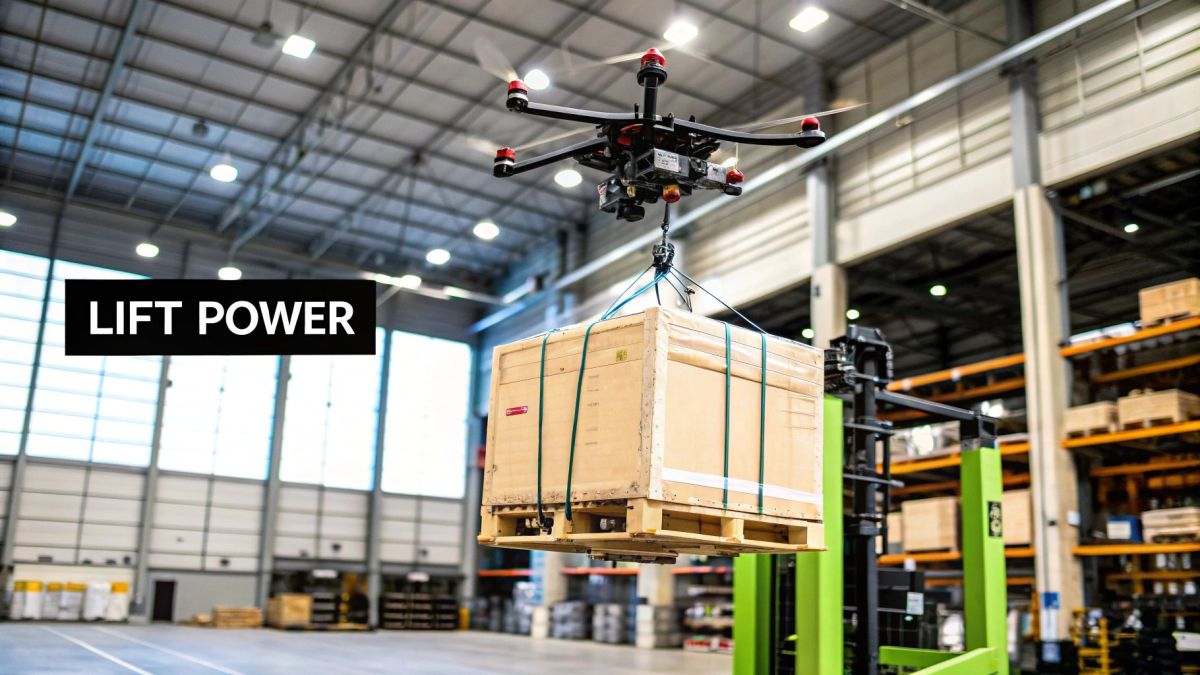
A heavy lift drone is a specialised unmanned aerial vehicle built to carry payloads that are way beyond what a standard consumer or camera drone can handle.
Think of it like the difference between a family sedan and a massive haulage truck. They're both vehicles, but their purpose, power, and what they can carry are in completely different leagues. These powerful machines are defined by their ability to transport heavy equipment, sensors, or cargo, turning them from simple data-gathering tools into proper airborne workhorses.
What Defines a Heavy Lift Drone
The real separator for a heavy lift drone is its payload capacity and the serious engineering needed to back it up. A typical drone might carry a camera weighing less than a kilogram, but a true heavy lifter is designed from the ground up for strength and stability. It's built to manage loads anywhere from 10 kg to over 100 kg.
This isn't just a simple upgrade; it's a completely different design philosophy.
You won't find lightweight plastics here. Instead, these drones use reinforced frames, often built from high-grade carbon fibre or tough aluminium alloys. This kind of structural integrity is crucial for handling the immense stress and torque that comes with flying a heavy, and sometimes awkward, payload. The entire system is built around one mission: carrying serious weight safely and reliably.
Core Engineering Principles
The muscle behind a heavy lift drone comes from its specialised parts, each one chosen to deliver maximum lifting force and endurance. We're not talking about off-the-shelf components; these are industrial-grade systems working together.
- High-Torque Motors: These drones rely on large, high-powered brushless motors. Unlike the smaller motors in hobby drones that focus on speed, these are engineered for raw torque—the rotational force needed to spin huge propellers and generate massive upward thrust.
- Oversized Propellers: To move enough air to create lift, the propellers are significantly larger and often have a much steeper pitch. It's this combination of high torque and big props that actually gets a heavy payload off the ground.
- Advanced Flight Controllers: A sophisticated flight control system is non-negotiable. It's constantly making tiny adjustments to keep the drone stable, compensating for shifting weight and external factors like wind gusts, which have a much bigger impact when you're hauling a heavy load.
A key thing to remember is the constant trade-off between payload and flight time. As you add more weight, the motors have to work harder, which drains the batteries faster and cuts down how long the drone can stay in the air.
This level of engineering is what makes a genuine heavy lift drone a world apart from a large hobbyist model. It's a purpose-built tool designed for demanding industrial jobs where the main goal is moving heavy objects through the sky. This opens up a whole range of applications that would be impossible for smaller drones, making them invaluable in fields like construction, logistics, and emergency response.
Understanding What Makes a Heavy-Lift Drone Tick
To really get what a heavy-lift drone is capable of, you need to look under the bonnet. Much like a high-performance ute, its power and precision come from a set of specialised components all working together. Getting your head around these parts and what their specs actually mean is the key to picking the right drone for the job.
At the core of any heavy-lift drone, you’ll find three critical systems that define its strength, smarts, and purpose.
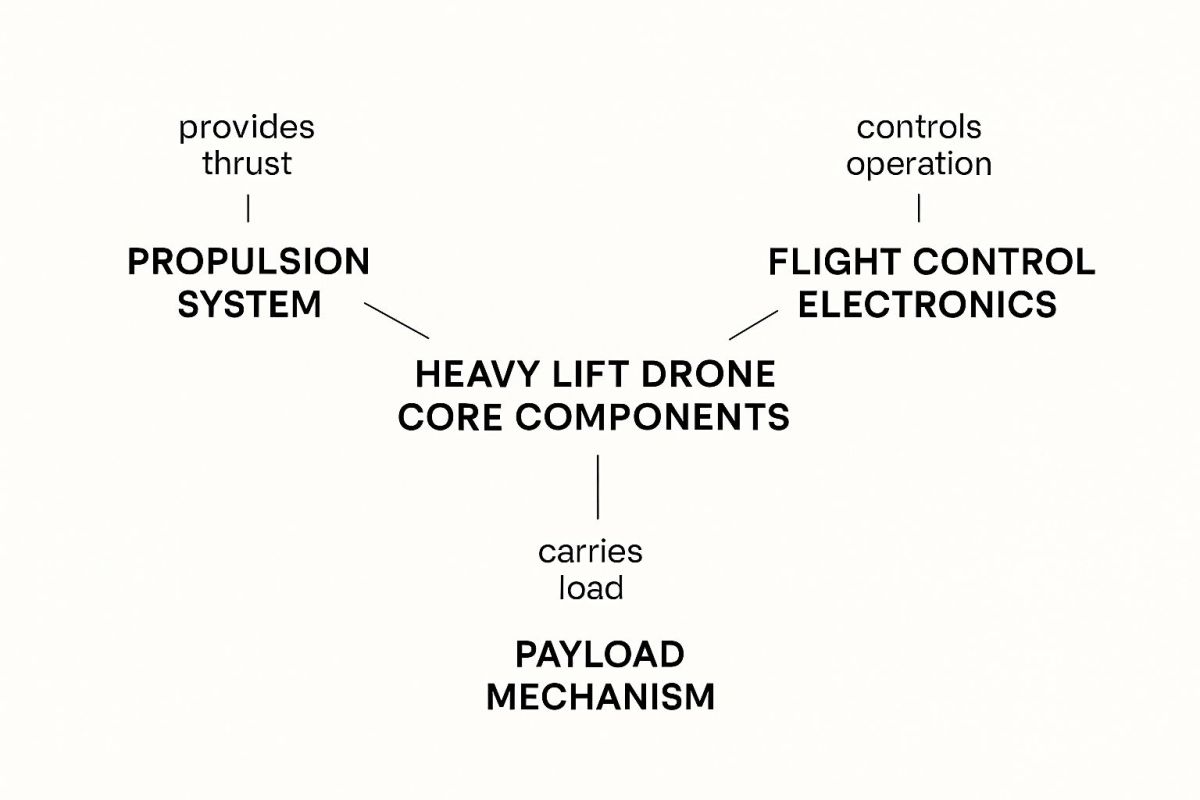
As you can see, it's a team effort. The propulsion system brings the muscle, the flight electronics provide the brains, and the payload mechanism is what lets the drone actually do the work.
The Powerhouse: Its Propulsion System
Think of the propulsion system as the engine and drivetrain. It’s what generates the raw thrust needed to get the drone—and whatever it’s carrying—off the ground. Heavy-lift drones almost always run on powerful brushless DC motors. They’ve completely replaced the older brushed motors because they're far more efficient, last longer, and pack a much bigger punch for their weight.
These motors spin large, high-torque propellers. The whole idea isn't speed, but to shove a massive amount of air downwards to create lift. Powering this whole setup are either high-capacity lithium-polymer (LiPo) batteries or, for those really long jobs, a petrol-electric hybrid system.
- Electric Systems: They're quiet and easy to maintain, but you're always watching the clock on battery life.
- Hybrid Systems: These pair a small petrol generator with the electric motors, giving you a huge boost in flight time. The trade-off is more weight and mechanical complexity.
The Brains of the Operation: Flight Control Electronics
If the motors are the muscle, the flight controller is the central nervous system. It's constantly processing information from a suite of sensors—gyroscopes, accelerometers, GPS, and barometers—to keep the drone stable and following commands. For a big, heavy drone, this system has to be incredibly reliable.
It makes thousands of tiny adjustments every second to keep things steady, which is vital when you're dealing with a swinging payload or a sudden gust of wind on a construction site. The more advanced flight controllers also handle pre-programmed flight paths, crucial safety features like 'return-to-home', and maintain the data link back to the pilot.
The quality of the flight controller and its software is what separates a reliable industrial tool from an expensive accident waiting to happen. The best systems have triple redundancy, meaning there are backup sensors and processors ready to take over instantly if anything fails.
Putting It to Work: Payload and Key Specs
The payload is the whole reason these drones exist. It could be a high-resolution camera, a sophisticated LiDAR scanner, a crate of emergency medical supplies, or even a set of tools for a remote site. The payload mechanism itself includes the mounts, gimbals, and release systems needed to carry and operate this gear.
When you're looking at a drone's spec sheet, three numbers matter more than anything else:
- Maximum Payload Capacity (kg): This is the absolute most weight the drone can safely lift. You should always leave a bit of a buffer; pushing it to 100% capacity hammers the batteries and puts a lot of strain on the motors.
- Flight Duration (minutes): This tells you how long the drone can stay in the air. Crucially, this number is almost always quoted with no payload. As soon as you add weight, that number starts to drop—often dramatically.
- Operational Range (km): This is how far the drone can fly from the controller before the communication link gets shaky.
The demand for drones with these kinds of capabilities is exploding. The global market for heavy-lift drones hit around USD 1.5 billion in 2024 and is on track to reach USD 5.4 billion by 2033. Here in Australia, drones that can carry over 50 kg are becoming essential in mining, construction, and for our emergency services.
Understanding these specs helps you read between the lines. For instance, a drone carrying a heavy LiDAR sensor for a detailed survey will have a much shorter flight time than the exact same drone doing a simple visual inspection. This constant trade-off between how much you can carry and how long you can fly is the most important calculation you'll make when planning any mission.
Matching Drone Specifications to Industry Needs
To help put this all into perspective, let’s look at how these specifications line up with the real-world needs of different Australian industries. It quickly becomes clear that there's no "one-size-fits-all" solution; the right drone always depends on the job at hand.
| Industry Application | Typical Payload Capacity | Required Flight Time | Essential Features |
|---|---|---|---|
| Agriculture | 15-50 kg (for spraying) | 15-25 minutes | Precision spraying nozzles, autonomous flight paths, terrain following |
| Mining & Surveying | 5-15 kg | 30-45+ minutes | High-end sensor compatibility (LiDAR/multispectral), long range, PPK/RTK GPS |
| Construction & Inspection | 5-25 kg | 25-40 minutes | High-resolution zoom cameras, thermal imaging, stable flight in wind |
| Emergency Services | 2-10 kg (observation/delivery) | 40-60+ minutes | Long endurance (hybrid option), thermal cameras, spotlight, loudspeaker |
| Logistics & Delivery | 25-100+ kg | 20-35 minutes | Secure cargo bay, automated drop mechanism, weather resistance |
As the table shows, a logistics drone built for heavy, short-haul deliveries has completely different priorities from a long-endurance surveillance drone used by emergency services. By understanding your specific mission requirements first, you can find a drone with the right balance of payload, endurance, and features to get the job done safely and efficiently.
How Heavy Lift Drones Are Reshaping Australian Industries
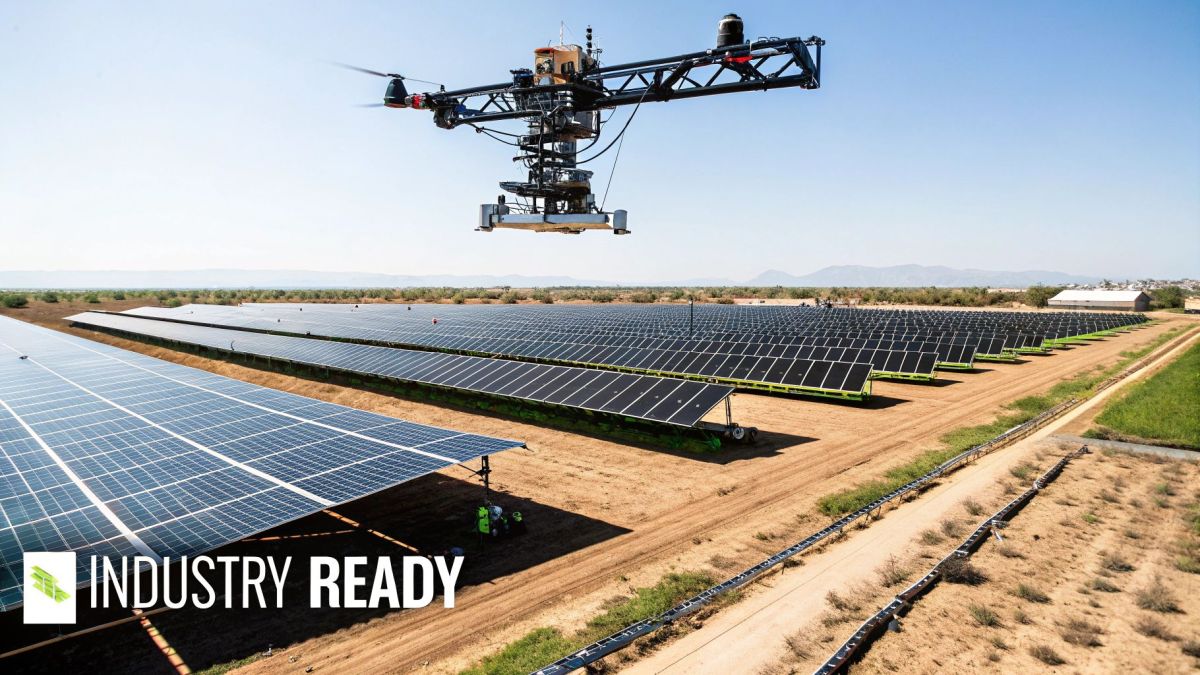
Right across Australia’s enormous and often unforgiving landscapes, a quiet revolution is taking to the skies. Heavy-lift drones have moved well past the experimental phase and are now essential tools on the ground—or rather, above it—solving complex problems that used to cost businesses a fortune in time and money. From the red dirt of the Pilbara to the green fields of the Riverina, these powerful machines are proving their worth day in and day out.
This isn't just about cool technology with impressive specs; it's about real, tangible results. Whether they're delivering critical gear, fine-tuning farming, or helping in an emergency, heavy-lift drones are opening up new ways to work more efficiently and safely across the country.
The numbers back it up, too. The Australian drone industry was valued at around USD 614 million in 2024 and is expected to climb to a massive USD 1.5 billion by 2033. That’s a compound annual growth rate of 10.44%, driven by government encouragement and the undeniable benefits everyone’s seeing in mining, agriculture, and emergency services.
Transforming Mining Operations in the Pilbara
Picture this: a huge haul truck, a linchpin in a multi-million-dollar mining operation, is stuck on a remote track in a Pilbara mine. A simple hydraulic hose has failed, grinding everything to a halt. In the old days, fixing this meant sending a maintenance ute out on a long, bumpy journey that could take hours, often writing off a full day of productivity.
Now, a heavy-lift drone completely changes the game. A maintenance crew can load a new hose and the tools needed—weighing up to 30 kg—onto a drone. Within minutes, it’s in the air, flying a straight line directly to the truck’s GPS location.
What used to be a logistical nightmare lasting hours is now sorted in under 30 minutes. The payoff is immediate and huge:
- Dramatically Less Downtime: The machine is back up and running in a fraction of the time, saving potentially hundreds of thousands in lost production.
- Safer Worksite: With fewer utes driving on busy haul roads, there's less risk of accidents.
- Smarter Workflow: Maintenance crews can stay put in a central workshop, sending out parts on demand without ever having to leave.
Boosting Yields in the Riverina's Agricultural Heartland
Down in the Riverina, our nation's food bowl, farmers are always up against the challenge of managing massive properties. The old ways of spraying crops with tractors or planes can be a bit hit-and-miss, often leading to wasted chemicals and compacted soil. Enter the heavy-lift drone, equipped with a big tank for a smarter approach.
These drones can carry 40 litres or more of fertiliser or pesticide. They fly pre-planned routes based on detailed maps of the land, applying treatments with surgical precision. They can even hug the contours of the land, flying up and down hills to make sure every last bit gets an even coat. Our guide on aerial surveying UAVs explains how getting this data first is key to precision farming.
This targeted method means less chemical runoff, healthier soil, and big savings on supplies. For Aussie farmers, it translates directly into better crop yields and more sustainable practices, shoring up the future of our food supply.
By putting resources exactly where they’re needed, heavy lift drones help farmers get more from less. This precision isn’t just about saving a few bucks on chemicals; it’s about future-proofing their whole operation for the long haul.
Aiding Emergency Services in Critical Moments
When disasters like floods hit, whole communities can be cut off from the world, desperate for essentials. During the recent floods in Queensland and New South Wales, heavy-lift drones became a lifeline.
These drones were sent on critical missions to deliver life-saving supplies—things like medicine, defibrillators, and satellite phones—to towns completely isolated by floodwaters. With the ability to carry payloads of 10-15 kg over long distances and through rough weather, they were the only way to get help to stranded residents.
This ability to simply fly over impassable roads and drop aid right where it's needed is changing how we respond to emergencies. It’s a powerful reminder of a heavy-lift drone's true value, where its capacity to carry a meaningful load can genuinely save lives.
A Practical Framework for Choosing Your Drone
Choosing the right heavy-lift drone is a big deal. It’s not like buying a tool off the shelf; it's more like commissioning a key piece of industrial machinery. To get it right, you need a clear, structured approach that starts with your operational needs and ends with the perfect piece of hardware.
A common mistake is jumping straight to comparing specs and prices. The best place to start is always the mission itself. Before you even look at a single drone, you have to nail down exactly what you need it to do, day in and day out. This crucial first step ensures your final choice is driven by real-world needs, not just flashy features.
Think of a well-defined mission profile as your compass. It guides every decision you make from here on out. Without it, you risk sinking a lot of money into a powerful machine that’s either overkill for your needs or, even worse, can't actually do the job you bought it for.
Start with a Detailed Needs Analysis
First things first: you need to conduct a thorough needs analysis. This just means answering a series of pointed questions about the tasks your drone will perform. It’s like creating a detailed job description before you hire someone for a role.
Start by defining your payload. What, exactly, will the drone be carrying? Is it a single, heavy object like a generator part, or a complex sensor array with multiple components? You need to document the precise weight and dimensions of every potential payload.
Next, get a clear picture of your operational environment. Where will the drone be flying? Consider factors like:
- Terrain: Will it be operating over flat farmland, rugged mining pits, or dense urban areas?
- Climate: Is the environment typically hot and dusty, or cold, wet, and windy? High winds are a massive factor for any drone operation.
- Altitude: Flying at higher altitudes means thinner air, which directly impacts a drone's ability to generate lift.
By mapping out these core requirements, you create a clear performance benchmark. You’ll know the minimum payload capacity, flight time, and environmental resilience your drone must have, which immediately helps narrow down your options.
Navigating Regulations and Total Cost
With your mission profile locked in, you can move on to the practicalities of ownership. Here in Australia, compliance is non-negotiable. All commercial heavy-lift drone operations fall under the authority of the Civil Aviation Safety Authority (CASA). This means making sure your chosen model is compliant and that your pilots are appropriately licenced.
Beyond the red tape, you absolutely must calculate the total cost of ownership (TCO). The sticker price of the drone is just the beginning. A realistic budget has to include:
- Multiple Battery Sets: To avoid sitting around waiting for recharges, you'll need enough batteries for continuous operation.
- Charging Systems: Industrial-grade chargers are a must to service multiple batteries quickly and safely.
- Specialised Payloads: The cost of a high-end LiDAR scanner or thermal camera can sometimes rival the cost of the drone itself.
- Software and Training: Don't forget subscription fees for flight planning software and the cost of comprehensive pilot training.
- Insurance and Maintenance: These are ongoing costs that protect your investment and keep your operations safe.
Understanding the full financial picture prevents nasty surprises down the track. A cheaper drone might look tempting upfront, but if it needs more frequent maintenance or has expensive proprietary accessories, its total cost of ownership could end up being much higher.
Evaluate Support and Local Expertise
Finally, never underestimate the value of good post-sales support. When you’re relying on a complex machine for business-critical tasks, you need to know that expert help is close by. Have a good look at the manufacturer or supplier’s support structure. Do they offer local technical help, repairs, and have spare parts readily available?
A drone that’s grounded for weeks waiting for a part from overseas can seriously disrupt your operations. This is one of the key benefits when you buy directly from a commercial UAV manufacturer; local support can drastically cut downtime and provide advice tailored to Aussie conditions.
By following this framework—from mission needs to support evaluation—you put yourself in the best position to make a smart, strategic investment that will deliver a powerful return.
The Future of Heavy Lift Drones in Australia
Heavy lift drones are already making waves across Australia, but what we're seeing now is just the tip of the iceberg. The coming decade is set to completely reshape what these aerial workhorses can do. We're not just talking about bigger drones carrying heavier boxes; the future is about smarter, more autonomous, and deeply integrated systems that will become a core part of our economy.
Picture this: logistics networks run almost entirely by fleets of autonomous heavy lift drones. These aren't just one-off delivery vehicles. They're part of an interconnected system that manages entire supply chains, zipping goods from urban distribution centres directly to remote mine sites or isolated regional towns. This is how you build a more resilient and efficient supply network, one that sidesteps the usual headaches of road and rail, especially in a country as massive as ours.
Smarter Drones for a Tough Climate
Let's be honest, Australia's weather can be brutal. From sudden cyclones to intense bushfire conditions, our climate throws up some serious challenges for any kind of aviation. The next generation of heavy lift drones will meet this challenge head-on with a serious upgrade: Artificial Intelligence (AI). And this isn't just about following a pre-planned route. It’s about giving the drone the brains to think on its feet.
An AI-powered drone could, for instance, dynamically reroute around a brewing storm, adjust its own stability to fight back against severe wind shear, or even find the safest spot to land if things go wrong. This kind of intelligence is what will make drone operations not just possible, but reliable, even when the weather is at its worst.
The real leap forward will be in endurance. Future drones won't be tethered to short flight times, transforming them from short-hop delivery tools into long-range logistical assets.
Pushing the Boundaries of Power and Flight
Right now, batteries are often the biggest bottleneck for heavy lift drones. It’s a constant tug-of-war between how much you can carry and how long you can stay in the air. But some major breakthroughs are just around the corner that will change the game entirely.
- Next-Generation Battery Chemistry: New technologies like solid-state batteries are promising much higher energy density. In simple terms, that means more power packed into a lighter battery, potentially doubling flight times without sacrificing an ounce of payload capacity.
- Efficient Hybrid Systems: We'll see more advanced hybrid power systems that blend a small, fuel-efficient generator with electric motors. This will allow drones to stay airborne for hours on end, making them perfect for those marathon jobs like long-distance pipeline inspections or spraying massive agricultural properties.
This jump in power and endurance will open up possibilities we're only just beginning to imagine.
The numbers back this up. A February 2024 report from Airservices Australia forecasts that total drone flights will skyrocket to 60 million annually by 2043. A huge chunk of that—46 million flights—will be for delivering goods. Mining operations alone are projected to hit nearly 500,000 drone flights a year, with many relying on heavy lift capacity to move tools and samples. You can check out the full forecast on the Airservices Australia website.
Frequently Asked Questions
Getting into the world of heavy-lift drones naturally brings up a few questions, especially around the rules, costs, and ongoing care here in Australia. Let's tackle some of the most common ones we hear.
What Are the Main Safety Regulations for Heavy-Lift Drones in Australia?
In Australia, the Civil Aviation Safety Authority (CASA) sets the rules for all drone operations. If you're flying a heavy-lift drone for work, you'll need a Remote Pilot Licence (RePL), and your business will need an RPA Operator's Certificate (ReOC).
The rules are pretty strict. You've got to keep the drone within your visual line-of-sight (VLOS) at all times, unless you get special approval for beyond visual line-of-sight (BVLOS) flights. You also have to maintain a safe buffer from people and property. Because these drones carry so much more risk, you’ll almost certainly need to conduct detailed risk assessments and create solid operational plans for every job. It’s a good habit to check the latest CASA regulations before you even think about taking off.
How Much Does a Heavy-Lift Drone Cost?
The price of a heavy-lift drone can be all over the map, depending on what it can do. An industrial model built to carry 10-20 kg will likely set you back somewhere between $20,000 to $40,000 AUD.
But if you need a real workhorse that can haul payloads over 50 kg, you're looking at a price tag that can easily shoot past $100,000 AUD.
Remember, the initial purchase price is just the beginning. You need to factor in the total cost of ownership, which includes things like multiple battery sets, charging stations, custom payload mounts, software, and of course, comprehensive insurance.
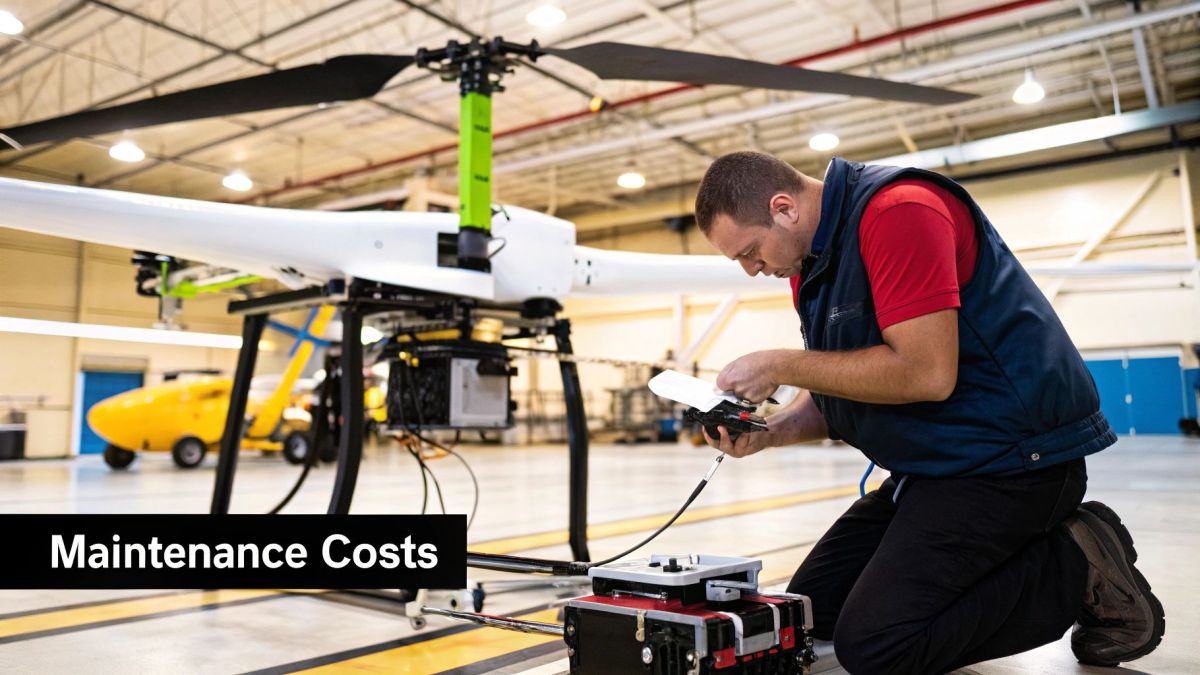
What Kind of Maintenance Do These Drones Require?
For a heavy-lift drone, consistent and meticulous maintenance isn't just a suggestion—it's essential for keeping it safe and reliable. This all starts with simple pre-flight and post-flight checks of the propellers, motors, frame, and batteries.
On top of the daily once-over, there’s a regular maintenance schedule to follow. This typically includes:
- Keeping the drone’s firmware up to date.
- Calibrating the onboard sensors to ensure they're accurate.
- Giving the airframe a thorough inspection for any stress fractures or general wear and tear.
Your manufacturer will provide a detailed service schedule based on flight hours. And if you're operating commercially, keeping detailed maintenance logs isn't just smart—it's a regulatory requirement to prove you’re running a safe and accountable operation.
At Innoflight International, we specialise in designing and manufacturing advanced heavy lift drone solutions tailored to Australian conditions. Our expert team can help you navigate the entire process, from defining your mission to selecting the right platform and ensuring regulatory compliance. Explore our robust and reliable aerial systems at Innoflight Technology.