Ever seen a drone that takes off like a helicopter but then shoots forward like a plane? That's the magic of a tilt-rotor system. This clever design gives a single drone the best of both worlds, blending two completely different flight styles into one incredibly versatile machine.
The Best of Both Worlds: A Hybrid Drone Design
A tilt-rotor drone is essentially a hybrid aircraft for the skies. It masterfully combines the vertical agility of a helicopter with the long-distance efficiency of an aeroplane, creating a platform that neatly sidesteps the biggest weaknesses of both traditional designs.
To really get why this matters, let's look at the two standard options. You've got your traditional quadcopters and other similar platforms, which are brilliant at vertical flight. They can pop up from a tiny clearing, land on a ship's deck, and hover dead-still for close-up inspections. The catch? They chew through battery power, which means shorter flight times and a limited range. We cover the basics of these designs in our detailed guide on the multi-rotor drone.
Then you have fixed-wing drones. These are the marathon runners of the drone world, built for speed and endurance. Just like an aeroplane, their wings generate lift, letting them cruise over huge distances with impressive efficiency. The downside is they need a runway or a catapult to get going and a decent amount of clear space to land, which just isn't practical for many Australian job sites with rough terrain or tight spaces.
A tilt-rotor drone simply refuses to choose. It uses its rotors to lift straight up like a helicopter, and then, once it's in the air, it physically tilts them forward to become propellers, transitioning into fast, efficient, plane-like flight.
This dual capability is what makes the technology such a game-changer. It unlocks a level of operational freedom that was once impossible with a single drone. You get:
- Vertical Takeoff and Landing (VTOL): The power to operate anywhere, no runway needed.
- High-Speed Forward Flight: The ability to cover large areas quickly and efficiently.
- Extended Endurance: The capacity to fly far longer and further than a standard multi-rotor.
- Operational Versatility: The flexibility to handle jobs in both tight spots and wide-open country.
This hybrid approach really is a massive leap forward, paving the way for far more complex and demanding aerial work.
How Tilt Rotor Drones Master Flight
The real magic of a drone tilt rotor is how seamlessly it switches between hovering like a helicopter and flying like an aeroplane. Imagine a swimmer treading water—their arms push down to stay afloat. To move forward, they change to a powerful freestyle stroke. A tilt-rotor drone pulls off a very similar trick, but with powerful rotors and wings.
It all starts with the rotors pointed straight up, exactly like a standard multirotor drone. In this mode, they generate pure vertical lift, pushing the aircraft straight off the ground. No runway needed. This is the VTOL (Vertical Takeoff and Landing) phase, and it’s what makes them perfect for launching from tight spots like a small clearing, the back of a ute, or a ship's deck.
Once airborne and at a safe height, the flight controller kicks off the transition. The engine pods, which are called nacelles, start to smoothly tilt forward. As they pivot, the thrust they produce changes from purely vertical to a mix of upward lift and forward push.
The Transition to Forward Flight
This transition is a delicate dance, all managed by sophisticated onboard computers. As the rotors tilt more and more, the drone's wings start to generate their own aerodynamic lift—just like a traditional plane. The flight controller has to perfectly balance the decreasing vertical thrust from the rotors with the increasing lift from the wings to keep everything stable and smooth.
When the rotors are fully horizontal, the drone is officially in its fixed-wing mode. Now, the rotors act like propellers, pulling the aircraft through the air, while the wings handle almost all the work of keeping it aloft. This is where tilt-rotors really come into their own, hitting high speeds and covering huge distances that a typical multirotor could only dream of.
This infographic breaks down the simple, yet brilliant, flight sequence of a tilt-rotor drone, from takeoff to cruising.
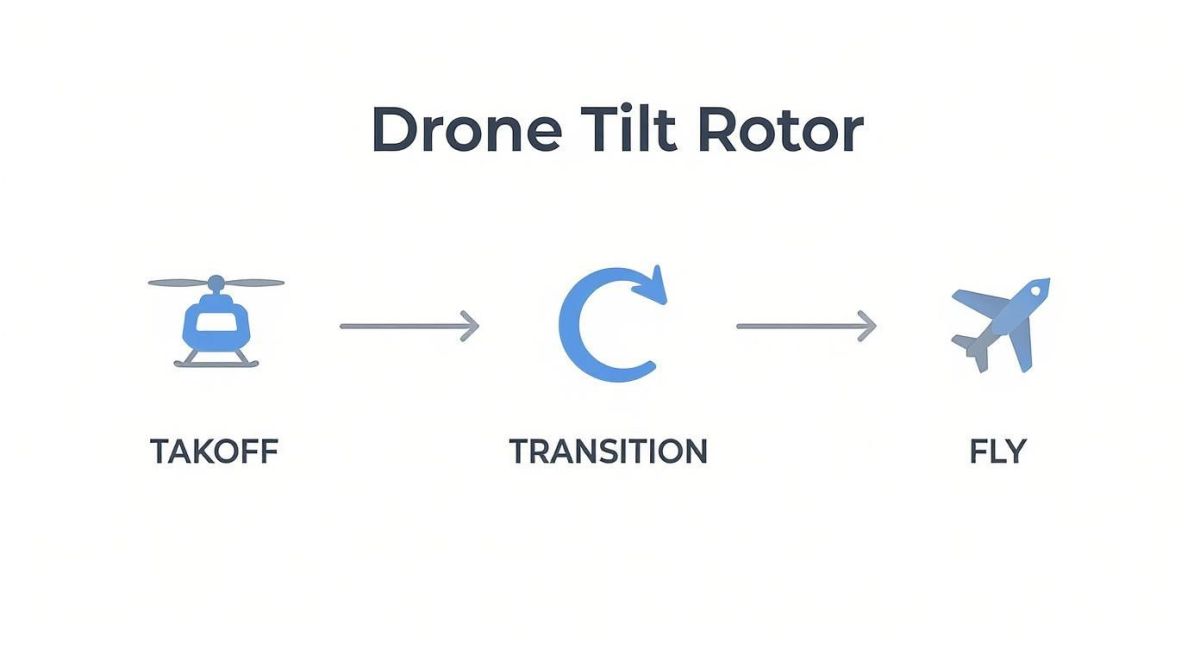
As you can see, the aircraft cleverly uses two completely different flight principles—the brute force of vertical lift and the efficiency of aerodynamics—all in a single mission.
This flexibility makes them incredibly useful, and it's easy to see why they're becoming so popular across different industries. Here's a quick comparison to put their unique capabilities into perspective.
Comparing Drone Flight Capabilities
| Feature | Multirotor Drone | Fixed-Wing Drone | Tilt Rotor Drone |
|---|---|---|---|
| Takeoff/Landing | Vertical (VTOL) – needs minimal space. | Runway needed – requires a long, clear strip. | Vertical (VTOL) – combines the best of both. |
| Hovering | Excellent – can stay stationary for detailed inspection. | Not possible – must always be in forward motion. | Excellent – can hover with precision like a multirotor. |
| Speed & Range | Limited – best for shorter, localised missions. | Excellent – flies fast and covers vast distances. | Excellent – achieves fixed-wing speed and range. |
| Energy Efficiency | Lower in forward flight – high power drain. | High – glides efficiently once at altitude. | High in forward flight, lower during hover. |
| Best For | Inspections, photography, tight-space operations. | Mapping large areas, long-range surveillance. | Missions needing both inspection and broad coverage. |
The table really highlights how tilt-rotors bridge the gap, offering a "no compromises" solution for complex jobs.
Powering Australian Operations
This operational advantage is stirring up a lot of interest right here at home. Australia's drone market is growing fast; it was valued at USD 0.28 billion and is expected to hit USD 3.06 billion by 2034. In this booming market, tilt-rotor designs are standing out as a key innovation, finding their place in Aussie operations thanks to their fantastic manoeuvrability and extended range. You can dig into more details by checking out the Australian drone market growth on expertmarketresearch.com.
The ability to switch between hover and high-speed flight isn't just a technical feature; it's an operational super-power. It means one aircraft can perform close-up inspections and then immediately transition to a wide-area survey without ever needing to land.
When it's time to come home, the process simply reverses. The nacelles tilt back up, slowing the drone's forward speed while re-engaging the rotors for vertical lift. This allows for a gentle, precise landing right back in the same small space it launched from, wrapping up its mission with incredible versatility.
The Strategic Advantages of Tilt Rotor Drones

So, what makes a drone tilt rotor a better choice than a more conventional design? The answer really comes down to a powerful mix of efficiency, speed, and operational freedom that offers a real return on your investment. These drones aren’t just versatile; they're genuine strategic assets that solve critical, real-world problems.
The biggest win is a massive leap in range and endurance. Your average multirotor drone might give you 30-40 minutes in the air, which really limits how far you can go. A tilt rotor, on the other hand, can switch to fixed-wing flight and stay airborne for over two hours, sometimes even longer.
This extended airtime opens up missions that would otherwise be impossible or require a frustrating cycle of multiple flights and battery swaps. Think about inspecting a remote gas pipeline stretching for kilometres across the Australian outback. A tilt rotor can cover the entire line in one go, saving time, money, and manpower.
Speed and Coverage
Another major benefit is raw speed. Once a tilt rotor transitions into its aeroplane mode, it flies much faster than a multirotor, which is constantly battling gravity to move forward. A tilt rotor can easily push past 100 km/h, letting it cover huge areas in a fraction of the time.
This speed is a game-changer for industries where every minute counts:
- Agriculture: A single drone can survey thousands of hectares of crops for health checks in just one morning.
- Mining: Operators can quickly map large open-cut pits or tailings dams without getting in the way of work on the ground.
- Emergency Services: During a bushfire or flood, a fast-moving drone can provide live situational awareness across a wide disaster zone.
A tilt rotor drone eliminates the compromise between precision hovering and long-range efficiency. It delivers both, allowing one aircraft to handle complex missions that would previously require two different types of drones.
Unmatched Operational Flexibility
Finally, the ability to take off and land vertically without a runway gives you incredible flexibility. A tilt rotor drone can be launched from almost anywhere – a tight spot on a construction site, the deck of a small research boat at sea, or a rough patch of ground in a remote mountain range.
This gets rid of the logistical headache of finding a suitable launch and recovery spot, which is a common pain point for traditional fixed-wing drones. For a marine biologist studying coastal erosion or a geologist surveying inaccessible terrain, this flexibility isn't just a nice-to-have; it's what makes the entire mission possible.
This unique combination of endurance, speed, and VTOL capability builds a strong business case. A tilt rotor drone is a powerful tool designed to overcome the limits of distance and terrain, making it a perfect fit for Australia’s demanding industrial landscapes.
Real-World Tilt Rotor Applications in Australia
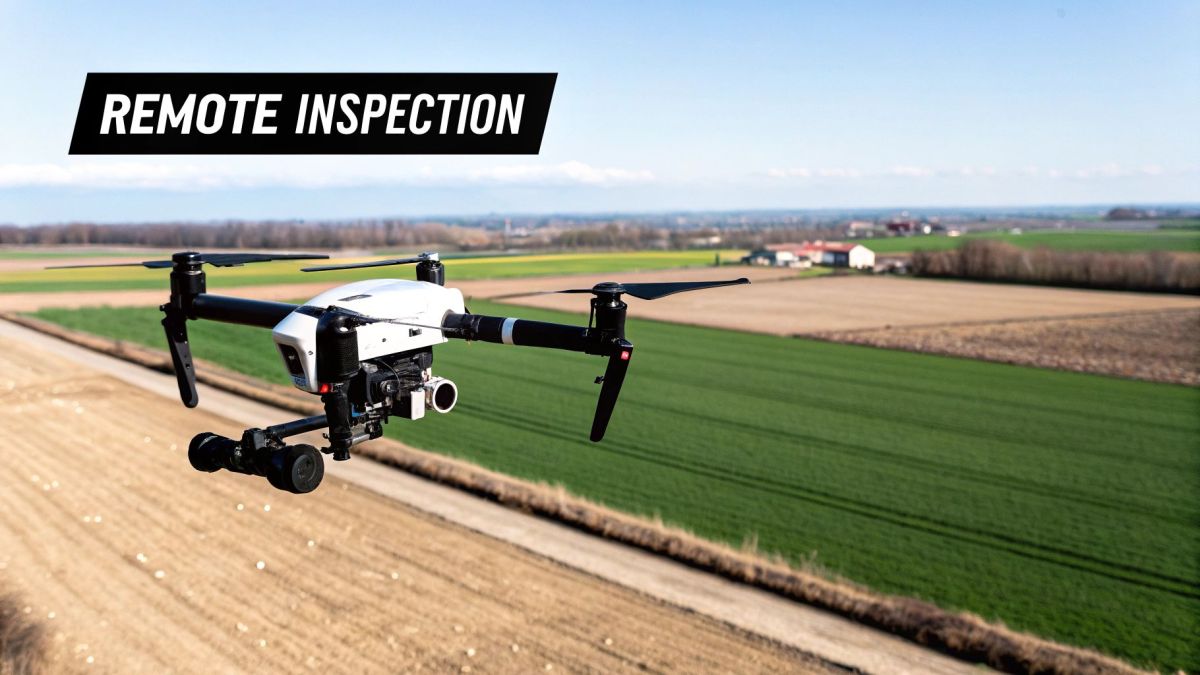
The real genius of a drone tilt rotor isn't just about the clever engineering; it's about the problems it solves out in the real world. Across Australia's vast and often unforgiving landscapes, this technology is already making a huge difference for industries that need to cover massive distances and work in tough spots.
From the sprawling wheat fields of Western Australia to the remote mine sites of the Pilbara, tilt rotor drones are proving their mettle. It’s their unique blend of on-the-spot vertical takeoff and long-distance, high-speed flight that makes them a perfect fit for Australia’s unique challenges.
Powering Modern Agriculture
Think about trying to manage a cattle station that’s bigger than a small European country. For years, checking fences, monitoring water troughs, or getting a read on pasture health meant endless hours in a ute or chartering an expensive helicopter. A tilt rotor drone completely flips that script.
It can lift off right beside the homestead, flick its rotors forward for a fast flight over hundreds of hectares, then switch back to hover mode for a detailed look at a single dam or a mob of cattle. Farmers get a clear picture of their entire property far more often and without the massive cost.
- Crop Health Monitoring: Quickly scanning huge broadacre farms to pinpoint areas that need water or fertiliser.
- Livestock Management: Counting stock and checking animal welfare across vast pastoral leases.
- Infrastructure Checks: Inspecting far-flung fences, gates, and water points without spending a day behind the wheel.
Enhancing Mining and Resources
In mining, nothing is more important than safety and efficiency. Surveying a massive open-cut pit or a tailings dam is traditionally a risky and slow process. With a tilt rotor, you can launch from a safe distance, map the entire site with incredible accuracy, and land back where you started without ever disrupting operations.
This is fundamentally changing how mine sites are run. The drone can gather data to calculate stockpile volumes, keep an eye on pit wall stability, or help plan haul roads. It delivers vital information that keeps the site running smoothly and, most importantly, safely. This kind of work is a huge part of why drone use is booming in Australia.
The commercial drone industry in Australia is set for massive growth, with flights expected to jump by 20% each year for the next two decades. Mining alone is forecast to make up almost half a million drone flights annually, showing just how deeply this tech is becoming embedded in the sector.
Supporting Emergency Services
When disaster hits, every second counts. Whether it's a bushfire, flood, or a search and rescue mission, emergency services need eyes in the sky, and they need them fast. A drone tilt rotor is the perfect tool for the job.
It can be deployed in minutes from a small clearing, fly at speed to the incident area, and then hover to provide a rock-steady, live video feed back to the command centre. Its long flight time means it can stay on-station for hours, tracking a fire front or searching for a missing person over rugged country where ground crews simply can't go. This hybrid flight ability is what makes it so effective for a wide range of commercial drone uses.
Overcoming the Hurdles of Tilt Rotor Adoption
While the benefits of a drone tilt rotor are compelling, bringing this technology into your workflow isn't without its challenges. Understanding these potential hurdles from the get-go is the key to making a smart investment and ensuring these advanced aircraft become a genuine asset to your operations.
The first thing you'll notice is the price. Tilt rotor drones are sophisticated pieces of engineering, essentially merging two different types of aircraft into a single, seamless system. All that clever design and mechanical complexity means they naturally cost more upfront than a standard multirotor or fixed-wing drone.
But it’s important to look past the initial price tag and consider the bigger picture. A single tilt rotor can often do the job that would otherwise require two separate drones, which means fewer aircraft to manage, fewer batteries to charge, and a smaller support team on the ground.
Mechanical Complexity and Maintenance
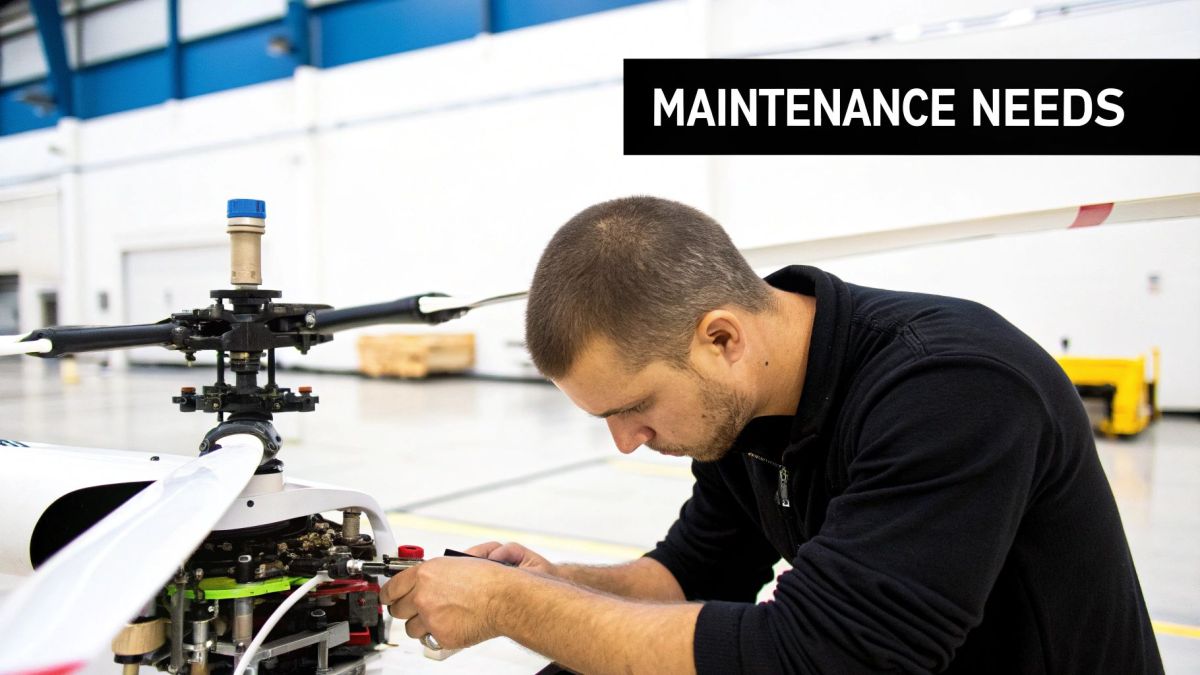
The very thing that makes tilt rotors so versatile—their ability to pivot their rotors—also makes them more demanding to maintain. Those transition mechanisms are precision-engineered and need a specific maintenance schedule carried out by technicians who know exactly what they're looking at.
It's a step up from the maintenance needs of a simple quadcopter, which has far fewer moving parts. Any organisation looking to invest should budget for specialised, ongoing support to keep their fleet flying safely and reliably for years to come.
Adopting tilt rotor technology is less about buying a product and more about investing in a capability. It requires a clear-eyed view of the commitment to training, maintenance, and regulatory navigation needed to unlock its full potential.
Regulatory and Training Hurdles
In Australia, the rules for flying advanced uncrewed aerial vehicles (UAVs) are always being refined. Operating a complex machine like a drone tilt rotor typically requires a higher level of certification and more detailed operational approvals from the Civil Aviation Safety Authority (CASA).
On top of that, pilots need specialised training. Mastering the unique flight envelope of a tilt rotor, especially that critical moment when it switches from vertical lift to forward flight, is a skill all its own. It's a far cry from standard drone piloting, demanding a much deeper grasp of the aircraft’s systems and what to do if things go wrong.
The main hurdles can be broken down like this:
- Higher Upfront Costs: The advanced engineering makes the initial purchase a significant investment compared to standard drones.
- Specialised Maintenance: The mechanical intricacy calls for expert servicing and a solid maintenance plan.
- Pilot Training: Operators must complete advanced training to safely handle the unique transition flight modes.
- Evolving Regulations: Keeping up with Australian aviation rules for advanced UAVs can be a complex task.
The global market for tilt-rotor aircraft is expected to grow substantially, hitting a projected USD 5.72 billion by 2032. Still, this growth is held back by the high costs of manufacturing and operation, which are major barriers, particularly for civilian use where every dollar counts. You can read a more detailed breakdown of the tilt-rotor aircraft market challenges at consegicbusinessintelligence.com.
By facing these factors head-on, any organisation can create a realistic and successful plan for bringing this powerful technology on board.
So, Are Hybrid Drones the Future?
For a long time, the drone world was a story of trade-offs. You either got a helicopter's ability to hover and land anywhere, or a fixed-wing plane's speed and endurance. You couldn't have both. That's precisely why the drone tilt-rotor is such a big deal—it breaks down that barrier, blending two very different flight styles into one incredibly capable machine.
This isn't just a minor tweak; it's where the entire industry is headed. The next wave of innovation will only build on this foundation. Think about missions that last for hours, not minutes, thanks to better battery tech. Or drones that can handle complex jobs entirely on their own, guided by smarter AI. We're also bound to see smaller, more agile tilt-rotors that can get into tight spots and do things we haven't even thought of yet.
Tilt-rotor technology is more than just another step forward. It's a fundamental change that positions hybrid drones as the go-to tool for the future of aerial logistics, remote sensing, and a whole host of critical jobs.
These hybrid aircraft are already demonstrating their value right here in Australia. They’re not just a futuristic concept; they're solving real problems today in everything from emergency services to broadacre farming. And we're only just scratching the surface.
To see what this technology looks like in action, check out platforms like the ScanLift 800 Hybrid. It’s a perfect example of how this innovative design is already making a huge impact in the real world.
Frequently Asked Questions
Even after seeing all the benefits, it's natural for organisations to have a few practical questions before bringing in advanced gear like a tilt-rotor drone. Let's tackle the most common ones head-on, so you can feel confident about your decision.
How Much More Do Tilt-Rotor Drones Cost?
Let's be upfront: a tilt-rotor drone does cost more to buy than a standard multirotor or fixed-wing model. There's a lot of clever engineering packed in there—the complex mechanics for the tilting motors and the advanced flight control systems simply cost more to build.
But the sticker price doesn't tell the whole story. The real value shows up when you look at what you get. One tilt-rotor can often do the job of two separate drones, like one for close-up hovering inspections and another for long-distance mapping. This means you have fewer aircraft to maintain, fewer batteries to juggle, and you might even be able to run with a smaller team in the field.
When you think about it, the ability to tackle more complex missions with a single, flexible platform makes the return on investment look a lot better than the initial purchase price might suggest.
Is Flying a Tilt-Rotor Drone More Difficult?
Yes, it does take more skill to fly a tilt-rotor than your average quadcopter. The pilot needs to be comfortable with both multirotor and fixed-wing flying, but the real test is mastering the transition between the two.
This is the moment when the aircraft’s behaviour completely changes, all managed by a very smart autopilot. Proper training is essential to make sure pilots understand what the system is doing, know how to take over manually if they have to, and can handle any curveballs mid-flight. Any good manufacturer will offer solid training programs to get operators up to speed, ensuring they can fly safely and effectively.
What Are the Main Safety Features to Look For?
Safety is non-negotiable, especially with aircraft this capable. When you're looking at a professional drone tilt-rotor, there are a few key safety features you should insist on:
- Redundant Systems: Look for backups on all the important stuff, like flight controllers, GPS units, and power systems. If one part has a problem, another one is ready to step in.
- Automated Failsafes: The drone absolutely needs a reliable return-to-home (RTH) function that kicks in automatically if the battery gets low, the signal is lost, or another issue pops up.
- Emergency Parachute Systems: Some top-tier models come with an integrated parachute. In a worst-case scenario, it can be deployed to bring the drone down safely.
- Advanced Obstacle Avoidance: Good sensors that can spot and steer clear of obstacles are a must-have for working in cluttered or tricky environments.
These features create layers of protection, not only for the people on the ground but for your investment in the drone itself.
At Innoflight International, we specialise in providing advanced, reliable aerial solutions that meet the demanding needs of Australian industries. Explore our range of high-performance drones and discover how they can transform your operations.