At its heart, a multi-rotor drone is an aircraft that uses several propellers to lift itself off the ground. This setup is what allows it to take off vertically, hover perfectly still, and zip around in any direction with incredible agility.
Think of it like a hummingbird. It can just hang there in mid-air, then dart off in a flash. This core design is the secret behind almost every drone you see today, from the small ones people fly for fun to the heavy-duty rigs used for professional filmmaking.
How a Multi-Rotor Drone Actually Flies
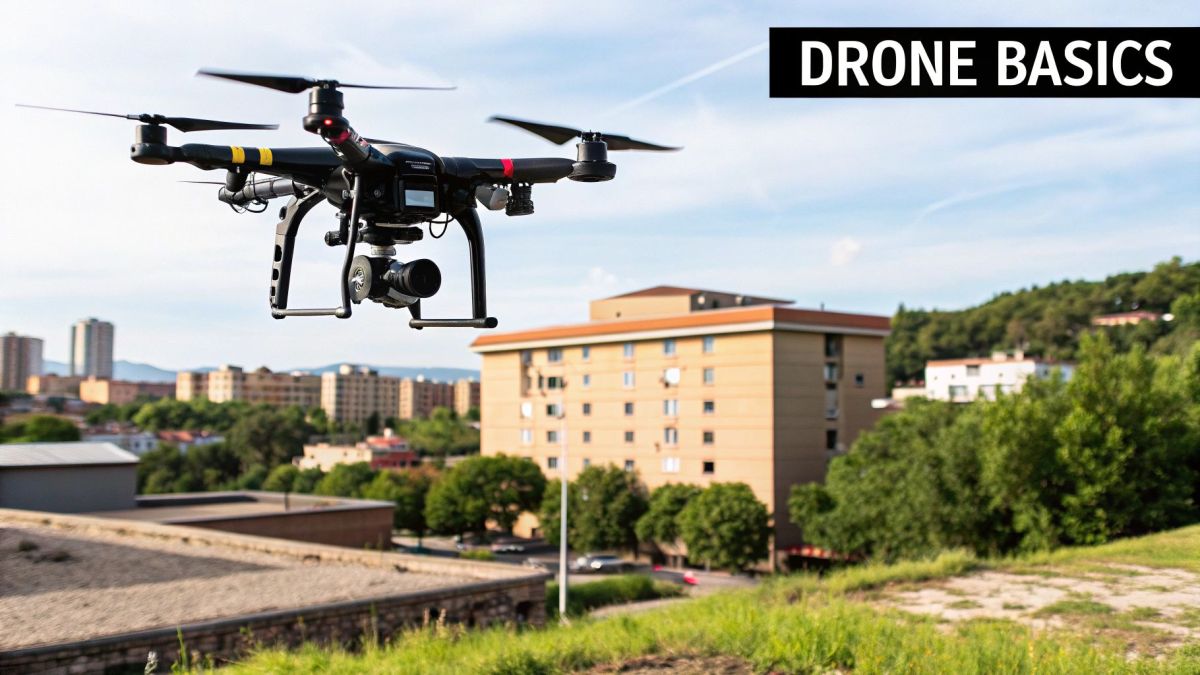
The way a multi-rotor drone gets airborne isn't magic; it's just clever physics at work. The main principle is something called Vertical Take-Off and Landing (VTOL). Unlike a plane that needs a long runway, a drone can go straight up and come straight down, which is why they’re so useful in tight spots.
This is all thanks to its propellers working together. Each motor spins a propeller, acting like a small, powerful fan pushing air down. Newton’s Third Law tells us that for every action, there's an equal and opposite reaction. So, as the rotors push air down, an upward force called lift is created. When that combined lift is stronger than the drone's own weight, it starts to climb.
Achieving Stability and Control
Just getting off the ground is one thing, but staying stable is the real trick. The drone’s "brain," its flight controller, is constantly making tiny adjustments to the speed of each motor, thousands of times a second. This is the key to its impressive stability.
-
To Hover: The flight controller tunes the speed of all motors so the upward lift perfectly cancels out the downward pull of gravity. The result? The drone hangs in the air as if it's weightless.
-
To Move Forward: To fly forwards, the motors at the back spin a little faster than the ones at the front. This tilts the whole drone forward, directing some of that vertical lift backwards and pushing the aircraft ahead. The same logic applies for moving in any other direction.
-
To Turn (Yaw): On a standard quadcopter, two motors spin clockwise and two spin counter-clockwise. To turn left on the spot, the clockwise motors speed up while the counter-clockwise ones slow down, causing the drone to rotate without tilting at all.
A multi-rotor drone’s flight controller is a powerhouse, processing data from gyroscopes and accelerometers hundreds of times per second. This lets it instantly react to a gust of wind or a slight imbalance, giving the illusion of a smooth, effortless flight.
The Power Behind the Rotors
The technology that makes this all possible is closely linked to the broader field of E-Mobility. Drones rely on highly efficient electric motors and powerful, lightweight lithium-polymer (LiPo) batteries. This combination delivers the instant bursts of power needed for those rapid rotor speed changes, making the drone incredibly responsive and mechanically much simpler than a traditional helicopter.
This elegant design has fuelled massive growth in the drone industry. In 2023, the global market for these aircraft was valued at a staggering USD 4.65 billion and is only expected to grow. This boom is a direct result of their unique ability to blend precise hovering with dynamic, agile movement, opening the door to countless new uses. You can read more about the versatility of multi-rotor drones right here on our site.
Decoding Different Drone Configurations
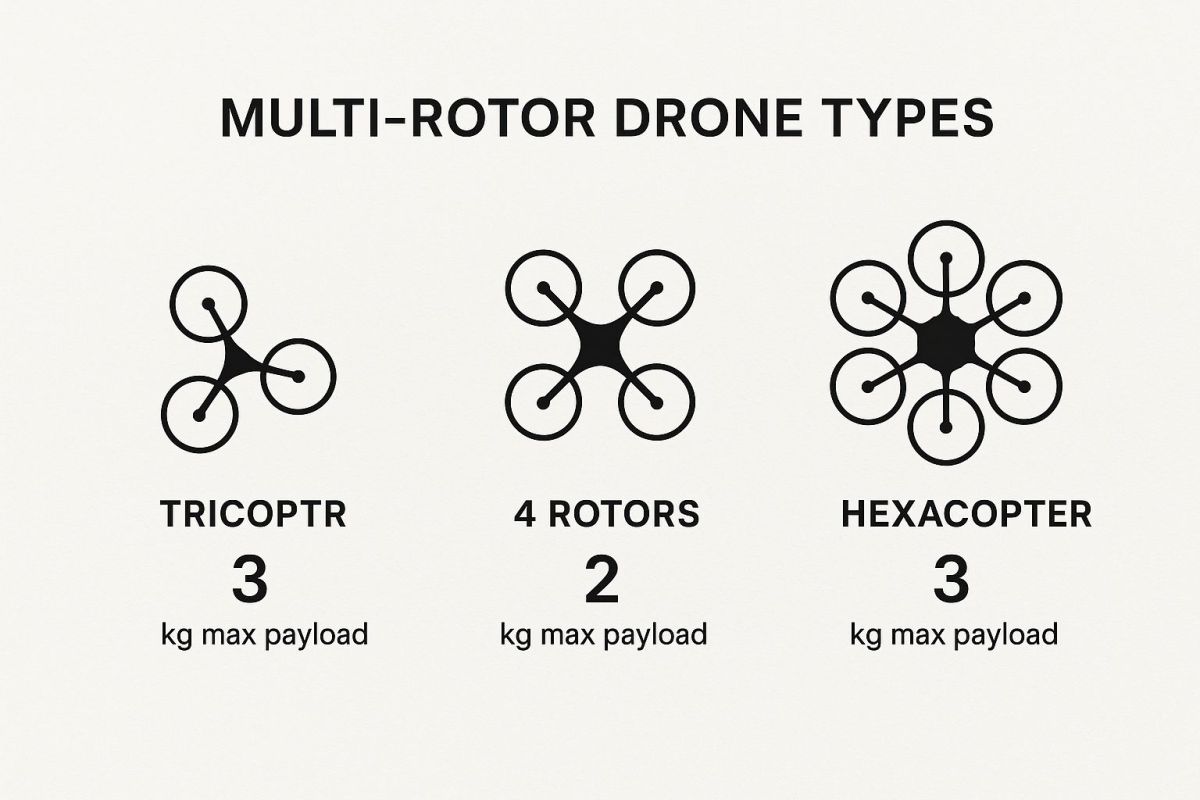
The term multi-rotor drone actually covers a whole family of aircraft. Think of it like cars – you have zippy sports cars, reliable family sedans, and heavy-duty trucks. They all have wheels and an engine, but the number of wheels and the power of the engine dictate what they're built for. It's the same with drones; the number of rotors completely changes how they perform, how stable they are, and how much they can carry.
Your classic, everyday drone is the quadcopter. With four rotors, usually in an 'X' or '+' pattern, it hits a sweet spot between simplicity, agility, and cost. This design is the true workhorse of the drone world, loved by hobbyists and professional photographers alike. Its straightforward mechanics make it dependable and relatively easy to fix, offering a brilliant blend of performance for most jobs.
But what happens when the mission needs more muscle or an extra layer of safety? That's when we start adding more rotors.
The Power of More Rotors
Enter the Quadcopter. As the name gives away, it has six rotors. This jump from four to six immediately brings two massive advantages: more lifting power and better stability. With six points of thrust pushing it up, a Quadcopter can comfortably carry heavier gear, like professional cinema cameras or specialised sensor packs for mapping and surveying.
Those extra rotors also bring something called redundancy, which is a huge deal for professional operators. If a motor fails on a quadcopter, it's coming down. But on a Quadcopter, the flight controller is smart enough to compensate for a single failed motor by adjusting the speed of the other five, allowing the pilot to land it safely. This makes them a much more reliable choice when you’ve got expensive equipment in the air.
Maximum Lift and Ultimate Stability
Taking things a step further, the octocopter rocks eight rotors. These are the heavy-lifters, the absolute powerhouses of the multi-rotor world, built for the most demanding commercial jobs. Their main strengths are massive payload capacity and incredible stability, even when the wind picks up. The eight rotors create a super-steady platform, which is perfect for capturing silky-smooth cinematic video or operating high-precision LiDAR scanners.
Just like Quadcopters, octocopters have excellent redundancy. An octocopter can usually lose one—sometimes even two—motors and still make it back home safely. When your drone is carrying a payload worth tens of thousands of dollars, that kind of reliability isn't just a nice-to-have; it's essential.
Choosing the right configuration is all about balancing these trade-offs. More rotors give you more lift and safety, but they also chew through battery life much faster. This often means shorter flight times compared to a quadcopter with the same battery pack.
So, why would a filmmaker choose an octocopter with a shorter flight time to carry a heavy camera? It all comes down to risk management. The rock-solid stability ensures they get the perfect shot, and the redundancy gives them peace of mind that a simple motor fault won't destroy a very expensive camera. On the flip side, a real estate agent just needs a nimble quadcopter to grab some great aerial photos of a house. Different tools for different jobs.
To make it easier to see the differences at a glance, here’s a quick comparison of the most common setups.
Comparing Common Multi Rotor Drone Configurations
| Configuration Type | Number of Rotors | Key Advantages | Common Disadvantages | Best Use Cases |
|---|---|---|---|---|
| Quadcopter | 4 | Agile, simple mechanics, cost-effective, widely available. | No motor redundancy; if one fails, it will crash. Limited payload. | Aerial photography, hobby flying, basic inspections, real estate. |
| Quadcopter | 6 | Increased stability, higher payload capacity, can survive a single motor failure. | More complex, higher cost, slightly shorter flight times than a quad. | Professional filmmaking, carrying survey equipment, industrial inspections. |
| Octocopter | 8 | Maximum stability and lift, excellent redundancy (can often survive two motor failures). | Most expensive, complex, and has the shortest flight times due to high power draw. | High-end cinematography, heavy-lift logistics, carrying LiDAR or hyperspectral sensors. |
Ultimately, by understanding these core differences, you can look at any multi-rotor drone and get a pretty good idea of what it was built for, what it's capable of, and the specific choices its designers made to create the perfect tool for a particular task.
The Key Components That Power Your Drone
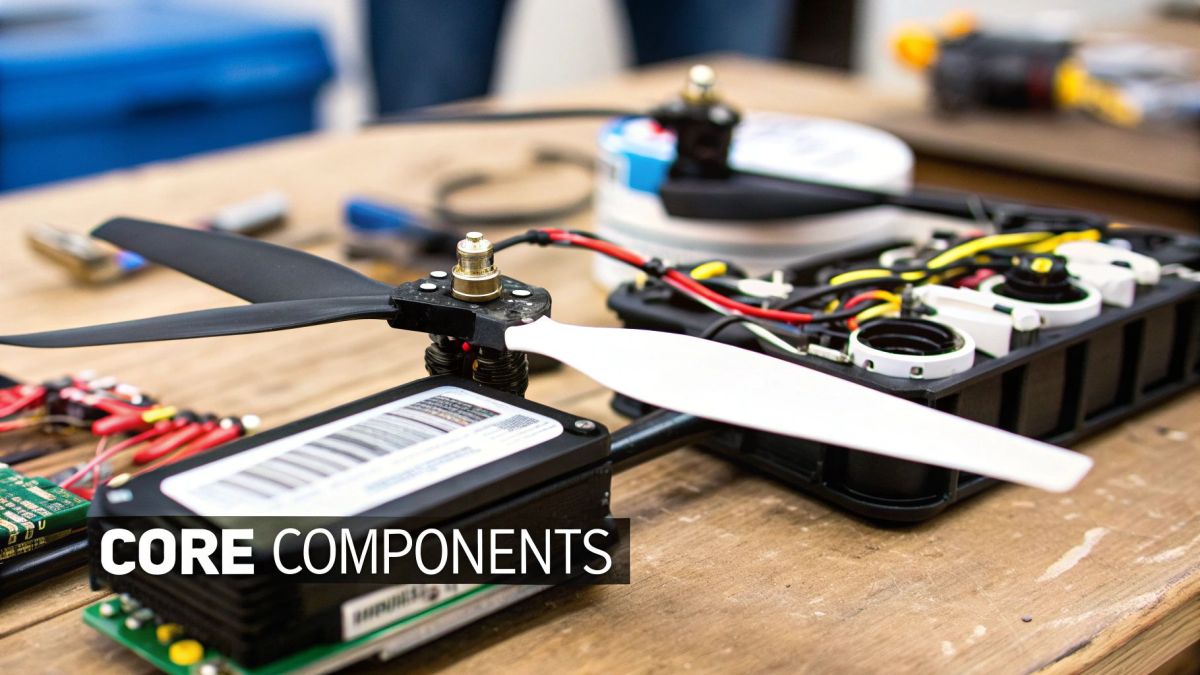
A multi-rotor drone is an incredible piece of engineering, a complex system where every single part plays a crucial role. Getting to know its anatomy isn't just for hobbyists; it helps you appreciate the tech and makes you a much smarter owner when it comes time for maintenance or troubleshooting. Let's lift the bonnet and see how all these pieces work together to give us stable, controlled flight.
It helps to think of a drone like a living thing. It has a skeleton for structure, muscles to create movement, a nervous system to send signals, and a brain to make all the important decisions. Each part has to communicate and work in perfect harmony with the rest.
The Brain and Nervous System
Right at the heart of the drone, you'll find the flight controller (FC). This is the drone's brain—a small circuit board packed with processors and sensors. It takes your commands from the remote control and instantly combines them with real-time data from its onboard sensors to manage every tiny detail of the flight.
The FC relies on a whole suite of sensors that act as its nervous system, constantly feeding it information about its position and movement. The most important of these are:
- Gyroscope: This clever device measures the drone's rate of rotation on all three axes: pitch, roll, and yaw. It tells the FC how fast the drone is tilting or turning, letting it make split-second corrections to stay level.
- Accelerometer: This sensor measures linear acceleration. It helps the FC figure out which way is down (thanks to gravity) and detects changes in speed, which is vital for overall stability.
- GPS Module: This gives the drone its sense of place in the world. By picking up signals from satellites, it enables awesome features like position hold (hovering perfectly in one spot) and return-to-home functions.
The real magic is how these components work together. The flight controller is processing sensor data hundreds of times a second, firing off precise instructions to the motors to fight a sudden gust of wind before the pilot even feels it.
The Skeleton and Muscles
The physical structure holding it all together is the frame. This is the drone’s skeleton, and it needs to be both incredibly light and extremely rigid. Frames are typically made from materials like carbon fibre or tough plastics to provide a strong, vibration-resistant platform for everything else.
The "muscles" of a multi-rotor drone are its brushless motors. These powerful electric motors are what spin the propellers with incredible force. They're paired with Electronic Speed Controllers (ESCs), which you can think of as each motor's individual manager. The ESCs get the signal from the flight controller and translate it into the exact amount of power each motor needs, allowing for the lightning-fast speed changes required for stable flight.
Finally, you have the propellers—the blades that actually bite into the air. Their shape, size, and pitch are all carefully designed to generate the most thrust as efficiently as possible.
Powering the Entire System
Of course, none of this would work without juice. The lithium-polymer (LiPo) battery is the drone’s heart, pumping energy to every single component. LiPo batteries are popular because of their high energy density, meaning they pack a lot of power into a small, lightweight package. This is absolutely essential for keeping the drone's total weight down.
The battery doesn't just power the motors; it runs the flight controller, sensors, receiver, and any payload you've attached, like a camera. Its capacity, measured in milliamp-hours (mAh), is the biggest factor in your drone's flight time. A bigger battery means longer flights, but it also adds weight, which makes the motors work harder.
It’s this delicate balancing act between power, weight, and component efficiency that engineers are always trying to perfect. Every part, from the frame material to the propeller design, is chosen to create a finely tuned system capable of amazing aerial feats.
How Multi-Rotor Drones Are Changing Industries
The real magic of a multi-rotor drone isn’t just that it can fly; it’s the real-world problems it solves. Once you look past the technical specs, you find these agile aircraft are becoming essential tools in a whole lot of industries. They're fundamentally changing how we work by making jobs safer, boosting efficiency, and opening doors to things we couldn't do before.
From massive farms to towering wind turbines, these drones are creating big shifts in how businesses operate. What used to demand dangerous manual labour or expensive helicopters can now be done faster, more safely, and with incredible precision.
Revolutionising Agriculture and Land Management
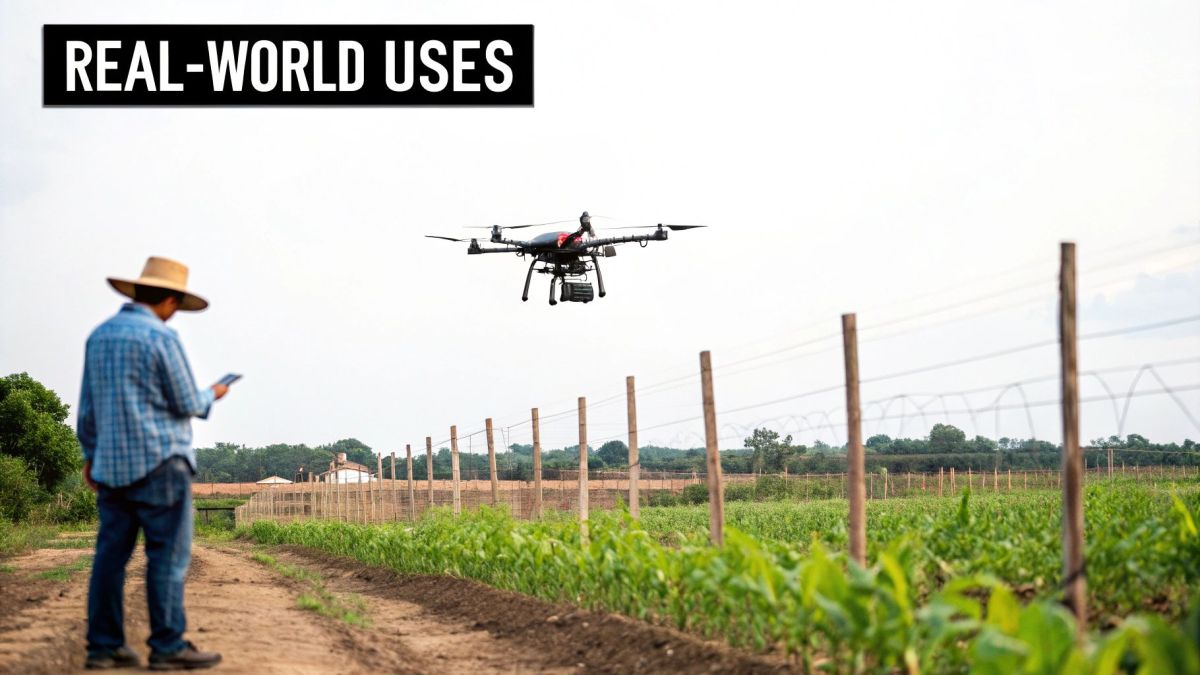
Modern farming is all about precision, and multi-rotor drones are a star player. Picture this: a farmer needs to check on a 500-acre crop. Instead of spending days walking the fields, a drone with a multispectral sensor can cover the whole area in one morning and build a detailed health map.
This isn't just a pretty picture; it's data you can act on. The map can pinpoint specific areas where crops are stressed, thirsty, or fighting off pests, often long before a person would notice. This means the farmer can apply water, fertiliser, or pesticides only where needed, saving a fortune in resources and boosting the final yield. The stable hover of a multi-rotor is perfect for this kind of detailed work. To see how this works in practice, you can explore our detailed guide on precision agriculture with drones.
This tech isn’t just for farms, either. It’s also a game-changer for forestry and environmental monitoring. Conservation teams use drones to:
- Track wildlife populations without disturbing their habitats.
- Monitor deforestation by creating detailed 3D maps of forest canopies.
- Assess bushfire damage quickly and safely, giving recovery teams the crucial data they need.
Making Infrastructure Inspection Safer and Smarter
Inspecting things like bridges, power lines, and wind turbines has always been a high-risk job. It used to involve rope access teams, costly scaffolding, or helicopters—all slow, expensive, and genuinely dangerous for the people involved.
Multi-rotor drones have completely flipped the script. Now, an engineer can stand safely on the ground and pilot a drone to get up-close, high-resolution images of a bridge’s support beams or a wind turbine’s blades. The drone can hover in place, get into tight angles, and capture detail that would be impossible to see otherwise. It doesn't just keep people out of harm's way; it can slash inspection times from days down to a few hours.
By using drones for asset inspections, companies can reduce physical risk to employees by over 90% in many scenarios. This shift isn't just about saving money; it's about fundamentally improving workplace safety.
This technology is also vital for managing long stretches of infrastructure. Utility companies can patrol hundreds of kilometres of power lines or pipelines far more efficiently than ground crews, using thermal sensors to spot potential faults before they cause an outage.
Transforming Media and Construction
In the world of filmmaking, multi-rotor drones have unlocked creative shots that were once reserved for Hollywood-sized budgets. Smooth, sweeping aerial footage has become a staple for everything from independent films to real estate marketing. The bigger Quadcopters and octocopters provide the stability and muscle needed to carry professional cinema cameras, delivering absolutely breathtaking visuals.
It's a similar story on construction sites, where drones give project managers an invaluable bird's-eye view. Regular flights can generate highly accurate 3D models and maps of a site, letting teams:
- Track progress against blueprints with millimetre-level accuracy.
- Calculate stockpile volumes of materials like sand and gravel.
- Improve site safety by spotting potential hazards from the air.
The growth in these fields is driving huge market expansion. In 2024, the Australian drones market was valued at around USD 0.28 billion, with multi-rotor drones making up the biggest slice of the pie thanks to their versatility. The market is projected to grow at an impressive 27% CAGR between 2025 and 2034, showing just how deeply they're becoming part of core industrial work. Discover more insights about the Australian drones market on expertmarketresearch.com. As these platforms get even more capable, their role is only going to expand.
Choosing the Right Multi-Rotor Drone
With so many models on the market, picking the right multi-rotor drone can feel overwhelming. The secret isn't finding the "best" drone, but the best one for your job. The perfect rig for a filmmaker is worlds away from what a farmer or an infrastructure inspector needs.
Before you even start browsing specs, the most critical step is to nail down your mission. What, exactly, do you need this drone to accomplish? Answering that question honestly will instantly cut through the noise and point you toward the features that actually matter.
Start With Your Primary Goal
Are you trying to capture breathtaking cinematic footage, run a high-precision survey, or just get a quick eye in the sky over a property? Your goal really does dictate everything that follows. A professional photographer needs a rock-steady platform with a top-tier camera, while someone in industrial inspections might put thermal imaging and ruggedness at the top of their list.
Think about the results you need. Having that clarity acts like a compass, guiding you through the sea of technical jargon and helping you focus on what will bring genuine value to your work.
Flight Time and Endurance
One of the first practical things to look at is flight time. This tells you how long the drone can stay in the air on a single battery, which directly affects how much work you can get done. For most consumer and professional quadcopters, you’re looking at flight times somewhere between 20 and 35 minutes.
Of course, it’s always a trade-off. Longer flight times demand bigger, heavier batteries, which can make the drone less nimble and reduce how much gear it can carry. For large-scale projects like surveying a big farm or inspecting kilometres of pipeline, maximising endurance is key to avoiding endless battery swaps. If that's your field, you can find a wealth of information in our guide to using UAVs for aerial surveying.
Payload Capacity and Sensor Options
The payload is simply everything your drone carries that isn't essential for it to fly. This could be anything from a lightweight action camera to a professional DSLR or a complex sensor package with LiDAR and thermal imaging. Your drone has to be able to safely lift and power whatever equipment your mission calls for.
A common pitfall is underestimating what your payload really weighs. Always add up the weight of the sensor, its gimbal, mounting gear, and any extra power packs to ensure you have a safe and stable flight.
Here’s a rough guide to payload scenarios:
- Light Payloads (under 2 kg): Perfect for high-resolution photography, basic video work, and smaller multispectral sensors used in agriculture. A quality quadcopter is usually the ideal choice.
- Medium Payloads (2-5 kg): This range can handle professional cinema cameras or smaller LiDAR units. You’ll generally need a robust Quadcopter for this kind of lift and stability.
- Heavy Payloads (5 kg+): This is for serious gear, like high-end cinematic rigs or survey-grade LiDAR scanners. This is where powerful octocopters shine, built for maximum lifting power and redundancy.
Camera Quality and Flight Range
If your work involves capturing any sort of visual data, camera quality is non-negotiable. Look past the megapixel count and check the sensor size, dynamic range, and whether it can shoot in RAW formats, which gives you far more flexibility later on. Video specs are just as important—look for resolution (4K or better), frame rates, and bitrates.
Just as crucial is the flight range, which is how far the drone can travel from the controller without losing its connection. While many drones boast ranges of several kilometres, it's vital to remember that regulations often require you to keep the aircraft within your visual line of sight. A solid, interference-resistant connection is far more valuable than a theoretical range you may never legally use. Always check the rules from your local aviation authority before you fly.
By carefully balancing these factors against your specific goals, you can invest confidently in a multi-rotor drone that will become a powerful and effective tool for years to come.
Got Questions About Multi-Rotor Drones?
As you start digging into the world of multi-rotor drones, a bunch of practical questions are bound to come up. It's one thing to understand the theory, but knowing how they handle in the real world—and the rules you need to follow—is just as crucial.
This section tackles the most common questions we get asked. We'll give you clear, no-nonsense answers to help you move forward with confidence.
How Long Can They Actually Fly For?
This is usually the first thing people want to know: "How long can it stay up there?" The honest answer is, it really depends on the drone, its battery, and what it's carrying.
For most consumer and professional models you see, you're looking at a flight time of around 20 to 30 minutes from a single battery. Some high-end, specialised platforms might push that closer to 40 minutes, but it's always a balancing act. Every extra bit of weight, whether it’s a bigger camera or another sensor, chews through the battery faster.
Are They Hard for a Beginner to Fly?
Flying a drone looks a lot more intimidating than it is. Modern tech has made getting into the air surprisingly straightforward. Thanks to smart flight controllers, GPS, and a host of other sensors, most drones today are incredibly stable and easy for a beginner to get the hang of.
Many models come with features built specifically to help new pilots:
- Beginner Modes: These limit the drone’s speed and how high it can go, keeping you out of trouble.
- Automatic Hovering: Let go of the controls, and the drone just sits there, perfectly still in the air.
- Intuitive Controls: The controls on the remote are designed to feel natural after just a few minutes of practice.
Of course, there’s a difference between just flying and flying well. Nailing those smooth, cinematic shots or pulling off complex manoeuvres takes practice. But the good news is, the initial learning curve is nowhere near as steep as it once was.
Think of the flight controller as a silent co-pilot. It's making thousands of tiny adjustments every second to keep the drone steady. This self-stabilising ability is the real secret to a beginner's success, letting you focus on learning to steer without worrying about crashing.
Do I Need a Licence to Fly One?
This is a big one. The rules around drone licences depend entirely on where you are and what you're using the drone for. In Australia, the Civil Aviation Safety Authority (CASA) sets the regulations.
For the most part, if you're flying a small drone (under 2kg) for fun on your own property, you probably don't need a licence. But you still have to follow the basic rules—like keeping it in your line of sight, staying clear of airports, and not flying over people.
The moment you fly for any kind of commercial reason—even a small payment—the rules change. You will almost certainly need to be certified. It's essential to always check the official CASA website for the latest guidelines before you take off.
How Does Bad Weather Affect Them?
Multi-rotor drones are light aircraft, and they’re very sensitive to what the weather is doing. Wind is the biggest challenge. A strong gust can easily push a drone off course, and fighting against the wind forces the motors to work much harder, draining your battery in a fraction of the normal time.
Rain is a definite no-go. The vast majority of drones are not waterproof, and moisture can fry the sensitive electronics inside. Flying in the rain is a quick way to cause a catastrophic failure. Always check the forecast before you head out and try to avoid flying in anything more than a gentle breeze.
At Innoflight Technology, we build robust drone solutions for tough, real-world jobs. From heavy-lift platforms for industrial inspections to high-precision drones for surveying, our systems are designed to perform when it counts. See what our advanced UAV platforms can do for you.