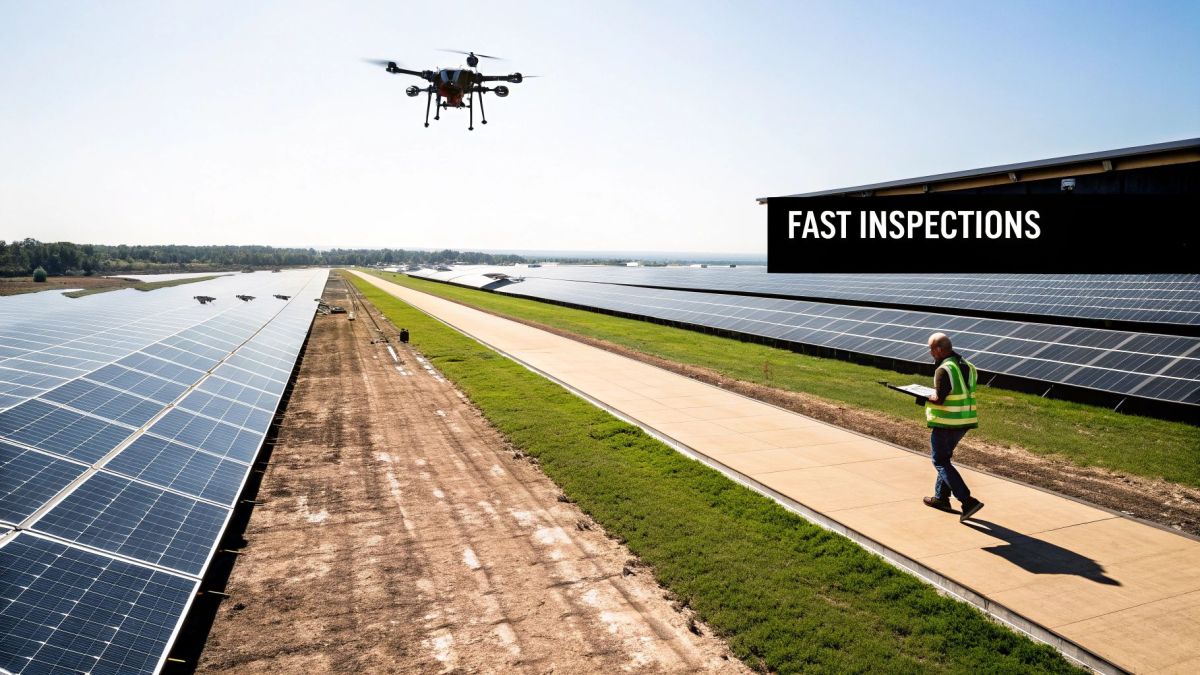
Using drones to inspect solar panels is a game-changer. It's a faster, safer, and far more thorough way to look after solar assets. Armed with thermal and high-resolution cameras, these drones can quickly spot hidden problems like hotspots, micro-cracks, and entire string outages across huge solar farms. This technology moves us beyond the slow, and often hit-and-miss, manual methods of the past, which is vital for keeping energy production high and protecting investments in Australia's booming solar industry.
Why Drones Are Essential for Modern Solar Farm Maintenance
Australia is all-in on renewable energy, and our solar capacity is growing at a staggering rate. Back in 2020, photovoltaic solar power made up about 21.7% of our total power capacity. Fast forward to 2030, and that figure is expected to leap to an incredible 47.56%.
This massive expansion creates a real headache for asset managers who are responsible for millions of individual panels. Before drones came along, keeping these huge installations in check was a slow, painstaking job. Technicians had to trudge up and down endless rows, checking panels one by one with handheld thermal cameras. It was time-consuming, physically demanding, and exposed workers to some pretty harsh conditions and electrical risks.
The Problem with Manual Inspections
Let's be blunt: the old way of doing things just can't keep up with the scale of modern solar farms. Think of it like a librarian trying to manually check every single book in the National Library. They'd have to walk every aisle, pull out each book, and flip through it. The task would take an eternity.
Manual solar inspections are stuck in a similar spot. The main drawbacks are pretty clear:
- Slow Coverage: It can take hours to inspect just one megawatt of solar panels, which is completely impractical for the massive sites we see today.
- Incomplete Data: Because it takes so long, teams often resort to 'spot checks', only sampling a small percentage of the panels. This means countless faults are likely missed.
- Safety Risks: Inspectors are out in the elements, dealing with extreme heat, uneven ground, and the ever-present danger of high-voltage equipment.
- High Labour Costs: The sheer amount of time and people needed makes manual inspections a major drain on the budget.
A single faulty panel might not sound like a big deal. But when you have thousands of them, those small power losses add up, taking a serious bite out of your revenue and return on investment.
Drones as the High-Speed Solution
This is where drones completely flip the script. A drone is like a high-speed digital scanner for that same giant library. Instead of a person slowly walking the aisles, the drone zips over the top on a pre-planned route, capturing crystal-clear thermal and visual data of every single panel. And it does it in a tiny fraction of the time.
This approach turns solar farm maintenance from a reactive, labour-intensive slog into a proactive, data-driven strategy. Of course, drones are just one piece of the puzzle; understanding broader expert solar power system maintenance tips is still key to the long-term health of any solar farm. By quickly flagging underperforming assets, operators can get straight to the repairs that matter most, boosting energy output and safeguarding their investment for years to come.
How Drones See What The Human Eye Cannot

The real magic of using drones for solar panel inspection is their ability to see what we can't. While our eyes just see sunlight reflecting off a panel, a drone equipped with the right sensors can see heat, tiny fractures, and other problems that are completely invisible to us. It turns a simple flyover into a full health check for every single panel on a solar farm.
Think of it like a doctor using both a stethoscope and an X-ray to get the full picture. Drones do the same thing for solar panels, primarily using two types of sensors: thermal (infrared) and high-resolution RGB cameras. Each one tells a different part of the story.
Thermal Imaging: A Window Into Panel Health
Imagine having a camera that sees heat instead of light. That’s exactly what a thermal camera does. Every object gives off a certain amount of infrared energy depending on its temperature, and a thermal sensor turns this energy into a visual heat map. Hotter areas typically show up as bright yellow or white, while cooler spots look dark.
This is a game-changer for solar panels. A healthy solar cell should have a fairly even temperature across its surface as it efficiently converts sunlight into electricity. But if there's a defect—like a micro-crack or a faulty connection—the electrical resistance in that spot spikes. All that trapped energy has to go somewhere, so it escapes as heat.
This creates a "hotspot," which is basically a fever for a solar cell. It's a dead giveaway that something is wrong. To the naked eye, the panel looks perfectly fine, but to a thermal drone, that hotspot glows like a beacon.
High-Resolution RGB: Providing Visual Confirmation
While thermal cameras find the heat, high-resolution RGB (Red, Green, Blue) cameras give us the "why." These are essentially powerful digital cameras that capture incredibly crisp, detailed photos. They're vital for spotting physical damage that might not create a clear thermal signature on its own.
An RGB camera can pick up issues like:
- Cracks or shattering from hail, debris, or impact.
- Soiling from layers of dust, dirt, or bird droppings that block sunlight.
- Delamination, where the protective layers of the panel start to peel apart.
- Vegetation growing over panels or casting shadows.
When you pair the thermal data (the "fever") with the visual data (the physical evidence), you get a complete diagnostic report.
Combining these sensor types is a powerful one-two punch for diagnostics. Thermal imaging points directly to the underperforming panels, while high-resolution visual imagery helps maintenance crews understand precisely what kind of physical repair is needed before they even arrive on site.
Common Solar Panel Faults Detected by Drones
To give you a clearer picture, here’s a breakdown of common issues and how different drone sensors help pinpoint them.
| Type of Fault | Visual Signature (RGB Camera) | Thermal Signature (Thermal Camera) | Impact on Performance |
|---|---|---|---|
| Cracked Cells | Fine lines or "snail trails" may be visible. | A single cell or a group of cells will appear significantly hotter than surrounding cells. | Reduced power output, can lead to complete module failure over time. |
| Soiling & Debris | Visible dirt, dust, leaves, or bird droppings on the panel surface. | The soiled area will appear cooler, as less sunlight is reaching the cells. | Blocks sunlight, directly reducing energy production. |
| Diode Failure | No visible signs. | An entire string or section of the panel will light up as a hotspot. | Significant power loss for the entire module. |
| Delamination | Bubbling, peeling, or cloudiness under the panel's glass. | Irregular, patchy hotspots as moisture and air get trapped. | Degrades panel integrity and efficiency, can cause short-circuits. |
| PID (Potential Induced Degradation) | Often no visible signs in early stages. | A "checkerboard" pattern of hot and cool cells. | Gradual but severe power loss across the entire solar farm. |
This table shows how just one type of sensor isn't enough. You really need both to accurately diagnose what's happening on the ground.
Automation And Precision: The GPS Advantage
Finding the faults is only half the job; you also need to know exactly where they are. This is where automated flight paths and GPS tagging come in. A drone doesn't just buzz around a solar farm randomly. It follows a pre-programmed grid, often called a "lawnmower" path, to make sure every panel is captured from the perfect angle.
Each photo, whether thermal or visual, is geotagged with centimetre-accurate GPS coordinates. This means that when a hotspot is found, its precise location is logged. The final report doesn't just say, "There's a problem in row 15." It gives you a digital map with a pin dropped on the exact faulty panel, often down to the serial number.
This level of precision saves maintenance teams countless hours of searching. They can go straight to the problem, tools in hand. Australian drone service providers have seen massive success with this method. Reports show that drones for solar panel inspection can slash inspection costs by 40–60% and find up to 95% of common panel faults. You can discover more insights about these findings from AUAV's 2025 report.
While thermal and RGB are the workhorses of solar inspection, some advanced operations are exploring other technologies. For a deeper dive into how different light spectrums can reveal even more, check out our guide on what multispectral imaging is and how it's used. This methodical, data-driven approach is what makes drone inspections so essential for modern solar farm management.
Here is the rewritten section, designed to sound like an experienced human expert.
So, Why Bother With Drones Anyway? The Key Advantages
We've talked about the tech, but let's get down to brass tacks: why should a solar asset manager actually care about using drones? The answer isn't about small tweaks; it's about fundamentally changing how you look after your assets. The whole argument really boils down to three powerful benefits: saving a serious amount of money, running a much tighter ship, and keeping your team safe.
Each of these points builds a rock-solid case for leaving slow, old-school manual methods behind. It’s time to embrace a smarter, data-driven way of managing a solar farm.
Let's break down exactly what that looks like in the real world.
Radically Lower Costs and Higher ROI
The first and most obvious win is the impact on your budget. Let’s be honest, traditional ground-based inspections are a huge drain on resources. You can have a team of technicians spend 2–5 hours inspecting just one megawatt (MW) with handheld tools. On a large-scale solar farm, that quickly adds up to weeks of work and a hefty wage bill.
Drones flip that equation on its head. A single automated flight can cover an entire site at speeds up to 25 km/h, knocking out a thermal scan in roughly 10 minutes per megawatt. That incredible speed means fewer boots on the ground for less time, which directly slashes your operational costs. In fact, many operators find drone inspections are around 40% cheaper than doing it the old way.
By finding and fixing underperforming panels faster, you minimise energy production losses. This boosts the overall output of your solar farm, directly increasing revenue and accelerating the return on your investment.
And this isn't just about saving money on labour. It's about making more money. When you can pinpoint issues like string outages or hotspots early, your maintenance crew can get them fixed and generating power again much sooner. That protects your revenue and helps you hit those all-important power purchase agreement targets.
A Leap in Operational Efficiency
Beyond just cutting costs, using drones for solar panel inspection turns your maintenance from a reactive headache into a proactive strategy. The speed of data collection is one thing, but the completeness of it is another. You get a full health check of your entire site in a tiny fraction of the time it used to take.
Think about it: manual inspections often rely on sample testing, which might only cover 10-25% of the entire farm. A drone, on the other hand, captures every single module. That's 100% coverage, meaning no hidden faults can slip through the cracks. The data you get is not only complete but also immediately usable.
Here’s where you’ll see the biggest gains:
- Precision Fault Location: Every problem the drone finds is geotagged with centimetre-level accuracy. No more sending your crew out to hunt for one faulty panel in a sea of thousands. They can go straight to the source, saving hours of frustration.
- Predictive Maintenance: When you're scanning regularly, you start building a historical record of your farm's performance. This lets you spot slow-burn problems like Potential Induced Degradation (PID) or soiling patterns long before they cause a major drop in output.
- Streamlined Workflow: The digital reports from the inspection software can often be plugged straight into your Computerised Maintenance Management System (CMMS). This can automatically create work orders and get repair teams dispatched without anyone lifting a finger.
This shift allows you to get ahead of problems, fixing minor issues before they snowball into major, expensive failures.
Unmatched Improvements in Worker Safety
Finally, and this one is crucial, drones get people out of harm's way. Manual solar inspections are full of risks. Technicians have to walk over uneven ground, often in blistering heat, all while working near high-voltage electrical equipment.
Drones pretty much eliminate these hazards. The pilot conducts the entire inspection from a safe spot, well away from any live equipment or scorching panel surfaces. This massively cuts down the risk of trips, falls, heat stress, and electric shocks. Understanding the critical role of safety in the solar industry really drives home this benefit. For a deeper dive into this topic, have a look at the guidance on UK Solar Safety Regulations.
By keeping your team off the ground, you’re not just creating a safer workplace; you're also reducing the chance of accidents and lowering your insurance liabilities. In any modern, responsible solar operation, that commitment to safety is non-negotiable.
What's Next for Solar Inspection Tech?
Thermal and RGB cameras are the bread and butter of drone inspections today, but the technology is far from finished evolving. The next wave is already here, and it’s all about giving asset managers a much deeper look into the health of their solar farms. We’re moving beyond just finding faults; we're starting to predict them.
This big leap is thanks to new sensor technologies that can check the internal health of solar cells in a way that used to only be possible in a lab. The idea is to spot problems forming at the cellular level, long before they show up as a hotspot or cause a major drop in power.
Think of it like giving a solar panel a full medical check-up while it's still mounted and working in the field. That’s where we’re heading, and it’s going to completely change how we approach predictive maintenance.
A New Frontier: Daylight Photoluminescence
One of the most exciting developments for drones for solar panel inspection is a technique called Daylight Photoluminescence (DPL) imaging. It sounds complicated, but the concept is pretty simple. It’s basically an X-ray for solar cells that works in the middle of the day.
In the past, this kind of luminescence imaging meant you had to take panels offline and test them in a dark, controlled environment. It was the only way to see how the silicon inside the cell lit up when energised, which is how you spot tiny micro-cracks and other internal defects. DPL technology completely sidesteps this huge roadblock.
Using special filters and sensors, DPL drones can capture this vital internal health data while flying over a fully operational solar farm. It’s a massive step forward, giving us diagnostic insights that go far beyond what thermal imaging can offer.
This tech lets us see the "bones" of the solar panel, not just its surface temperature. It can spot degradation and faults at the very beginning, giving an unparalleled view into the long-term health and durability of the asset. For solar farm operators, this means shifting from a reactive maintenance model to one that's truly predictive.
The Power of Catching Problems Early
The real-world benefit of DPL is its knack for finding problems sooner and with more accuracy than anything we've had before. A thermal camera is great at spotting a hotspot, but that’s a symptom—it means a fault has already happened. DPL, on the other hand, can detect the root cause, like a micro-crack, before it even starts to heat up.
This early warning system is a game-changer. Just think about the advantages:
- Proactive Warranty Claims: Operators can find manufacturing defects and cell degradation well inside the warranty period, with rock-solid evidence to back up their claims.
- Accurate Degradation Analysis: DPL gives a precise measure of how panels are ageing. This leads to more accurate performance forecasts and smarter long-term financial planning.
- Smarter Maintenance: By showing the difference between minor and critical internal faults, maintenance teams can focus their time and money on the panels that are the biggest risk to production.
This level of analysis is already making waves in Australia. The Australian Renewable Energy Agency (ARENA) recently invested nearly AU$4 million to support a drone-based DPL technology developed at the University of New South Wales. The project's goal is to bring this powerful, lab-grade analysis to large-scale solar farms. You can read more about this federally funded solar inspection tech and its potential to shake up the industry. This kind of investment shows just how valuable and promising these next-generation drone inspection methods really are.
Getting a Drone Inspection Program off the Ground
Making the switch to a drone-based workflow can feel like a massive undertaking, but it’s really just a step-by-step process. A successful program for drones for solar panel inspection is about more than just buying a drone; it’s about creating a solid, repeatable system that gives you consistent, high-quality data every single time. If you think through the whole process—from the first plan to the final report—you can make sure your investment really pays off.
Let's say you're the asset manager for a 50-megawatt solar farm. Right now, you might be relying on random, manual spot checks. The goal is to shift to a full-scale aerial inspection every quarter. This framework will show you how to get there smoothly and effectively.
The infographic below breaks down the three main stages of setting up a drone program, from figuring out your goals to getting insights you can actually use.
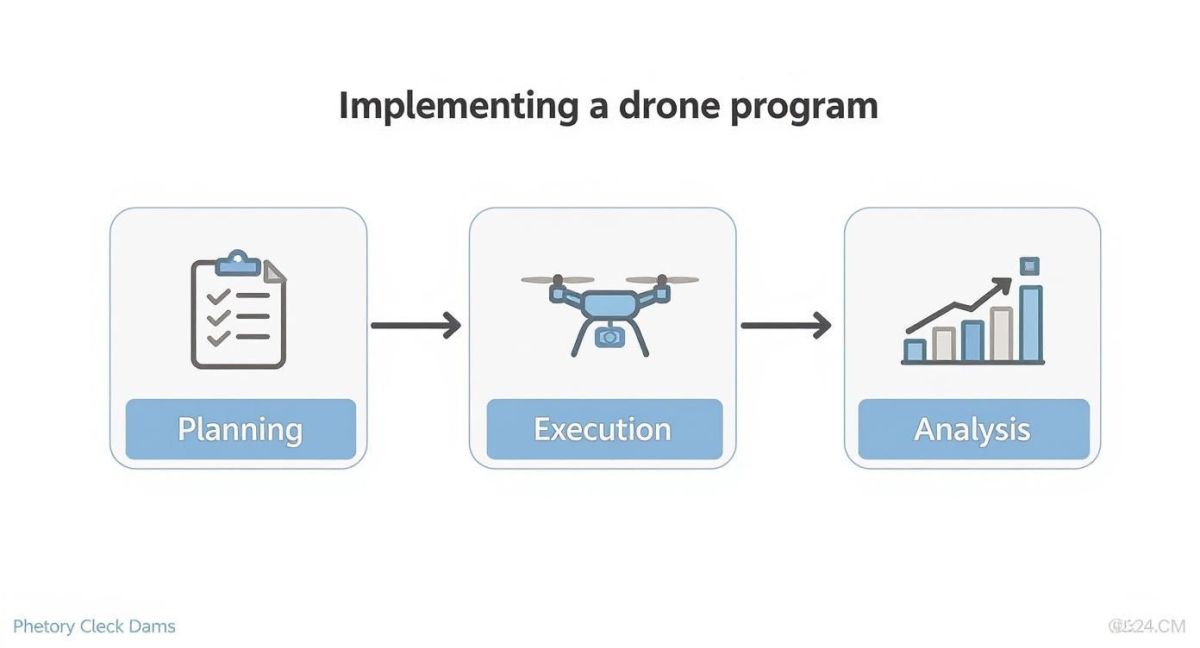
As you can see, it's a continuous cycle. The findings from one inspection feed directly into the planning for the next one, helping you get smarter and more efficient over time.
Phase 1: Planning and Preparation
This is where you lay all the groundwork. You’ll define what the mission needs to achieve and set the key parameters. For our 50 MW farm, the main objective is simple: find every underperforming module and string-level outage to get energy production back to its peak.
First up is a thorough site assessment. This means getting out the site maps, spotting potential hazards like communication towers or tricky terrain, and marking out safe spots for take-off and landing. You’ll also need to check local airspace rules with the Civil Aviation Safety Authority (CASA) to make sure every flight is above board.
The last piece of the planning puzzle is building the automated flight mission. Using specialised software, you import the site’s layout and map out the flight grid. To get a better handle on this crucial step, you can look into guides on UAV flight planning software and see how these tools operate. This ensures the drone captures every single panel with just the right amount of image overlap for precise data processing later on.
Phase 2: Execution and Data Capture
With a solid plan locked in, the actual execution is surprisingly straightforward. The drone pilot gets to the site when the weather is right—ideally a clear, sunny day with solar irradiance above 600 W/m², which is perfect for capturing clean thermal data.
After running through some pre-flight checks, the pilot launches the drone. From there, it’s all automatic. The drone follows the pre-programmed flight path on its own. For a 50 MW site, the whole data capture might only take a few hours, a world away from the weeks a ground crew would need. As it flies, the drone’s dual-sensor payload snaps high-resolution RGB photos and radiometric thermal images at the same time, tagging each one with exact GPS coordinates.
The real magic in this phase is the automation. A pre-planned mission takes human error out of the equation. It guarantees that every inspection is done under the exact same conditions, which means you can confidently compare data from one quarter to the next.
Phase 3: Analysis and Reporting
Once the drone has landed, the raw data is offloaded and the real analysis begins. This is where powerful analytics software steps in to do the heavy lifting. The software stitches thousands of individual images together to create two complete, high-resolution maps of the entire solar farm: one thermal and one visual. These are called orthomosaics.
Next, AI-powered algorithms get to work, scanning the maps to automatically find and classify any anomalies. The software flags everything from hotspots and string outages to soiling and physical damage, and even assigns a severity level to each issue. For our 50 MW farm, this process could easily pinpoint several hundred problems, from minor hotspots to critical inverter faults that need immediate attention.
The final result is a detailed, actionable report. This isn’t just a long list of problems. It’s an interactive map that shows the precise location of every faulty panel. Your maintenance crews get a clear, prioritised list of jobs, so they can head straight to the problem areas and get things fixed fast.
In-House Team or Outsourced Provider?
One of the first big decisions you'll face is whether to build your own drone team or hire an expert third-party provider. Each path has its pros and cons, and the best fit depends on your company's needs and scale.
Deciding between building an in-house team and outsourcing can be tough. The right choice often comes down to your organisation's scale, budget, and long-term goals.
In-House vs Outsourced Drone Inspection Programs
| Aspect | In-House Program | Outsourcing to a Provider |
|---|---|---|
| Initial Cost | High upfront investment in drones, sensors, software, and training. | Low to no initial capital spending; you just pay for each inspection. |
| Operational Control | You have complete control over scheduling, data security, and methods. | Less direct control; you rely on the provider's schedule and processes. |
| Expertise | Requires a serious commitment to hiring and training skilled pilots and analysts. | You get immediate access to experienced, certified professionals and the latest tech. |
| Scalability | Can be challenging to scale up quickly to cover a large portfolio of assets. | Very easy to scale; providers can send multiple teams to cover huge areas quickly. |
| Best For | Large asset owners with a big portfolio and a long-term strategic vision. | Small to medium operators, or anyone wanting to try drones without a big upfront cost. |
Ultimately, there's no single right answer. It all hinges on your organisation's size, financial situation, and what your asset management strategy looks like for the years ahead.
Choosing the Right Drone and Software
Picking the right gear for drones for solar panel inspection is a lot like choosing the right tool for any job. You wouldn’t use a screwdriver to hammer a nail, and you wouldn't pick a tiny drone for a massive solar farm. The best choice always comes down to the scale of your operation and what you're trying to achieve.
It’s easy to get lost in a sea of technical specs. The trick is to cut through the noise and focus on what really matters for getting the job done efficiently. You're not just buying a drone; you're investing in a system that needs to deliver solid, actionable information about your solar assets.
Key Drone Hardware Considerations
When you're looking at different drones, think about how they'll perform in the real world, not just what a brochure says. Things like weather resistance, how long it can stay in the air, and what kind of sensors it can carry are far more important than a long list of fancy features.
Here are the hardware essentials to look for:
- Flight Time: This is a big one. Longer flight times mean you can cover more ground with each battery. For large solar farms, a drone that can stay up for 40-50 minutes is a game-changer, cutting down on the downtime spent swapping batteries.
- Payload Options: Your drone needs to be able to carry both a high-resolution visual (RGB) camera and a radiometric thermal sensor. Some models come with an integrated dual-sensor payload, while others let you swap them out easily. Either way, this flexibility is non-negotiable.
- Weather Resistance: Australian weather can be unpredictable. A drone with a decent IP rating (like IP55) can handle a bit of dust or a sudden light shower, meaning your inspection schedule won't be ruined by a little bad weather.
Think of your drone as the ute of the sky. It needs to be tough, reliable, and built for the environment it's working in. Durability and endurance will always beat flashy gimmicks.
Essential Software Features
The drone is what captures the images, but it's the software that turns that raw data into something genuinely useful. Without a powerful software platform, all you have are thousands of pictures. The right software handles everything from planning the flight to creating the final report for your maintenance crew.
When you're comparing software, make sure it has these core features:
- Automated Flight Planning: Good software makes it dead simple to create precise flight paths that give you 100% coverage of the solar farm. This automation ensures you get consistent, reliable data every single time you fly.
- AI-Powered Data Analysis: Nobody has time to manually inspect thousands of thermal images. That's where AI comes in. It automatically finds, classifies, and pinpoints anomalies like hotspots, string failures, or soiling.
- Seamless Reporting: The whole point of the inspection is to get a clear, actionable report. The software must be able to generate reports that show maintenance teams exactly where the faults are, so they can get straight to fixing them.
If you want to get a better sense of what's out there, checking out different types of software for UAV operations can give you a great overview. At the end of the day, it's the right mix of drone and software that will completely change how you approach solar maintenance.
Got Questions? We've Got Answers
Switching to drone inspections for your solar assets naturally comes with a few questions. Getting these sorted is the key to feeling confident about the tech and making the transition a smooth one. Here are some straight answers to the things we get asked most often by asset managers.
What's the Perfect Weather for an Inspection?
Think clear, blue skies and not much wind. For accurate thermal imaging, you need consistent sunshine hitting the panels. Clouds are the enemy here – they cast shadows and can create temporary cool spots on the panels, which can look like faults when they're not.
That’s why most experienced pilots will fly in the middle of the day. The sun is at its highest, the panels are working their hardest, and any real thermal issues like hotspots will stand out like a sore thumb.
Do I Need a Special Licence to Fly Drones in Australia?
Yes, absolutely. The Civil Aviation Safety Authority (CASA) keeps a close eye on commercial drone use in Australia, and for good reason. If you're inspecting a solar farm professionally, your drone pilot must hold a Remote Pilot Licence (RePL).
On top of that, the business itself needs a Remotely Piloted Aircraft Operator's Certificate (ReOC). Following these rules isn't just about ticking boxes; it's about ensuring every flight is safe, legal, and up to professional standards.
Sticking to these regulations is non-negotiable. It protects everyone involved and shows your clients you operate at a high professional level, which is exactly what you want for complex industrial work.
How Does All This Drone Data Fit into My Current Software?
This is where things get really clever. Modern drone inspection platforms are designed to play nicely with the software you already use. Data can usually be exported in common formats like CSV, or you can get detailed PDF reports where every single identified fault has a geotagged image.
Many systems also have APIs that link directly with your existing asset management tools or a Computerised Maintenance Management System (CMMS). This creates a beautifully efficient process, going from an automatically detected fault straight to a work order for your maintenance crew without missing a beat.
At Innoflight International, we build tough, reliable drone platforms specifically for large-scale industrial jobs like this. Our systems are engineered to give you the high-quality, actionable data needed to keep your solar farm running at peak performance for years to come. See our advanced aerial solutions for yourself at https://evolutionflight.com.