When you hear the term 'drone', you might picture a small quadcopter buzzing around for photos or videos. But a heavy-lift drone with a 100kg payload capacity is a completely different beast.
This isn't a camera platform; it's a flying sky crane. It's an industrial workhorse built from the ground up for one primary purpose: to move serious weight. We're talking about equipment, supplies, or tools tipping the scales at up to 100 kilograms. Hitting that payload number is a massive jump in capability, opening up a whole new world of aerial logistics.
Unpacking the 100kg Heavy-Lift Drone
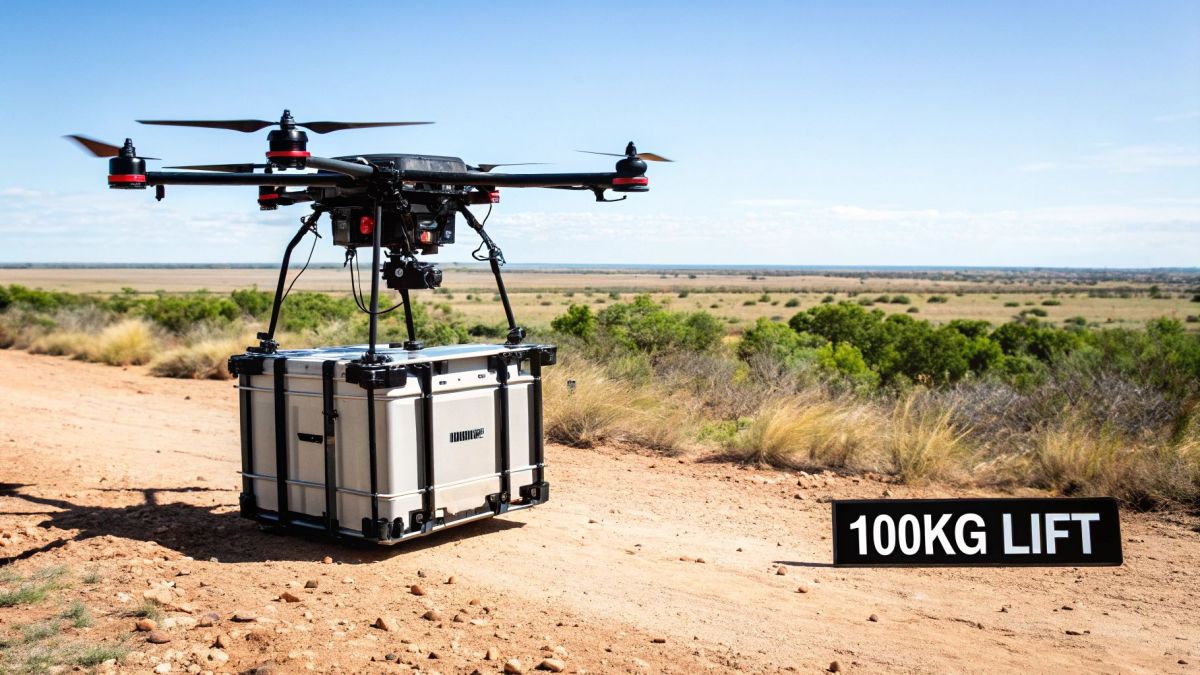
Talking about a heavy-lift drone of 100kg means we’ve left conventional drone uses far behind. This is no upscaled hobbyist model. It's a purpose-built industrial machine designed to tackle tricky logistical problems where traditional methods just don't cut it.
At its core, its job is to act as an aerial crane, either flown by a remote pilot or operating autonomously. It’s designed to get into places that are hard to reach or just plain dangerous for people.
These powerful machines stand out because of their rugged engineering. They’re packed with multiple high-torque motors, oversized carbon fibre propellers, and reinforced airframes all designed to handle the incredible stress of lifting heavy, often awkward, objects. The 100kg payload isn't just a number—it's the key that unlocks a vast range of industrial applications.
What Sets This Drone Class Apart
Unlike their smaller cousins used for mapping or photography, a 100kg drone solves a completely different class of problem. This level of capacity means it can carry loads that, until now, you'd need a helicopter or a ground-based crane to move—often with far more flexibility and at a fraction of the cost.
So, what really makes them different?
- Industrial-Grade Components: Everything is built tough. From the motors to the power distribution systems, every part is designed for total reliability under extreme loads.
- Advanced Flight Control: It takes seriously sophisticated software to keep a machine stable and precise while carrying a heavy payload that might shift in the wind.
- Specialised Operator Skills: You can't just pick one of these up and fly it. Operating these drones safely and legally in Australia demands advanced training and certification, well beyond a standard drone licence.
The ability to lift 100 kilograms fundamentally changes the game for industries like construction, mining, and emergency response. It bridges the gap between light aerial jobs and heavy-duty ground logistics, creating entirely new ways of working.
In this guide, we'll dive deep into the engineering, real-world applications, and the rules you need to know about these impressive machines. You'll get a clear picture of how they're set to reshape Australian industries.
The Engineering Behind a 100kg Lift Capacity
Getting a drone to lift 100kg off the ground isn't as simple as just making a smaller drone bigger. It’s a completely different ball game, demanding a ground-up approach to engineering where every single part is chosen for maximum performance under extreme stress.
Think of it this way: you wouldn't use a standard ute to haul a shipping container. You'd need a prime mover—a vehicle where the engine, chassis, and drivetrain are all purpose-built for that one job. It's the same principle here. This isn't just about raw power; it's a finely tuned symphony of strength, power, and intelligent control working together to lift and move a payload that would rip a lesser machine apart.
Motors and Propellers: The Powerhouse Duo
At the core of any heavy lift drone 100kg are its motors and propellers. These machines rely on massive, high-torque brushless motors—the drone equivalent of a brawny V8 engine. Their sole purpose is to generate an immense amount of rotational force (torque) to spin colossal propellers without breaking a sweat, even with a full load.
The propellers themselves are a sight to behold. Often made from super-rigid carbon fibre and measuring over a metre across, they are the drone's tyres, gripping the air and forcing it downwards. This action creates the huge column of thrust needed to hoist the drone and its cargo into the sky. Getting the balance right between motor power and propeller size is everything, and designers need a solid grasp of how to calculate propeller thrust to make it all work.
A Lightweight Yet Brutally Strong Frame
The drone's airframe is its skeleton. For a machine carrying this much weight, that skeleton needs to be incredibly tough but also surprisingly light. Every gram saved on the frame is another gram that can be added to the payload.
This is where advanced materials come into play—they’re not just a nice-to-have, they're essential.
- Carbon Fibre Composites: This is the go-to material. It boasts a strength-to-weight ratio that leaves materials like aluminium in the dust, giving the frame the stiffness to handle the powerful forces from the motors without twisting or buckling.
- Aerospace-Grade Aluminium: You'll find this used in key high-stress spots, like motor mounts or joints, where its durability is critical.
Newer manufacturing methods are also changing the game. As highlighted in discussions about the impact of 3D printing in the aerospace industry, it's now possible to create complex, optimised parts that are both stronger and lighter than what traditional methods could produce.
Power Systems and Flight Control: The Brains of the Operation
A heavy lift drone 100kg is seriously power-hungry and needs a massive, stable supply of electricity on demand. This is where the power system and flight controller come in.
Remember, a drone built to lift 100kg could have a total take-off weight of over 200kg. The propulsion system doesn't just lift the payload; it has to lift the entire aircraft, with enough power left in reserve to stay stable and manoeuvre safely.
To meet this demand, these drones are typically powered by multiple high-voltage battery packs (12S or 14S) wired in parallel. This setup provides the sheer electrical current needed to feed the hungry motors and, just as importantly, builds in redundancy. If one battery pack were to fail mid-flight, the others can take the load and allow for a safe landing.
Watching over this entire operation is the flight controller—the drone's central nervous system. It processes a constant stream of data from an array of sensors, making thousands of tiny adjustments to the motors every second. This is what keeps the aircraft perfectly stable, whether it's dealing with a sudden gust of wind or a shifting payload. It’s this intelligent control that ensures the mission is done right.
Now, let's break down the key parts that make these drones so different from their smaller cousins.
Table: Key Components of a 100kg Heavy Lift Drone
Here’s a look at the critical hardware that sets a true heavy-lifter apart from a standard commercial drone. Each component is chosen not just for its individual performance, but for how it contributes to the entire system's strength and reliability.
| Component | Function and Importance | Analogy |
|---|---|---|
| High-Torque Brushless Motors | These provide the immense rotational force needed to spin large propellers under heavy load. Without high torque, the motors would stall. | The V8 engine in a semi-trailer. It’s built for pulling power, not just speed. |
| Oversized Carbon Fibre Propellers | Their large surface area and rigid design allow them to move massive volumes of air, generating the required lift. | The wide, grippy tyres on a heavy-duty truck, designed for maximum traction on the road (or in this case, the air). |
| Reinforced Carbon Fibre Frame | The skeleton must withstand incredible stress from motor torque and payload weight while remaining as light as possible. | The high-strength steel chassis of a crane, engineered to support massive loads without bending. |
| High-Voltage Battery System (12S+) | Delivers the high-current electrical power needed to run the motors at peak output. Often uses multiple parallel packs for redundancy. | The industrial-grade power supply for a factory, providing consistent, reliable energy for heavy machinery. |
| Advanced Flight Controller | The "brain" that uses sensor data to make constant micro-adjustments, ensuring stability, especially with a shifting centre of gravity. | The combination of a skilled pilot and an advanced fly-by-wire system in a modern airliner. |
| Redundant Power Distribution Board | Manages the flow of electricity from the batteries to the motors and other electronics, with backup circuits in case of failure. | A building's main switchboard with backup generators, ensuring critical systems stay online during an outage. |
As you can see, every piece of the puzzle is engineered with a focus on power, strength, and fail-safe operation. It's this holistic approach that makes lifting 100kg payloads not just possible, but reliable.
Australian Innovation in Heavy Drone Technology
The tech behind the heavy lift drone 100kg class isn't just something happening overseas; it's being developed and perfected right here in Australia. Our local innovators are tackling challenges unique to our vast and rugged country, turning huge distances and tricky terrain into a proving ground for new ideas.
Instead of just making bigger versions of existing drones, Australian companies are building specialised solutions from the ground up, designed for the real-world needs of our industries.
The Cooperative Lift Breakthrough
One of the cleverest developments is what's known as a 'cooperative lift' system. Think of it this way: instead of building one massive, complicated drone to lift a 100kg payload, this approach uses a team of smaller drones working together in perfect sync to share the load. It's like a coordinated team of removalists lifting a heavy piano that no single person could handle.
This teamwork brings some serious advantages:
- Scalability: Need to lift something heavier or lighter? Just add or remove drones from the team.
- Safety Through Redundancy: If one drone has a problem, the others can take up the slack and ensure the payload lands safely.
- Greater Flexibility: The same fleet of drones can be sent out on individual small jobs or brought together for a major lift.
This infographic gives a great breakdown of the core components that make these advanced drone operations possible.
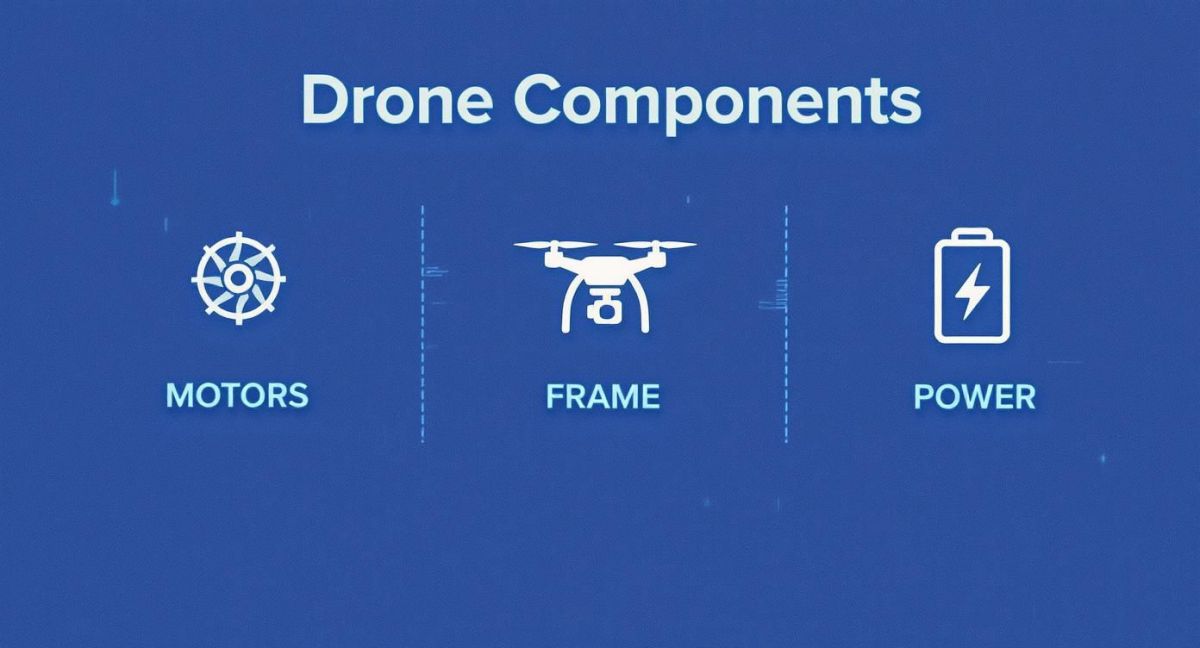
As the graphic shows, it’s all about a careful balance between powerful motors, a strong but lightweight frame, and a battery system that can deliver the goods.
Fuelling a High-Growth Market
These local breakthroughs are powering a booming market. The Australian commercial drone industry was valued at around USD 772 million in 2023 and is expected to climb to nearly USD 2,091 million by 2032.
A big part of that growth comes from companies like Melbourne-based Freespace Operations. They made waves by announcing their 'Cooperative Lift' tech, which allows multiple drones to share loads up to 100kg. A regional defence customer snapped it up almost immediately, proving just how ready the market is for Aussie-made heavy lift solutions.
It's clear that UAV innovator with design in Australia and manufacturing in the USA and Australia aren't just joining the global heavy drone industry—they're helping to lead it. By creating unique solutions like cooperative lift systems, they are putting our nation on the map in a seriously competitive field.
This home-grown tech is a game-changer for sectors like mining, disaster relief, and defence, where getting heavy gear into remote places is a constant headache. To see who else is making an impact, you can check out our list of top Australian drone manufacturers. The solutions being built here are solving our nation's problems while creating technology the whole world can use.
How These Drones are Changing the Game in Australian Industries
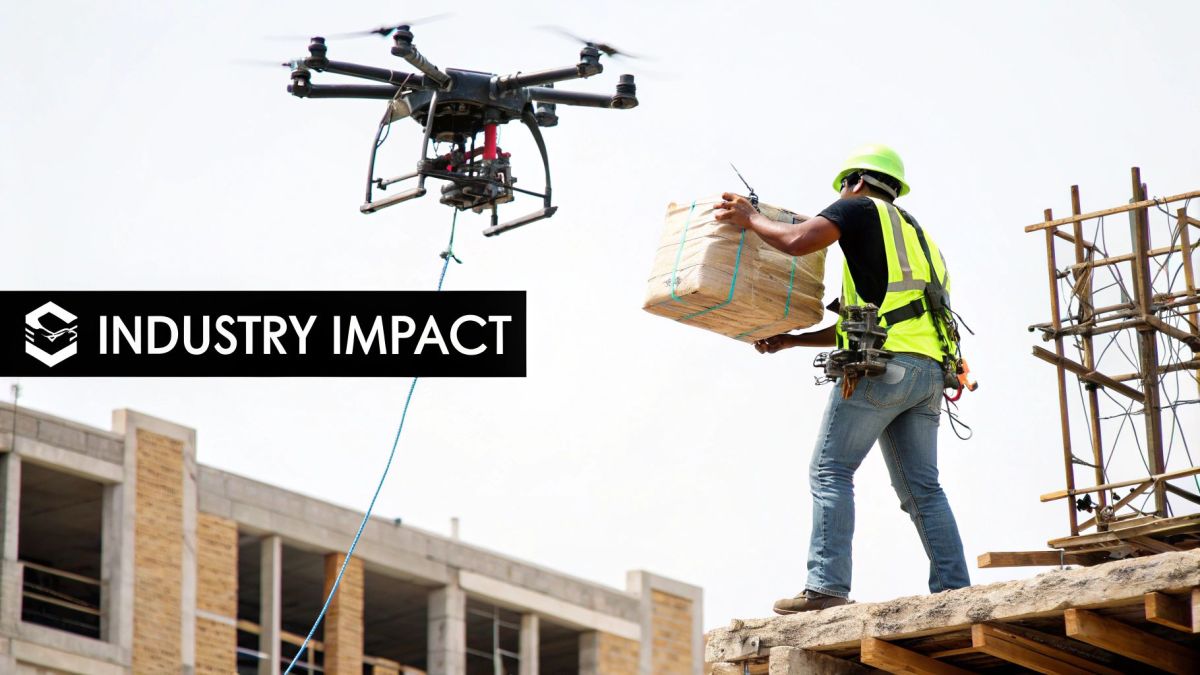
The ability to lift 100 kg isn’t just a number on a spec sheet; it's a genuine game-changer for worksites all across Australia. From the tight confines of city construction projects to the sprawling, rugged outback, these aerial workhorses are tackling old problems in completely new ways. The result? Safer, more efficient operations.
Think about a high-rise being built in Sydney. Instead of a crew waiting around for the tower crane to be free, a heavy lift drone with a 100kg capacity can zip a box of power tools or crucial materials straight up to the thirtieth floor. This simple act cuts down on idle time and keeps workers clear of dangerous ground-level lifting zones.
Construction and Infrastructure Support
In the world of construction, time is money. A 100kg heavy lift drone brings an agility to the worksite that traditional machinery just can't offer. These drones quickly become more than just lifters; they integrate into the daily rhythm of the job.
- Delivering Tools and Materials: They can hoist equipment, spare parts, or building supplies to high or awkward spots without needing to tie up a crane.
- Setting Up the Site: Need to get a generator, lighting tower, or water pump into position on rough terrain? A drone can handle it.
- Making Lifting Safer: By reducing the number of people needed in high-risk lift areas, the chance of an accident drops significantly.
This really changes how projects are planned and executed. A task that once required a team, complex rigging, and a mountain of safety paperwork can now be knocked over with a single drone flight. It’s a massive boost for both productivity and safety on site.
Logistics and Middle-Mile Delivery
Australia's sheer size creates some serious logistical headaches, especially for "middle-mile" delivery—that crucial link between regional depots or remote communities. A 100kg heavy lift drone can fly significant loads over terrain where trucks are slow, inefficient, or completely stopped by things like floods.
This is a huge deal for remote mining operations and isolated farming properties. Imagine flying a 100kg replacement part out to a broken-down harvester; it could prevent days of expensive downtime and turn a potential crisis into a minor hiccup.
The rise of Australian-designed, USA- and Australian-manufactured platforms is a real turning point. We're seeing innovations like coordinated multi-drone formations that can lift up to 100 kg, filling a gap where normal transport just isn't practical. This kind of tech is fuelling rapid growth, particularly in mining logistics and emergency supply chains.
The progress is clear. The Aussie commercial drone market was valued at USD 772 million in 2023 and is expected to almost triple by 2032. Much of this growth is being driven by the flexibility of drones in the 100 kg class, with major contracts already underscoring their strategic value. You can read more about this breakthrough in multi-drone coordination over at DroneLife.com.
Agriculture and Emergency Services
It's not just about industrial sites. These drones are also providing critical support where it matters most. For farmers, a single drone can drop bags of feed across huge paddocks that are too waterlogged for a ute or tractor to get through. This keeps livestock fed without tearing up the land.
In emergencies like bushfires or floods, their role becomes even more vital. They can be lifelines, delivering essential supplies to communities that have been completely cut off.
- Medical Kits: Flying in first aid equipment and critical medicines.
- Communication Gear: Deploying satellite phones or radio repeaters to restore contact.
- Food and Water: Dropping urgent provisions to stranded people.
In these high-stakes situations, the speed and get-anywhere capability of a 100kg heavy lift drone can truly make the difference between life and death. It's fast becoming an essential tool for building a more resilient Australia.
Navigating Australian Drone Regulations and Safety
Flying a 100 kg heavy-lift drone isn't like taking a hobby craft for a spin in the park. It's a serious piece of aviation, and in Australia, that means it’s governed by strict rules from the Civil Aviation Safety Authority (CASA) to keep everyone on the ground safe.
Think of it like getting a licence for a B-double truck versus a standard car. The skills, responsibilities, and legal hurdles are on a completely different scale. You can't just buy one and launch it; CASA requires both the pilot and the business to be properly certified to professional standards.
These regulations aren't just bureaucratic red tape. They provide a solid framework for safe and predictable flights, which is absolutely critical when you have a machine weighing well over 200 kg (with its payload) in the air.
Core Licensing Requirements
To legally fly a 100 kg heavy-lift drone for any kind of commercial work in Australia, there are two non-negotiable certifications you must have. Operating without them is not only illegal but dangerously irresponsible.
- Remote Pilot Licence (RePL): This is your individual pilot’s licence. It’s proof that you have the theoretical knowledge and practical flying skills to safely handle drones in a specific weight class.
- RPA Operator’s Certificate (ReOC): This is the certification for your business. It demonstrates that your company has documented safety systems, robust risk management processes, and the right operational protocols for complex drone missions. You can dive deeper into the requirements for drone commercial use and how to get your operations up to standard.
Getting these certificates is a thorough process. It involves in-depth training, practical flight exams, and submitting detailed manuals of your procedures to CASA. It’s designed to make sure you’re truly ready for the massive responsibility that comes with heavy-lift drone operations.
Beyond the Basics: Special Approvals
Your standard licences cover the basics: flying during the day and only as far as you can physically see the drone (known as Visual Line of Sight, or VLOS). But let's be honest, many of the most valuable heavy-lift jobs need more than that—like covering vast distances or working after dark.
Flying a heavy payload drone beyond the pilot’s direct line of sight is one of the most complex operations in the drone world. It demands advanced technology, rigorous risk assessments, and specific approval from CASA to ensure it can be done without endangering people or property.
These more advanced missions require special authorisations from CASA, particularly for Beyond Visual Line of Sight (BVLOS) flights. Gaining BVLOS approval is a major undertaking. It requires operators to prove an incredibly high level of safety, often demanding things like redundant communication links and certified "detect-and-avoid" technology.
Essential Safety Protocols
Beyond the licences and approvals, a deep-seated culture of safety is what truly separates the professionals from the amateurs. Every single flight must begin with meticulous pre-flight checks and a crystal-clear operational plan.
This means establishing secure take-off and landing zones well away from people and obstacles. It also means having solid contingency plans for anything that could go wrong, like a sudden storm rolling in or an unexpected system alert.
Finally, critical fail-safes are not optional extras. For a 100 kg heavy-lift drone, things like redundant flight controllers, multiple independent battery systems, and even emergency ballistic parachutes are non-negotiable parts of the system.
The Future of Heavy Aerial Logistics
As impressive as today's heavy lift drone 100kg models are, we're really just scratching the surface of what’s possible in aerial logistics. The machines we see now are the groundwork for something much bigger, paving the way for drones that are smarter, more connected, and far more capable.
Think about a future where AI doesn't just assist a pilot—it is the pilot. We're talking about drones that can instantly calculate the safest, fastest routes on their own, dodging bad weather and unexpected obstacles in real-time. This isn't a far-off dream. We’re also on the cusp of seeing "swarm logistics," where fleets of drones coordinate autonomously, moving enormous payloads with the synchronised efficiency of an ant colony.
Seamless Integration and Advanced Tech
The ultimate vision is a totally integrated supply chain. Imagine a heavy lift drone 100kg landing on a self-driving truck to pick up a component, then flying it directly to the 50th floor of a construction site, all without a single human touching the controls. This future is closely linked with wider advancements in aerial transport, like the exciting innovations in Urban Air Mobility.
As battery technology and materials science continue to advance, we can expect drones with even greater payload capacities and significantly longer flight times, making them indispensable tools for Australian industry.
These breakthroughs will cement their place as essential technology. Soon, seeing these drones at work across mining, construction, and emergency services will be commonplace, as they take on the jobs that are currently too slow, too expensive, or just too dangerous for people.
Got Questions? We've Got Answers
When you're looking into something as specialised as a 100 kg heavy-lift drone, a lot of practical questions come to mind. It's a big step up from your standard commercial drone. Here are some of the most common things people ask us about these incredible machines.
How Long Can It Fly with a 100 kg Load?
Realistically, you're looking at a flight time of around 15 to 30 minutes when the drone is carrying its maximum 100 kg payload.
Of course, that number isn't set in stone. It can change based on the weather—strong winds make the motors work harder—as well as the health of your batteries and how aggressively you're flying. If you drop the payload weight, you'll see that flight time increase quite a bit. It’s always a trade-off between how much you lift and how long you can stay in the air, which is a massive part of planning any successful mission.
What's the Price Tag on a 100 kg Heavy-Lift Drone?
These aren't off-the-shelf gadgets; they are serious industrial assets, and the price reflects that. For a complete package—the drone, the ground control station, and all the initial support—you should budget anywhere from AU$150,000 to over AU$500,000.
What causes that big price range? A few things:
- The base model and its built-in features.
- Any customisations you need, like specific payload mounts or software tweaks.
- The amount of hands-on training and ongoing support you want.
The best way to think about it is like buying any other piece of heavy machinery. The cost is tied directly to the engineering, the multiple layers of safety systems, and the raw power required to lift so much weight safely and reliably, day in and day out.
What Kind of Training Do I Need to Fly One in Australia?
Flying a drone this big for commercial work in Australia is tightly regulated, and for good reason. The pilot flying the drone must hold a Remote Pilot Licence (RePL) that’s been endorsed for the correct weight class.
On top of that, the company operating the drone needs its own RPA Operator's Certificate (ReOC) from CASA. This proves you have the right safety protocols and operational manuals in place. And beyond the official paperwork, you absolutely need in-depth, hands-on training from the manufacturer for the specific model you're using. There's just no substitute for that expert guidance.
Ready to see what a heavy-lift drone could do for your business? Get in touch with Innoflight International for a chat. We can help you find the perfect aerial solution for your industrial challenges at https://evolutionflight.com.