If you’ve ever seen a drone hover perfectly still in mid-air, you’ve witnessed a multi-rotor in action. Unlike a helicopter with one massive rotor, these aircraft use multiple propellers to generate lift and navigate. This design is their secret sauce, giving them incredible stability and pinpoint control.
It’s what allows them to take off and land vertically, even in the tightest spots, and has made them indispensable tools in just about every industry you can think of.
What Are Multi-Rotor Drones and How Do They Work?
Imagine trying to balance a plate on your fingertip. You’re constantly making tiny, subconscious adjustments to keep it level. A multi-rotor drone does something very similar, but with propellers.
The drone's flight controller—its brain—is the master of this high-speed balancing act. It continuously tweaks the speed of each motor, changing the thrust from each propeller to perform maneuvers that are simply impossible for a traditional plane or helicopter.
This is how it pulls off its signature moves:
- Hovering: The drone keeps the thrust from all propellers perfectly even, creating a force that exactly cancels out gravity. The result? It hangs motionless in the air.
- Ascending & Descending: To go up, the controller spins all rotors faster at the same time. To come down, it slows them all down in a controlled manner.
- Flying in Any Direction: Want to fly forward? The rear propellers spin a bit faster, tilting the drone forward and pushing it through the air. The same principle applies to moving backward or side-to-side.
- Rotating (Yaw): To turn left or right without moving from its spot, the drone adjusts the speeds of the propellers spinning in opposite directions, causing it to pivot on its central axis.
The Game-Changer: Vertical Takeoff and Landing
This precise control over lift and movement gives multi-rotor drones their most powerful feature: Vertical Takeoff and Landing (VTOL).
A fixed-wing airplane needs a runway. A multi-rotor drone just needs a few square feet. It can launch from a rooftop, a small clearing in a forest, or a cluttered industrial yard and land right back where it started. This flexibility is everything in complex environments where open space is a luxury.
It's this operational freedom that has fueled their explosive growth. The global market for these drones was valued at around USD 10 billion in 2024 and is expected to soar to USD 46.24 billion by 2037. You can dive deeper into the multi-rotor drone market growth trends and see the data for yourself.
Because they combine VTOL capability with high maneuverability, multi-rotor drones have unlocked applications that were previously impractical or too dangerous for human crews, from up-close infrastructure inspections to dynamic aerial cinematography.
On top of all that, their design is relatively simple, which means they’re often easier to fly and maintain than more complex aircraft. You can explore a variety of multi-rotor UAS platforms to see how different configurations are engineered for specific commercial jobs. This accessibility has made them the go-to choice for businesses looking for a reliable and efficient eye in the sky.
Choosing Your Drone: From Quadcopters to Octocopters
When we talk about "multi-rotor drones," we're really talking about a family of aircraft. The number of propellers a drone has is the single biggest factor determining what it can do. It's a lot like choosing the right vehicle for a job. You wouldn’t use a compact car to haul a ton of lumber, and you wouldn’t take a semi-truck for a quick grocery run.
The decision always comes down to a fundamental trade-off: agility versus power. More rotors give you more lift and better stability, but that muscle often comes at the expense of flight time and maneuverability. Getting that balance right is everything.
The most familiar design, and for good reason, is the quadcopter. With its four rotors, it hits a sweet spot between performance, cost, and agility, making it the go-to workhorse for countless commercial jobs.
The image below gives you a quick visual breakdown of how the rotor count stacks up against payload capacity.
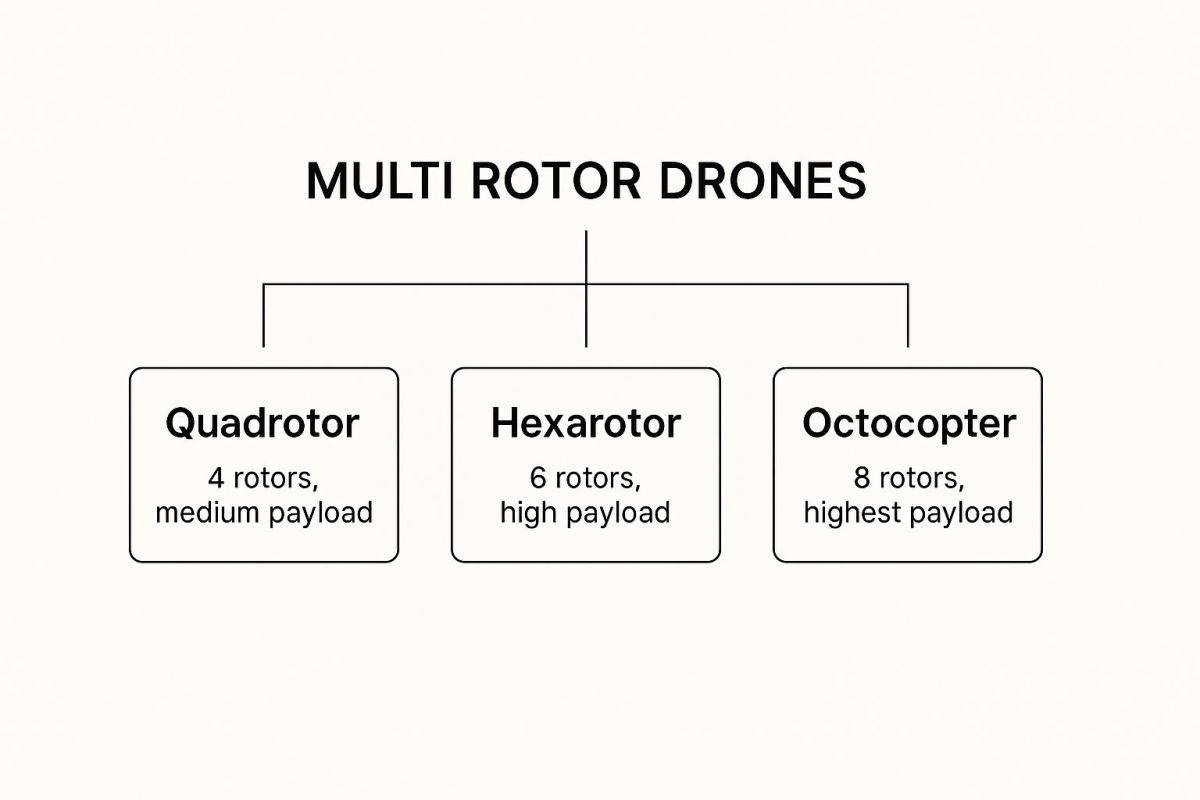
As you can see, there's a clear progression. As you add more rotors, the drone’s ability to carry heavier gear increases, moving from medium-lift capabilities all the way up to serious heavy-duty payloads.
To help you decide, let's look at the most common configurations you'll encounter. The following table breaks down the key differences to give you a clearer picture of which platform might be the right fit.
Comparing Multi Rotor Drone Configurations
This table compares the most common multi rotor drone types based on their key performance characteristics to help users select the best option for their needs.
| Drone Type | Number of Rotors | Key Advantage | Common Applications | Typical Payload Capacity |
|---|---|---|---|---|
| Quadcopter | 4 | Agility & Efficiency | Aerial photography, inspections, crop scouting | Light to Medium |
| Quadcopter | 6 | Redundancy & Stability | Professional cinematography, surveying, public safety | Medium to Heavy |
| Octocopter | 8 | Maximum Lift & Redundancy | Heavy-lift cinema, industrial LiDAR, package delivery | Heavy to Ultra-Heavy |
This comparison highlights the core strengths of each setup. Your choice ultimately depends on the specific demands of your mission—balancing the need for agility, safety, and lifting power.
The Nimble Quadcopter
Think of the quadcopter as the jack-of-all-trades. With just four propellers, it's light on its feet and incredibly efficient compared to its bigger brothers. That efficiency often means longer flight times when carrying lighter payloads, which is perfect for jobs where you need to stay in the air and cover a lot of ground.
An agricultural specialist, for instance, can use a quadcopter to zip over hundreds of acres, making tight turns and changing altitude on a dime to inspect crops. Its smaller size and lower operating cost make it a no-brainer for routine monitoring.
The Stable Quadcopter
Stepping up a level, we have the Quadcopter. Its six rotors bring one massive advantage to the table: redundancy. If a motor fails mid-flight, a well-built Quadcopter can usually stay airborne on the remaining five and land safely. That’s a game-changer when you're flying over people or carrying expensive gear.
Those two extra rotors also deliver much better stability in gusty winds and allow for a heavier payload. It’s why you’ll see film crews gravitating towards Quadcopters. They can carry a professional cinema camera and lens without breaking a sweat, all while keeping the shot rock-steady. The market for these drones is growing fast, and you can see why—they offer a fantastic blend of capability and safety. For more on this trend, check out these insights on the growth of Quadcopter drone use on cognitivemarketresearch.com.
The Heavy-Lifting Octocopter
At the top of the food chain is the octocopter. With eight rotors generating serious thrust, this machine is built for one thing: lifting heavy stuff. These are the heavy-haul trucks of the drone world, designed to carry high-end LiDAR scanners, multiple sensor arrays, or significant delivery packages.
An octocopter's eight rotors generate immense thrust and provide the highest level of stability and redundancy. This makes it the go-to platform for high-stakes missions where failure is not an option and maximum payload capacity is a must.
A construction firm mapping a huge industrial site would bring in an octocopter. It has the raw power to carry a heavy, survey-grade LiDAR unit for an extended flight, capturing millions of precise data points. Its incredible stability ensures the data is clean, and the built-in redundancy provides peace of mind when you have a six-figure sensor in the air. While they are more complex and expensive, octocopters open the door to applications that smaller drones simply can't handle.
How Multi-Rotor Drones Actually Fly
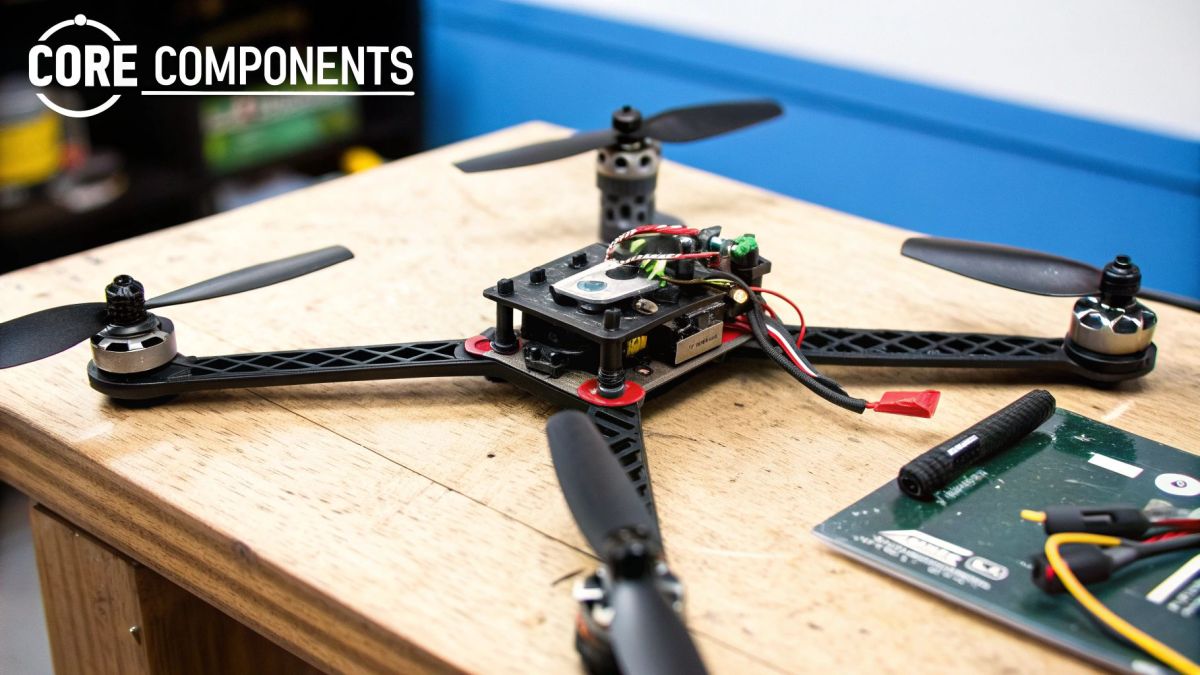
Watching a multi-rotor drone hover perfectly in place or dart through the air with precision can feel a bit like magic. But it’s not magic at all—it's a high-speed conversation between a handful of core components working in perfect sync. The star of this show is the flight controller (FC), which is essentially the drone's brain.
Think of the FC as both the central nervous system and the pilot. It’s constantly taking in data from sensors like gyroscopes and accelerometers to know exactly where it is and how it’s oriented. It then takes the operator’s commands and translates them into thousands of tiny, rapid-fire adjustments for each motor.
Those instructions don't go straight to the motors, though. They first pass through a critical middleman: the Electronic Speed Controller (ESC). Each motor has its own ESC, which acts as a translator and power regulator. The FC sends a signal, and the ESC interprets it, delivering just the right amount of electricity to spin the motor at the exact speed required. This all happens thousands of times a second, creating that smooth, stable flight we see.
The Brain and Its Messengers
The flight controller is the command center where all the complex math happens. It's what keeps the drone level against a gust of wind and what allows it to follow a pre-programmed flight path. The ESCs, in contrast, are the disciplined messengers that execute the FC’s orders instantly and without question.
A top-tier flight controller and a set of responsive ESCs are the bedrock of any reliable commercial drone. Their ability to communicate without lag is what determines the aircraft’s stability, agility, and overall safety during a mission.
To get a real sense of this, picture a simple command to fly forward. The FC instantly calculates that the rear motors need to spin faster to create more lift at the back. It sends a stronger signal to the rear ESCs, which then pump more power to their motors. This tilts the drone forward and sends it on its way. It's a constant, delicate balancing act happening in the blink of an eye.
Here’s a simple breakdown of that core relationship:
- Pilot Input: The operator pushes a stick on the remote control.
- Flight Controller: The FC gets the command and combines it with sensor data.
- ESCs: The FC sends precise signals to each of the drone's ESCs.
- Motors: The ESCs feed the exact voltage needed, and the motors spin the props to make it happen.
This entire sequence is almost instantaneous, which is what gives multi-rotor drones their signature agility.
Motors, Props, and Power
The final pieces of the puzzle are the motors, the propellers, and the battery that fuels the whole operation. Brushless motors are the industry standard for professional drones because they’re powerful, efficient, and built to last. They take the electrical energy from the ESCs and turn it into the raw rotational force that spins the propellers.
The propellers themselves are basically tiny, spinning wings, or airfoils. As they rotate, they create a pressure difference that generates lift. The size, pitch, and material of the props are all carefully engineered to match the motor's power and the drone's specific job, whether that's staying airborne for an hour or lifting a heavy sensor package.
Finally, the lithium-polymer (LiPo) battery is the heart of the system, supplying the high-current juice needed to make everything work. A drone’s flight time is a direct trade-off between the battery's capacity and how much power the motors are drawing. Balancing battery weight against flight duration is one of the fundamental challenges in drone design.
Of course, beyond the mechanics of flight, knowing where the drone is is critical for any automated mission. You can explore the wider applications of GPS tracking solutions for assets to see how crucial location data has become in other industries. Understanding how all these parts—FC, ESCs, motors, and battery—work together gives you a real-world insight into a drone's performance, limitations, and what it takes to keep it flying safely.
How Drones Are Changing the Game Across Industries
Multi-rotor drones are much more than flying cameras. They've become serious tools for solving real-world problems, delivering a tangible return on investment in one industry after another.
By giving us a view from above—a perspective that used to be too dangerous, expensive, or just plain impossible to get—these aircraft are creating new ways to work and unlocking efficiencies that are changing how business gets done.
A New Foundation for Construction and Real Estate
Nowhere is this shift more obvious than on a construction site. In the past, surveying a large project meant sending out a ground crew for days of tedious, and often hazardous, work.
Today, you can send up an octocopter with a high-resolution camera or a LiDAR sensor to do the same job in a few hours.
A multi-rotor drone can fly a pre-planned grid over the site, capturing thousands of images that get stitched together into incredibly accurate 3D maps. This doesn't just save time; it keeps people out of harm's way. Project managers get a constant, reliable stream of data to track progress, catch mistakes early, and keep the project on budget.
This technology has also found a natural home in real estate. The right aerial shot can make a property listing stand out, offering buyers a perspective they can't get from the ground. Learning about the benefits of real estate drone photography shows just how much of an impact it can have.
A Critical Asset for Public Safety
When the stakes are high and every second is critical, multi-rotor drones are an incredible tool for first responders. Their ability to get in the air quickly provides immediate situational awareness that can truly be the difference between life and death.
Imagine a search-and-rescue mission in a thick forest. Instead of relying only on people on the ground, a drone equipped with a thermal camera can scan huge areas from above. It can spot a person’s heat signature, helping crews find someone much faster than they could on foot. Fire departments use the same idea to size up a fire from a safe distance, identifying hot spots without putting firefighters at risk.
In emergency situations, multi-rotor drones are a force multiplier. They are the team's eyes in the sky, delivering real-time intel that leads to faster, safer, and smarter decisions when it counts the most.
After a disaster like a hurricane or flood, drones are essential for mapping out the damage. They give emergency managers a clear picture of the aftermath, helping them identify cut-off communities and plan relief efforts with a level of detail that was simply out of reach before.
A Smarter Approach to Agriculture and the Environment
The impact of drones isn't limited to urban environments; it's also being felt across our farmlands and natural landscapes. In what’s known as precision agriculture, drones have become a go-to tool for modern farmers.
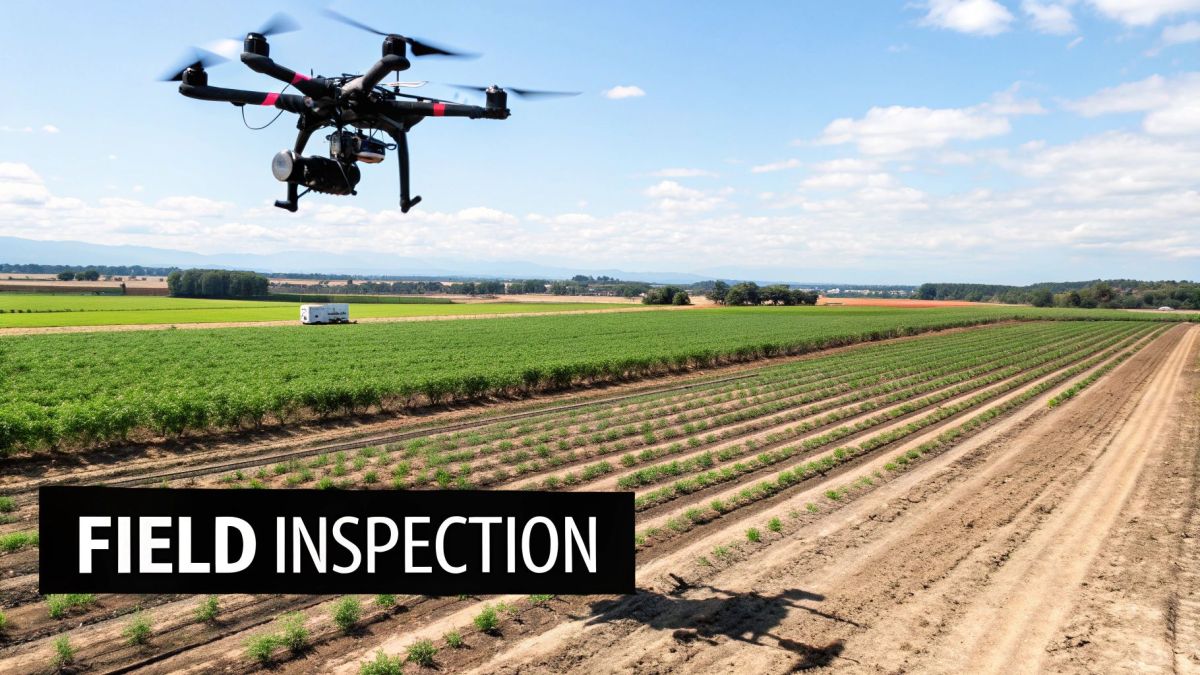
A drone carrying a multispectral sensor can fly over a field and see subtle signs of crop stress that are completely invisible to the human eye. This data lets a farmer be incredibly precise with resources, applying water or fertilizer only where it’s actually needed. This means less waste, lower costs, and better yields. If you're curious about this, our guide to precision agriculture with drones goes into much more detail.
This growth is happening because drones are finding new jobs to do everywhere—from logistics and surveillance to farming and emergency response. It's all thanks to big steps forward in battery life, sensor technology, and the software that lets them fly on their own. Drones are also helping us keep an eye on the planet, monitoring everything from coastal erosion to wildlife populations in a way that’s efficient and non-invasive.
Selecting the Right Drone for Your Mission
When it comes to choosing a multi-rotor drone, it’s not about finding the "best" one on the market. It’s about finding the right tool for the job. Investing in the wrong platform can cost you dearly in bungled operations, poor data, or even a total mission failure.
The whole process shouldn't start with a spec sheet. It starts with a hard look at what you actually need to accomplish.
Think of it like buying a work truck. A zippy sports car might look impressive, but it’s useless if you need to haul lumber. In the same way, the perfect drone for shooting slick real estate videos will fall flat—or out of the sky—trying to inspect a wind turbine in a stiff breeze. The key is to ask the right questions before you start shopping.
Define Your Operational Requirements
Before you even glance at a drone model, you need a crystal-clear picture of what you expect it to do day in and day out. This "mission profile" becomes the standard you’ll measure every potential drone against.
What's the main job? Are you surveying massive tracts of land, getting up close to inspect a bridge, or checking on crop health? Each task demands a different set of skills from the aircraft. A survey mission, for instance, needs a stable platform with long flight times, while an indoor inspection puts a premium on agility and obstacle avoidance.
You also have to consider where the drone will be working. Will it fly over wide-open fields, navigate a crowded city, or tackle remote, rugged terrain? The weather matters, too. Wind, rain, and extreme temperatures will quickly tell you if your drone is tough enough for the job. A lightweight model that’s great on a calm day could be completely grounded by the high winds you’d find around a cell tower.
Evaluate Key Performance Metrics
Once you’ve got that mission profile nailed down, you can start digging into the specs that actually matter. It’s easy to get overwhelmed by numbers on a data sheet, but focusing on a few critical areas will help you cut through the noise.
For any serious commercial operation, these three are non-negotiable.
1. Payload Capacity
The payload is everything the drone carries that isn't part of the drone itself. This could be a high-resolution camera, a LiDAR scanner, a thermal sensor—you name it. The sensors you need will dictate how much lift you require. A heavy, sophisticated sensor package demands a more powerful drone, pushing you toward a Quadcopter or octocopter that can carry the weight and still fly steady.
2. Flight Time and Endurance
This one’s simple: how long can the drone stay in the air on a single battery? This metric is directly tied to how efficient your operation will be. If you’re mapping a pipeline or a large farm, longer flight times are a must to avoid constantly landing for battery swaps. Just remember, the more you load onto the drone, the shorter that flight time will be.
3. Data Security and Compliance
In the enterprise world, the data you collect is often your most valuable asset—and it can be highly sensitive. You have to look at the entire ecosystem, from the flight control app to the cloud platform where data is stored. Is the data encrypted? Are there protocols in place to prevent unauthorized access?
For anyone working in defense, public safety, or critical infrastructure, this goes a step further. It's not just about what the drone can do, but where it comes from. Choosing a drone from a manufacturer that is compliant with national security standards, like the US National Defense Authorization Act (NDAA), is often mandatory.
Build a Mission-Specific Checklist
To keep your selection process on track, put together a checklist based on your specific needs. This simple tool will help you make apples-to-apples comparisons and ensure you don’t forget something critical.
Your checklist should cover:
- Operating Environment: What are the typical wind, temperature, and weather conditions?
- Required Payload: List the exact sensors needed and their combined weight.
- Minimum Flight Time: What’s the real-world endurance you need to be productive?
- Software Ecosystem: How intuitive is the flight software? What about data processing and security?
- Regulatory Needs: Does the drone meet government or industry compliance standards (e.g., NDAA)?
- Support and Training: What kind of technical support, maintenance, and training does the manufacturer offer?
By working through these factors methodically, you shift from just browsing drones to making a targeted evaluation. This structured approach helps you pick a multi-rotor drone that not only does the job but also fits right into your workflow, giving you reliable performance and a solid return on your investment.
The Future of Multi-Rotor Drone Technology
We're seeing multi-rotor drones get smarter, faster, and more capable at an incredible pace. The industry is rapidly moving past simple remote-controlled flight and into a new era of genuine aerial autonomy. Soon, these machines will handle complex jobs with very little human input, opening the door to new applications and massive efficiency gains.
The real game-changer here is the deep integration of Artificial Intelligence (AI) and machine learning. These aren't just buzzwords; they are fundamentally changing drones from tools that follow orders into partners that can think on the fly.
Smarter Drones and Autonomous Missions
Picture a drone inspecting a damaged bridge. Instead of a pilot carefully navigating every inch, the drone of the near future will fly itself. It will use its own sensors to spot structural weaknesses, analyze the data right then and there, and create a detailed report before it even lands. This is where the technology is heading.
This kind of autonomy isn't a single breakthrough but a combination of several key developments:
- Enhanced Onboard Processing: Drones will come standard with powerful computers on board, capable of running sophisticated AI models without needing to connect to the cloud.
- Real-Time Data Analysis: Onboard AI will allow drones to make sense of everything they see and sense—from high-res cameras to LiDAR scanners—in real time, enabling them to make instant decisions.
- Predictive Maintenance: The drones themselves will monitor their own systems, flagging potential component failures before they become a problem, which is a huge step forward for safety.
The next frontier isn't just about flying longer or carrying more. It's about turning multi-rotor drones into intelligent agents that can perceive, reason, and act on their own to solve real-world operational challenges.
Connectivity and Endurance Breakthroughs
While onboard intelligence is critical, how drones talk to the ground and each other is also getting a major overhaul. The wider adoption of 5G networks will finally give us the rock-solid, low-latency connection needed for flying drones safely over huge distances. An operator in New York could realistically fly a mission in Los Angeles, getting crystal-clear video with zero lag.
At the same time, battery technology is finally catching up. This has always been the Achilles' heel for multi-rotors. But with next-generation power sources like solid-state batteries and even hydrogen fuel cells on the horizon, flight times are set to expand dramatically. Today's most advanced platforms are already pushing the envelope; you can see what's possible by looking into the current generation of long-endurance UAV models. Before long, all-day missions won't be the exception—they'll be the standard.
Got Questions? We’ve Got Answers
Even after you've got a good handle on the technology, a few questions always seem to pop up when people are looking at multi-rotor drones for professional work. Let's tackle some of the most common ones head-on.
What’s the Real Difference Between a Multi-Rotor and a Fixed-Wing Drone?
It all boils down to agility versus stamina.
Think of a multi-rotor drone as a helicopter. It can lift straight up, hover in one spot with incredible stability, and zip around in any direction. This makes it the go-to choice for detailed inspections, filming in complex environments, or any job that requires getting up close and personal.
A fixed-wing drone, on the other hand, is more like a small airplane. It needs a bit of a runway or a launcher to get going and has to keep moving forward to stay in the air. You can't hover with it, but its efficient design lets it glide for much longer flight times and cover huge areas. It's the champion of large-scale mapping and surveying over wide-open spaces.
How Much Should I Expect to Budget for a Professional Multi-Rotor Drone?
This is a tough one because the price range is massive, stretching from a few thousand dollars to well over $50,000. It really depends on what you need it to do.
A solid entry-level quadcopter for something like real estate photography might run you $3,000 to $5,000. But if you're looking at a heavy-lift octocopter built to carry a professional cinema camera or a sophisticated LiDAR sensor, the price tag can easily jump past $30,000—and that's often before you even buy the payload. The final cost is shaped by things like how much it can carry, how long it can fly, the quality of its sensors, and whether it meets specific government standards.
What Are the Basic Rules I Need to Know for Flying a Commercial Drone?
Regulations are different everywhere, so this is crucial to get right. In the United States, most commercial drone flights are governed by the FAA's Part 107 rules.
Some of the big ones include:
- The person flying the drone must have a Part 107 remote pilot certificate.
- The drone needs to be registered with the FAA and weigh less than 55 pounds at takeoff.
- You have to keep the drone within your visual line of sight at all times.
- Flights are generally limited to daytime hours and can't go higher than 400 feet above the ground.
It is absolutely critical to check both national and local laws before you fly. These rules are constantly evolving.
When you need a tough, mission-ready multi-rotor drone built for the most demanding industrial jobs, Innoflight Technology has you covered. Check out our advanced UAS solutions and find the perfect platform for your work at https://evolutionflight.com.
Article created using Outrank