When you're looking at a drone's price tag, it's easy to think that's the final number. But that's just the tip of the iceberg. The real total cost of ownership (TCO) covers everything else: maintenance, software, pilot training, and even the hidden cost of downtime. To truly reduce your total cost of ownership, you need to see the whole picture.
The Real Investment Behind Your Drone Fleet
Think about buying a new car. You know the upfront payment is just the start of the journey. You're already bracing yourself for fuel costs, insurance, regular servicing, and the odd unexpected repair bill. It’s second nature.
This is exactly the kind of mindset you need when managing a drone fleet, but it’s amazing how often it gets missed. If you only focus on the purchase price, you’re setting yourself up for some nasty financial surprises down the track—surprises that can seriously hurt your program's profitability.
The first real step to building a drone operation that lasts is to stop thinking 'purchase price' and start thinking 'lifetime investment'. This means looking past the shiny new hardware and getting a handle on all the costs that will stack up over the drone’s working life. Once you understand the complete financial picture, you can start making much smarter decisions right from day one.
Breaking Down Total Cost of Ownership
So, what does TCO actually include? It helps to think of it as a framework made up of a few core parts. Each one adds to the total cost, and getting a grip on each is the key to running a tight, cost-effective operation.
The main cost areas are usually hardware, software, and maintenance, as you can see in the diagram below.
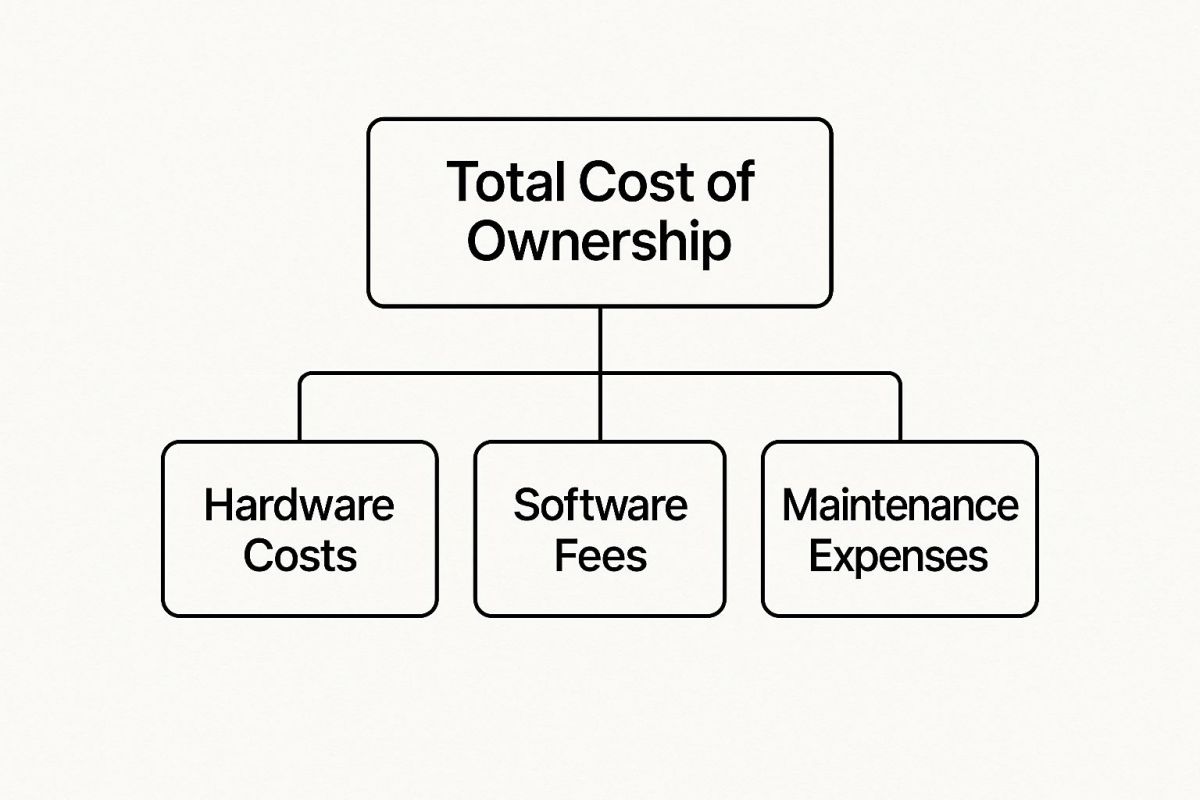
This visual makes it clear that TCO isn’t one single number. It’s the sum of a bunch of different, ongoing expenses that you have to manage together. For instance, a drone with a cheaper upfront cost might end up costing you more in the long run with higher maintenance needs or expensive, locked-in software subscriptions.
Why Seeing the Big Picture Matters
Getting your head around the TCO model is absolutely vital for long-term success. It’s estimated that a massive 75% of an asset's total cost doesn't come from the initial purchase, but from its operational and maintenance phases. That single statistic shows just how much your early decisions can affect your future budget.
By analysing the complete lifecycle cost, you can:
- Budget with Confidence: No more nasty surprises. You can forecast your expenses far more accurately.
- Choose the Right Gear: Select drones and equipment based on real long-term value, not just a tempting price tag.
- Keep Your Fleet Flying: Stay ahead of maintenance and training to maximise your operational uptime and revenue.
- Get a Better ROI: Make sure your drone program is delivering maximum value by keeping costs in check at every stage.
The goal is to implement systems and processes that enable the best possible decisions in terms of both total cost of ownership and maintaining performance standards throughout the asset lifecycle.
Ultimately, understanding TCO takes your drone program from being just a collection of expensive gear and turns it into a strategic part of your business. It gives you the blueprint you need to cut costs, work more efficiently, and make sure your investment pays off. In the sections ahead, we’ll dig into each of these components and share practical strategies for reducing the total cost of ownership across your entire fleet.
Analysing the True Cost of Drone Hardware
When you’re looking at building out a drone fleet, it’s easy to get fixated on the price tag of the drone itself. But that initial purchase price? It’s just the tip of the iceberg. The real cost of your hardware is a much bigger financial picture, one that includes a whole ecosystem of components that will hit your budget over the drone's entire life.
Getting this mindset right is the first major step in reducing your total cost of ownership.
Think of it like buying a ute for the business. The sticker price is just the entry fee. In Australia, for example, the average price of a new car is expected to be around $47,462 in 2025. But we all know the running costs—fuel, insurance, rego, maintenance—are what really add up over time. A cheaper ute might seem like a bargain, but if it chews through fuel and needs constant repairs, its total cost could easily eclipse a more expensive but reliable model. The exact same logic applies to your drones.

Looking Beyond the Drone Body
The airframe is what everyone sees, but it's the supporting cast of gear that often drives your long-term expenses. It’s a classic trap: buying a cheap drone only to find it relies on ridiculously expensive, proprietary accessories. A deal that looked great on paper can quickly turn sour when you’re forking out for replacement parts or essential add-ons.
To get a proper handle on hardware costs, you have to look at the whole system:
- Batteries and Charging Systems: Batteries are consumables; they don’t last forever. Cheaper, lower-quality batteries often degrade faster, meaning you'll be replacing them more often and running a higher risk of a failure mid-flight.
- Controllers and Ground Stations: Durability here is everything. A controller built to withstand the tough conditions out in the field will long outlast a flimsy model, saving you a bundle on replacements and repairs.
- Specialised Payloads: High-end sensors like LiDAR or thermal cameras are a serious investment. Their compatibility with other systems, their durability, and the ongoing cost of calibration are massive factors in your TCO.
A drone's real value isn't just that it can fly. It's in its reliability and how affordable it is to keep it in the air. A grounded drone, no matter how little you paid for it, is a non-performing asset that costs you money every single day.
By prioritising durability and repairability from day one, you avoid getting locked into a costly cycle of endless replacements.
The Hidden Costs of Poor Reliability
A low purchase price can sometimes be a red flag for poor reliability. And an unreliable drone doesn't just fail; it triggers a domino effect of expensive problems that blow out your total cost of ownership. These issues pop up in all sorts of ways, from small annoyances to major operational shutdowns.
Think about the cost of frequent repairs, needing to keep more spare parts on hand, and the much higher chance of a catastrophic failure that could wipe out the drone and its expensive payload entirely. A drone that costs 20% less upfront but breaks down twice as often isn't a bargain—it's a financial liability waiting to happen.
Making Smart Hardware Investments
To genuinely start reducing the total cost of ownership, you need to evaluate hardware beyond the flashy marketing. Before you buy anything, it's worth putting together a quick checklist to analyse the long-term viability of the equipment.
Hardware Cost Evaluation Checklist
This simple checklist can help you look past the sticker price and see the bigger picture, focusing on lifetime value and operational costs.
| Hardware Component | Initial Cost Factor | Long-Term Cost Factor (Reliability, Replacement) |
|---|---|---|
| Drone Airframe | The sticker price and what's included in the box. | Durability of materials, how easy it is to repair, and the availability of affordable spare parts. |
| Batteries | The cost per battery. | Charge cycle lifespan, performance in hot and cold weather, and replacement cost. You can learn more in our comprehensive guide on Li-Po battery for drones. |
| Payloads (Cameras, Sensors) | The upfront investment for the sensor itself. | Calibration needs, warranty terms, and how well it holds up to elements like dust and moisture. |
| Controllers & Software | The price of the controller and any included software. | The build quality, battery life, and whether the software locks key features behind an ongoing subscription. |
This kind of systematic approach helps you focus on what really matters: lifetime value. When you choose hardware that's built to last, easy to fix, and supported by a solid ecosystem of reasonably priced parts, you're making an investment that will pay off for years to come through lower running costs and maximum uptime.
Building a Proactive Maintenance Program
Unplanned repairs are the silent budget killers in any drone program. A sudden failure isn’t just a repair bill; it’s a grounded asset, project delays, and potentially thousands in contractual penalties. The single most effective way to cut your total cost of ownership is to stop putting out fires and start preventing them with a proactive maintenance schedule.
Think of it like your company ute. You don't wait for the engine to seize before changing the oil; you stick to a schedule based on kilometres to keep it reliable and avoid a catastrophic, expensive failure. A drone is no different. Its "kilometres" are just measured in flight hours.
Shifting your mindset this way turns maintenance from a frustrating, unpredictable cost into a smart investment in reliability and uptime. It’s absolutely fundamental to running a successful operation long-term.
Creating a Structured Maintenance Schedule
A solid maintenance program is built on two things: consistency and good records. You can start with the manufacturer's recommendations, but you’ll need to adapt them to your reality. Drones flying over dusty mine sites will need a lot more attention than those mapping grassy fields in milder conditions.
Your schedule should be tiered, starting with the simple daily stuff and moving up to more serious, in-depth servicing.
- Pre-Flight Checks (Daily): These are non-negotiable. Every pilot, every time. It’s a quick visual scan for things like tiny cracks in propellers, loose batteries, or dirt on a sensor. Simple, but it catches big problems before they start.
- Routine Servicing (e.g., every 50 flight hours): This is a more thorough look. You'll want to check motor health, inspect wiring for any chafing or wear, and run basic calibrations on the compass and IMU.
- Major Servicing (e.g., every 200 flight hours): Time for a deep dive. This often means a full teardown to inspect internal components, perform comprehensive sensor calibrations, and maybe even replace parts that have a limited lifespan, like motors or bearings.
A well-kept maintenance log does more than just ensure safety. It seriously bumps up the resale value of your drones. When a buyer sees a clear, professional record of care, they know the asset has been managed properly.
Writing everything down is crucial. Every check, every repair, every part you swap out should go into a central log. This data is gold—it helps you spot recurring issues, predict future failures, and make a solid case when you need to budget for spare parts.
Key Focus Areas for Proactive Upkeep
Beyond just having a schedule, you need to know where to focus your attention. Paying close attention to these key areas can prevent the vast majority of common drone failures.
Battery Health Management
Drone batteries are consumables, and they have a shelf life. Trying to squeeze a few extra flights out of a battery that's past its recommended cycle count (usually 200-300 cycles) is a gamble that almost never pays off. A failing battery can mean the total loss of the aircraft and its expensive payload. Get into the habit of tracking each battery's purchase date, charge cycles, and internal resistance. Retire any battery that looks swollen, damaged, or can't hold a full charge anymore.
Fleet-Wide Firmware Updates
Firmware updates are important—they often include critical bug fixes, security patches, and even new features. But rolling them out across your entire fleet without a plan is asking for trouble. Always have a clear process: test the new firmware on one, non-critical drone first. Make sure it doesn’t introduce new headaches before you deploy it to all your operational aircraft.
Accurate Repair Documentation
Every single repair, no matter how small, needs to be logged. This creates an invaluable history for each asset. For example, if you see the same motor failing on one particular model over and over again, you can investigate if it’s a manufacturing flaw or something about how you're flying it. This data-driven approach is what truly helps reduce total cost of ownership. For a real-world look at how this pays off, our case study on a drone that’s 300 hours still going strong shows what meticulous upkeep can achieve.
In-House Versus Outsourced Maintenance
The final piece of the puzzle is deciding who does the work. Do you build an in-house team or partner with a specialist? There's no single right answer; it really depends on the size of your fleet, your budget, and the skills you have on your team.
| Maintenance Model | Pros | Cons |
|---|---|---|
| In-House Team | Faster turnaround for minor repairs. Full control over the process and quality. Builds valuable skills within your team. | Big upfront investment in training, tools, and a parts inventory. May not have the expertise for very complex repairs. |
| Outsourced Provider | Access to specialised tools and certified technicians. No need to invest in a workshop. Frees up your pilots to focus on flying. | Can be more expensive for routine jobs. Potential for longer downtime while drones are shipped out for service. |
For many organisations, a hybrid approach hits the sweet spot. They handle the daily checks and minor fixes themselves but lean on a trusted partner for the major servicing and tricky diagnostics. This gives you the best of both worlds: it's cost-effective for the day-to-day stuff while ensuring you have expert-level support when you really need it.
Investing in Pilot Training to Reduce Risk
Your fleet's most advanced drone is only as good as the person flying it. A skilled pilot is your single best defence against costly accidents, steep regulatory fines, and botched missions. When you invest properly in training, you're directly tackling the most unpredictable part of your drone program's cost: human error.
Good training is so much more than just learning to take off and land. It’s about creating deep institutional knowledge, turning a basic operator into someone who truly understands how to manage the asset they're controlling. A well-trained pilot doesn't just know how to do something; they understand why they're doing it.
This is the kind of proficiency that prevents expensive mistakes. It's the difference between a pilot who panics when the GPS signal drops and one who calmly switches to a pre-practised emergency procedure, saving a multi-thousand-dollar aircraft and its payload.
From Basic Manoeuvres to Operational Excellence
Initial flight training is the bare minimum, but it’s just the starting line. To really drive down your long-term costs, your training needs to build mastery in a few key areas that directly hit your bottom line.
A solid program should focus on:
- Emergency Procedures: Pilots need muscle memory for handling things like motor failure, battery emergencies, or a sudden loss of communication.
- Complex Airspace Navigation: A single slip-up in controlled airspace can lead to thousands of dollars in fines and even get your operating licence suspended.
- Advanced Mission Planning: Smart flight planning saves battery life, reduces wear and tear on parts, and makes sure you capture data correctly the first time. No one wants costly re-flights.
- Payload-Specific Operations: Flying a sensitive LiDAR unit is a different ball game than using a simple camera. Specialised training stops you from accidentally damaging expensive sensors.
These skills aren't just about playing it safe; they're about being financially smart. Every crash you avoid, every fine you sidestep, and every re-flight you prevent directly lowers your total cost of ownership.
It's a huge mistake to see pilot training as just another expense on a spreadsheet. Think of it as asset protection—an insurance policy against preventable losses that pays you back through smarter operations and longer-lasting equipment.
Comparing Training Models for Maximum ROI
Not all training delivers the same bang for your buck. The trick is to find a mix that builds real-world skills without breaking the bank.
Hands-On Workshops
Nothing beats actual flight time. Workshops run by seasoned instructors let pilots practise tricky manoeuvres and emergency drills in a controlled setting. This kind of hands-on experience builds the confidence and sharp decision-making you just can't get from a book.

Advanced Flight Simulators
Simulators are a brilliant way to drill emergency procedures over and over without risking a single piece of hardware. A pilot can practise an engine-out landing or a flyaway recovery dozens of times, building the instincts needed to save a drone when it really counts. They’re also great for rehearsing missions, letting your team iron out the kinks before they even get to the site.
The idea of managing long-term costs isn't unique to drones; you see it everywhere, even in personal finance. Take the Australian housing market, for example. The hefty upfront price of a property—with the median home price hitting $831,000 in June 2025—is just the beginning. A drone operator has to factor in maintenance and pilot skills, just as a homeowner has to manage mortgages, rates, and upkeep. Smart strategies, whether it's refinancing a home loan or investing in pilot proficiency, are what make these long-term commitments manageable. You can find more on how Aussies handle these costs in the 2025 home ownership statistics.
At the end of the day, a well-trained team is the foundation of reducing the total cost of ownership. By investing in their skills, you slash the financial risks from equipment damage, regulatory penalties, and inefficient operations, ensuring your drone program is built to last.
Calculating the High Cost of Fleet Downtime
A drone sitting on the shelf isn't just an idle piece of tech; it's a hole in your pocket. Downtime is easily one of the biggest—and most overlooked—costs draining your budget, pushing up your fleet's total cost of ownership. The true financial sting isn't the repair bill. It's the ripple effect: project delays, frustrated clients, and lost revenue that can make the cost of the drone itself seem trivial.
If you’re serious about reducing your total cost of ownership, you have to stop thinking of downtime as just an inconvenience. It’s a critical business metric you need to track and manage aggressively. Every hour a drone is grounded is an hour it’s not making you money.
This isn’t unique to drones, of course. Think about the cost of running a car. In Australia, the average annual cost can hit $23,389 once you add up fuel, servicing, and insurance. A breakdown is never just about the mechanic's bill; it's the lost time, cancelled meetings, and cost of a rental. To truly manage the expense, you have to see the whole picture, as this analysis of Australian car ownership costs shows. It’s the exact same mindset you need for your drone fleet.
Quantifying the Real Cost of a Grounded Drone
Figuring out what downtime really costs means looking past the obvious. A broken propeller might be a $20 fix, but the financial damage goes much deeper. Your calculation has to account for all the knock-on effects.
Start by adding up these key areas:
- Lost Revenue: This one’s simple. If a drone booked for a full-day survey is out of action, you've just lost a full day's income.
- Idle Labour Costs: Your pilot and support crew are still on the clock, getting paid to wait for a tool they can't use.
- Project Delays and Penalties: Commercial contracts live and die by deadlines. A grounded drone can push a project off schedule, and that can trigger some painful contractual penalties.
- Reputational Damage: When equipment issues make you unreliable, word gets around. It makes winning that next big contract a whole lot harder.
When you add these numbers up, you get a far more realistic view of what each hour of downtime is setting you back. That number is powerful. It’s the business case you need to justify spending a little more upfront to prevent these issues from happening in the first place.
Practical Strategies to Maximise Uptime
Keeping your drones in the air has less to do with luck and everything to do with smart planning. The goal is to build resilience into your workflow so a minor snag doesn't snowball into a full-blown financial disaster. A few key strategies can make a world of difference.
A proactive approach to uptime is the difference between a drone program that struggles to stay profitable and one that consistently delivers results. Treat every flight as a mission-critical operation, because financially, it is.
Here are three practical things you can do right now to keep your fleet flying and earning.
1. Create an Essential 'Go-Bag' of Spares
Don't let a tiny, replaceable part kill an entire day's work. Every team heading into the field needs a 'go-bag' packed with the most common failure items.
Your kit should always include:
- A complete set of spare propellers.
- Extra memory cards and fully charged batteries.
- A basic toolkit with screwdrivers and hex keys.
- Backup cables for your controllers and payloads.
This simple bit of prep turns a day-ending problem into a five-minute fix on-site.
2. Standardise Your Fleet for Easy Swaps
Running a mixed bag of different drone models might feel flexible, but it's a nightmare when something breaks. Standardising on just one or two core platforms is a game-changer for reducing total cost of ownership.
When your drones, batteries, controllers, and sensors are all interchangeable, a single failure becomes a minor inconvenience. You just grab the backup, swap it in, and you're flying again in minutes. Of course, getting the most out of each battery swap is key; check out our guide on how to maximise your drone flight duration for more on that.
3. Use Digital Checklists for Pre-Flight Inspections
So many avoidable failures come down to simple human error. Relying on memory for pre-flight checks is just asking for trouble. By making digital checklists mandatory, you ensure every critical system is inspected before every single takeoff.
This disciplined routine helps pilots spot small problems—a loose battery latch, a tiny crack in a prop—before they become catastrophic failures mid-air. It's a small change in process that saves you from huge repair bills and even bigger losses from downtime.
Your Action Plan for Lowering Drone TCO
So, how do you actually lower your drone fleet's total cost of ownership? It all comes down to a fundamental shift in how you think about your program. You need to stop seeing your drones as just tools and start managing them like a high-value business unit, where every choice directly impacts your bottom line.
This means moving beyond the initial purchase price and embracing a bigger-picture strategy. It’s built on four simple, but powerful, pillars. First, look beyond the sticker price when buying new hardware; prioritise drones that are built to last and easy to fix. Second, commit to proactive maintenance. Treat it as a smart investment that prevents expensive, mission-killing failures down the track, not just a reactive cost.
A Unified Strategy for Fleet Management
The third pillar is all about your people: invest in skilled pilots. Continuous, high-quality training is your single best defence against costly crashes and mistakes. Finally, aggressively minimise downtime. This means getting smart with systems like standardised fleets and having essential spare parts on hand, ensuring your drones are always ready to fly and earn their keep.
Embracing this comprehensive approach means you stop managing individual drones and start optimising a complete operational system. The goal is to make informed decisions that enhance performance while containing costs across the entire asset lifecycle.
For a deeper dive into streamlining your operations, it's worth exploring various strategies to reduce operational costs and boost efficiency. Integrating these principles can make an immediate and noticeable difference to your program's financial health.
Adopting this mindset is the secret to reducing total cost of ownership. It’s what allows you to build a more resilient, efficient, and ultimately profitable drone operation that will deliver a strong return on your investment for years. Your action plan doesn’t start with a purchase; it starts with a commitment to smarter management.
Your Questions Answered: Drone TCO
Even with the best plans in place, questions always pop up when you're trying to get a handle on the total cost of ownership. Let's tackle some of the most common ones that drone program managers ask.
What's the Single Biggest Hidden Cost in a Drone Program?
This can change depending on the operation, but more often than not, the answer is unplanned downtime. It's a classic hidden cost because it’s not just about the repair bill for a grounded drone. The real damage comes from the ripple effect—project delays, idle staff you still have to pay, and even potential contract penalties.
Think about it: a single drone being out of action for a week can easily stall a project worth ten times the aircraft’s sticker price. This is exactly why being proactive with maintenance and having a backup plan isn't just a "nice-to-have"; it's a core part of keeping your TCO in check.
Is It Cheaper to Standardise My Fleet with One Drone Model?
In almost every case, absolutely. Sticking to a single drone model across your fleet is one of the smartest moves you can make to lower your total cost of ownership. It makes pilot training much simpler because everyone learns the same system, and it massively simplifies your maintenance workflow.
When you standardise, you can keep a smaller, more focused inventory of spare parts, batteries, and payloads that work across every aircraft. This cuts down on complexity, gets drones back in the air faster, and often unlocks bulk discounts from suppliers.
This kind of operational efficiency is what really chips away at those long-term expenses.
How Often Should I Replace Drone Batteries to Minimise Long-Term Costs?
The general rule of thumb from most manufacturers is to replace LiPo batteries after 200-300 charge cycles. You should also replace them immediately if you spot any swelling, damage, or a sudden inability to hold a charge. A good performance benchmark is when a battery can no longer hold at least 80% of its original capacity.
Trying to squeeze a few extra flights out of an old battery is a dangerous and costly gamble. The risk of a complete failure in the air skyrockets, which could destroy the drone and its expensive payload.
It’s always cheaper to replace a battery proactively than to replace an entire UAS. Using a good battery management system to log charge cycles and monitor health is a fundamental tactic for protecting your bigger hardware investments and controlling your TCO. It's simply not negotiable for a cost-effective drone program.
Ready to build a more efficient and cost-effective drone fleet? Innoflight International offers advanced UAS solutions designed for reliability and long-term value. Explore our platforms and see how our technology can help you reduce your total cost of ownership.