When you think about what makes a drone so agile and powerful, your mind probably jumps to the motors and propellers. But the real secret sauce, the component that makes it all possible, is the LiPo battery. It’s the high-performance heart of your drone, engineered to pump out a massive amount of power from the lightest possible package.
Why LiPo Batteries Power Your Drone
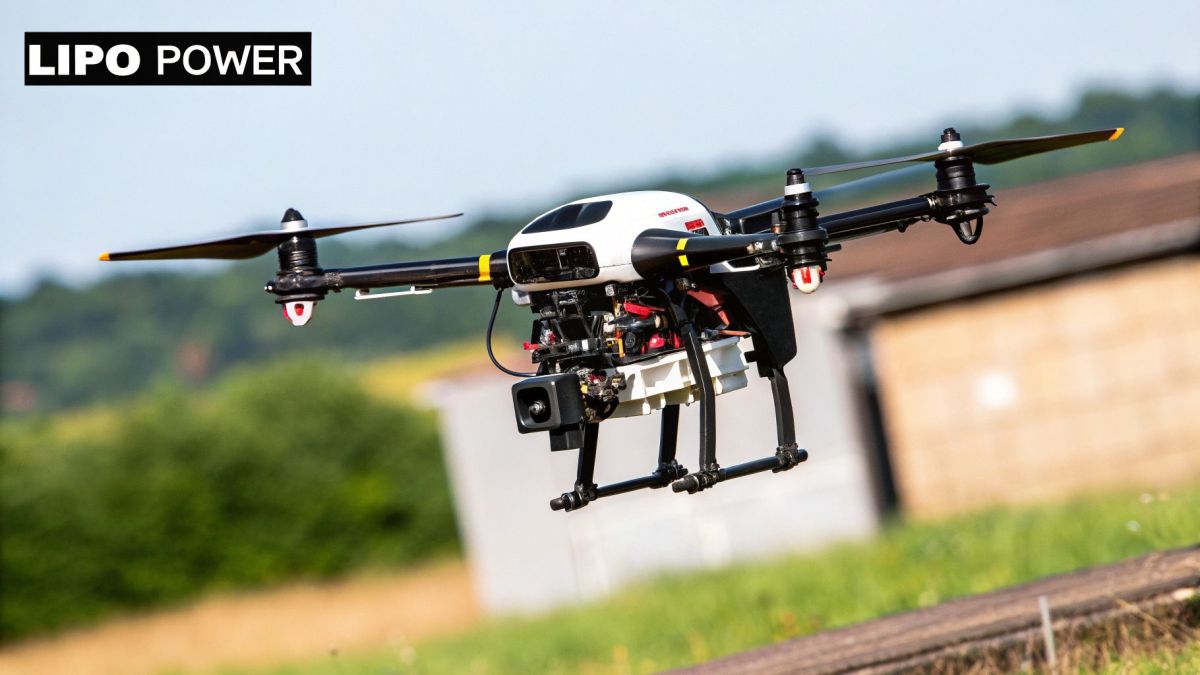
So, what gives your drone its incredible zip? It's not just clever engineering; it’s the raw energy packed inside its Lithium Polymer (LiPo) battery. Think of it as the high-octane fuel and engine of a race car all rolled into one—built specifically to deliver a huge burst of power while weighing as little as possible.
This unique combination is exactly why the LiPo battery is the go-to choice for virtually every drone out there. Whether you're flying a tiny backyard quad or a heavy-lifting cinema rig, this is the technology that provides the muscle for aggressive moves and the stamina for decent flight times.
The Power-to-Weight Advantage
In anything that flies, weight is everything. Every single gram you add to a drone means the motors have to work harder, which eats into your flight time. This is where LiPo batteries truly shine. They offer a much better power-to-weight ratio than older tech like Nickel-Metal Hydride (NiMH) or Nickel-Cadmium (NiCd).
This efficiency has a direct impact on how your drone performs in the air. A lighter, more powerful battery lets your drone:
- Accelerate Faster: Get that instant thrust you need for quick punch-outs and nimble manoeuvres.
- Fly Longer: Squeeze more time out of a single charge, keeping you in the air where you want to be.
- Carry Heavier Payloads: Give you the ability to mount better cameras, gimbals, or other gear without killing performance.
To put it in perspective, a standard LiPo cell has a nominal voltage of 3.7V. A typical NiMH cell, on the other hand, is only 1.2V. This means you need fewer LiPo cells to get the voltage your drone needs, resulting in a lighter and more compact battery.
Built for High-Demand Flying
The battery in your TV remote sips power slowly over months. A drone battery does the complete opposite. When you jam the throttle forward, the motors demand a massive surge of electricity, and they need it right now.
LiPo chemistry is specifically designed to handle these intense, high-discharge situations without breaking a sweat. This ability to pump out consistent power under heavy load is what prevents "voltage sag," ensuring your drone stays responsive and stable, even when you're pulling off aggressive freestyle tricks or fighting a stiff headwind. It's a fundamental trait that makes safe, reliable drone flight possible and sets the stage for the more technical specs we'll dive into next.
Decoding the Numbers on Your Drone Battery
Looking at a LiPo battery for the first time can feel a bit like trying to read a secret code. You'll see a string of numbers and letters like 5200mAh 75C 6S, but what do they actually mean for how your drone flies? Let's break down this code, piece by piece.
Don't think of it as technical jargon; see it as a performance summary. Each number tells you a vital part of the battery's personality—how long it can stay in the air, how much punch it can deliver, and its total energy reserve. Getting this right is the key to matching the perfect battery to your drone and flying style.
Capacity (mAh): Your Drone's Fuel Tank
The first number you'll usually spot is the capacity, measured in milliampere-hours (mAh). This one is the easiest to get your head around because it's a direct measure of endurance.
Think of the mAh rating as the size of your drone's fuel tank. A battery with 5000mAh simply holds more "fuel" than one with 3000mAh. All else being equal, it will give you a longer flight time. Simple, right? But here's the catch: a bigger fuel tank adds more weight, forcing your motors to work harder just to lift off. This creates a constant tug-of-war between flight time and agility.
Here in Australia, commercial drones are becoming indispensable for massive jobs. Industries like agriculture and mining need high-performance LiPo batteries, often in the 5000-10000 mAh range, to cover huge areas without constantly landing. This demand is set to fuel market growth of around 9.1% CAGR between 2025 and 2035.
C-Rating: The Power Delivery Speed
While capacity tells you how much energy is in the tank, the C-Rating tells you how fast the battery can safely push that energy out. This is a massive deal for performance, especially if you're into FPV racing or acrobatic flying where you need instant, face-melting bursts of power.
If capacity is the fuel tank, the C-Rating is the fuel pump. A low C-Rating is your standard pump, delivering a steady flow for a smooth cruise. A high C-Rating, on the other hand, is like a high-pressure performance pump, ready to dump a massive amount of fuel into the engine for explosive acceleration.
A higher C-Rating doesn't mean your drone will magically fly faster. It just means the battery can handle bigger power demands without getting stressed or damaged. Your drone's motors will only draw the amperage they need. Using a battery with a C-Rating that’s higher than required is perfectly safe and can even help it run cooler, which might just extend its lifespan.
The chart below shows why LiPo batteries are the go-to choice for drones—they pack way more power for their weight compared to other common rechargeable batteries.

As you can see, LiPos pack significantly more energy into the same amount of weight. This high energy density is the secret sauce that lets drones be both nimble and have decent flight times. For really demanding jobs like the aerial survey work detailed in the Innoflight and LiDAR USA partnership, this level of performance isn't just nice to have—it's essential.
Finding the Right Balance
Picking the right li po battery for drone flying always comes down to a trade-off. You have to decide what matters more for what you're doing: getting the maximum flight time for those long cinematic shots, or having maximum agility and power for high-speed action?
The table below breaks down this balancing act.
LiPo Capacity vs C-Rating Trade-Offs
| Battery Spec | Primary Benefit | Primary Drawback | Best Use Case |
|---|---|---|---|
| High Capacity, Lower C-Rating | Extended flight time | Heavier, less agile, slower power response | Aerial photography, long-range cruising, mapping |
| Low Capacity, High C-Rating | Lighter, more agile, instant power delivery | Shorter flight time | FPV racing, freestyle acrobatics, aggressive flying |
| Balanced Capacity & C-Rating | Good mix of flight time and responsiveness | A compromise; not the best at either extreme | All-purpose flying, hobbyists, general videography |
A heavy, high-capacity battery is fantastic for endurance missions but will make the drone feel a bit like a bus in the corners. On the flip side, a light, high C-Rating battery is perfect for racing but will have you landing for a swap before you know it. It’s all about finding that sweet spot for your needs.
Understanding Voltage and Cell Count (The 'S' Rating)

We've covered the fuel tank (capacity) and the fuel pump (C-Rating). Now, let's talk about the octane rating of that fuel: voltage. This is the raw electrical punch your battery delivers, and it’s all wrapped up in one simple number you’ll see on every pack: the 'S' rating.
When you see a battery labelled 3S, 4S, or 6S, that number is telling you how many individual LiPo cells are stacked together in series inside the pack.
Think of it like putting batteries in an old torch. One battery gives you a weak beam. Pop a second one in, and the light gets much brighter. Each cell you add bumps up the total voltage, which in the world of drones means your motors spin faster, giving you more thrust, speed, and overall authority in the air.
How Voltage Translates to Power
Every standard LiPo cell carries a nominal voltage of 3.7V. So, figuring out the total voltage of a battery pack is just simple multiplication. A 4S battery isn't one giant cell; it's actually four 3.7V cells linked together to pool their power.
- 3S Battery: 3 cells x 3.7V = 11.1V
- 4S Battery: 4 cells x 3.7V = 14.8V
- 6S Battery: 6 cells x 3.7V = 22.2V
This difference is massive when you're actually flying. A drone built for a 6S battery will feel incredibly responsive and powerful compared to a 4S setup, even at the same throttle position. We’re talking about much faster acceleration, a higher top speed, and that satisfyingly "locked-in" feel you want for aggressive flying.
This incredible power-to-weight ratio is exactly why the li po battery for drone market is thriving. In fact, its value in the South Asia & Oceania region (including Australia) is pegged at a massive US$405.4 million in 2024. This isn't just hobbyists; commercial and industrial drones rely on this technology for long flight times and demanding safety standards. You can dive deeper into the numbers with this drone battery industry analysis from Fact.MR.
Matching Voltage to Your Drone's Components
Now for the most important part: you can't just slap a 6S battery on a drone built for 4S and expect a free power upgrade. Your drone's entire power system—specifically the motors and the Electronic Speed Controllers (ESCs)—is designed for a certain voltage range.
Think of it like plugging a 120-volt Aussie appliance into a 240-volt outlet in Europe without an adapter. You’ll get a pop, a puff of smoke, and a dead appliance. The exact same thing happens to your drone's electronics.
Always, always check the specs for your motors and ESCs. They will clearly state their voltage limit, usually as a range like "2-6S compatible". Pushing past this limit is the quickest way to fry your components, often mid-air, leading to a crash and a very expensive repair bill.
Common Voltage Setups and Their Uses
Different S-ratings are better suited for different kinds of flying, usually balancing raw power with efficiency and the cost of the parts.
- 3S-4S: This is the sweet spot for many beginners, smaller freestyle quads, and some cinematic rigs. The components are typically cheaper, and the power delivery is much smoother and more manageable.
- 6S: This has become the gold standard for high-performance FPV racing and aggressive freestyle flying. It delivers incredible power for those explosive punch-outs while often being more efficient, which can lead to longer flight times.
- 8S-12S and Beyond: You'll find these high-voltage setups on heavy-lift cinematography and industrial drones. By running at a higher voltage, the system can draw less current (amps) to achieve the same power output, which is far more efficient and puts less stress on the wiring and electronics.
Your Guide to LiPo Charging and Connectors
Getting your charging routine right is one of the most important parts of flying drones. It’s not just about plugging a battery in and waiting for a green light; it’s about understanding the gear that keeps your drone in the air and your batteries healthy for the long haul.
Let's break down the physical connectors and the charging process itself. None of this is rocket science, but it absolutely demands your attention. Nailing this from day one will make you a more confident pilot, save you money on batteries, and most importantly, keep you safe.
The Two Plugs You Need to Know
When you pick up a LiPo battery, you'll see two sets of wires hanging off it. Each one has a very specific and crucial job.
-
Main Power Connector: This is the big, beefy plug with thick wires. Its whole purpose is to dump a massive amount of current into your drone’s motors. It has to be tough to handle the power needed to fly. The most common one you’ll see is the bright yellow XT60 connector, which is fantastic for its snug, reliable fit. You might also find smaller XT30s on micro-drones or huge XT90s on heavy-lift rigs.
-
Balance Lead: This is the smaller, white plastic plug with a ribbon of much thinner wires. Each of these tiny wires connects to an individual cell inside your battery. Think of it as the battery's health monitor—it’s only used during charging, but it's the key to keeping your battery in good shape.
One of the biggest mistakes newcomers make is thinking the big power plug is for charging. While a few very basic chargers might do that, any smart charger worth its salt will use both the main plug for the heavy lifting and the balance lead to make sure every cell is happy.
Why You Must Always Balance Charge
A LiPo battery isn't just one big block of power; it's actually a bundle of individual cells working as a team. And just like any team, it only works well when everyone is on the same page. That's exactly what balance charging does.
When you use a proper LiPo balance charger, you connect both the main power lead and the smaller balance lead. The charger is then smart enough to watch the voltage of each individual cell. If one cell starts getting a bit ahead of the others, the charger gently slows it down, letting the others catch up.
The goal is to get every single cell to hit the perfect peak charge of 4.2V at precisely the same moment. Without this, you risk overcharging some cells while others are left behind. An overcharged cell is not only ruined forever, but it’s also a serious fire hazard. Seriously, don't skip this step.
Picking the Right Charger
Your charger is just as critical as the batteries themselves. Skimping here with a cheap, no-name charger is a gamble you really don't want to take with a li po battery for drone flying.
- Get a Dedicated LiPo Balance Charger: This is non-negotiable. Stick to well-known brands that give you clear, easy-to-use settings for LiPo batteries.
- Check for LiHV Support: You might eventually want to use High-Voltage LiPo (LiHV) batteries, which charge to a higher 4.35V per cell. Make sure your charger has a specific LiHV mode for this. Trying to charge a standard LiPo on a LiHV setting is a recipe for disaster.
- Don't Forget the Power Supply: A lot of good chargers don't plug straight into the wall. They need a separate power supply unit (PSU) to feed them the right DC voltage. Make sure the PSU you get can provide enough watts to power your charger at the speeds you want.
Turning your charging process into a simple, safe routine is the best thing you can do for your gear. It's what separates a quick hobby from countless successful flights.
Essential Safety for Handling and Storing LiPo Batteries

There’s no getting around it: a li po battery for drone use packs a serious punch. That incredible energy density is what gives our drones flight, but it also demands our respect. Treating these batteries with care isn't just a good idea for making them last longer; it's fundamental to keeping you, your property, and your drone safe.
Understanding the real-world risks, like a battery swelling up or even catching fire, helps you put simple, effective precautions in place. This isn't about being scared of your gear. It's about building confidence through smart habits that will quickly become second nature, ensuring every flight is as safe as it is fun.
Rules for Safe Charging
If a LiPo battery is going to have a bad day, it’s most likely to happen while it's on the charger. This is when the internal chemistry is most active, and it’s when things can go wrong if you're not paying attention. There’s one golden rule that you simply can't ignore.
Never, ever leave a charging LiPo battery unattended. This is the single most important safety rule, period. A catastrophic failure can happen in seconds, and being there to pull the plug if you see swelling, smoke, or excessive heat can prevent a disaster.
To back this up, make these practices a non-negotiable part of your routine:
- Charge in a Safe Area: Always charge on a non-flammable surface. Think concrete floors, a ceramic tile, or inside a proper LiPo-safe bag. Keep anything flammable—paper, carpet, wood—well away from your charging setup.
- Use the Correct Settings: Before you plug anything in, double-check that your charger is set to the right cell count (the 'S' rating) and the right chemistry (LiPo) for the specific battery you're charging. Using the wrong settings is one of the fastest ways to start a fire.
- Don't Charge Damaged Batteries: If you spot a battery that’s puffy, dented, or has a torn wrapper, don't even think about charging it. A damaged battery is unstable, and you just can't predict what it will do.
The Importance of Proper Storage
What you do with your batteries between flights is just as crucial as how you charge them. Storing them incorrectly can slash their lifespan and create unnecessary risks. One of the worst things you can do is leave a LiPo fully charged for days on end, as it puts a huge strain on the internal chemistry.
This is where the concept of a storage charge comes into play. It’s the ideal voltage for letting a battery rest when you're not planning to fly for more than a day or two. Any decent balance charger has a "storage" function that will automatically bring each cell to around 3.8V.
Honestly, taking this one simple step is the best thing you can do to protect your investment and keep your batteries healthy for a long time.
Smart Storage and Transport Solutions
Proper storage isn't just about voltage; it's also about physical protection. You need a way to contain a potential failure and shield the batteries from getting knocked around. For a deep dive into mitigating these risks, it's worth understanding safe lithium-ion battery storage practices.
Here are the best ways to keep your batteries secure:
- Use a LiPo Safety Bag: These fire-retardant bags are cheap and essential. They are designed to contain the intensity of a fire if a battery fails, giving you precious time to react. Use one for charging and for storage.
- Store in a Cool, Dry Place: Heat is the ultimate enemy of a LiPo battery. Keep them at room temperature and well away from direct sunlight or hot spots, like the boot of your car on a summer's day.
- Inspect Before and After Every Flight: Make it a habit to give your batteries a quick once-over. Look for any puffing (swelling), dents, or punctures. After a crash, a thorough battery inspection is mandatory before you even consider using it again. This kind of diligence is absolutely critical for professionals who rely on their gear for demanding work like https://evolutionflight.com/aerial-surveying-uav/.
Pro Tips for Squeezing More Life Out of Your Drone Batteries
Getting the most from your drone's LiPo batteries isn't just about what you buy; it's about how you treat them. A few simple, consistent habits can make a massive difference, extending the life and reliability of your packs. This means more flights, fewer surprise failures, and less money spent on replacements.
Think of a new LiPo like a pair of high-performance running shoes. You wouldn't sprint a marathon in them straight out of the box, would you? You’d break them in. The same idea applies here. For the first five flights, take it easy. Avoid high-throttle manoeuvres, charge at a slow 1C rate, and don't drain them completely. This gentle break-in period helps settle the battery’s internal chemistry, setting it up for a long, healthy life.
Master the 80 Percent Rule
If there’s one golden rule for LiPo longevity, it’s the 80% rule. The concept is simple: try not to use more than 80% of your battery’s capacity on any given flight. This means you should never let it dip below 20%.
In the real world, this translates to landing your drone when the battery voltage reaches about 3.5V per cell while it's still in the air (under load). Pushing a LiPo until it’s dead flat causes permanent chemical damage, rapidly shortening its lifespan and killing its performance. It's the battery equivalent of redlining your car's engine everywhere you go—it just wears things out faster. Sticking to this rule is the single most powerful thing you can do to get hundreds of solid cycles from your batteries.
You can dive deeper into other factors that impact your UAV's endurance in our comprehensive guide to improving drone battery life.
Keep an Eye on Internal Resistance
As a battery gets older and goes through more cycles, its internal resistance (IR) slowly climbs. Think of IR as electrical friction. The higher the resistance, the harder the battery has to work to deliver power, which generates more heat and reduces its efficiency. The result? Shorter flight times and sluggish performance.
Most modern smart chargers have a function to measure the IR of each cell. When a battery is brand new, its IR will be very low, usually in the single-digit milliohms. It's a great idea to jot this number down. Check it every dozen flights or so. If you see a big jump in the numbers, or one cell's IR is wildly different from the others, it’s a clear warning sign that the battery is on its way out and should be retired soon.
Respect the Temperature
LiPo batteries are a bit like people—they have a preferred temperature range. They work best when they're warm, ideally around 30-40°C.
Flying on a cold day can cause a sudden and dramatic voltage sag, making your drone think the battery is nearly empty, even when it has plenty of charge left. To avoid this, keep your batteries somewhere warm (like an insulated pouch or even an inside jacket pocket) until right before you fly.
The opposite is also true. Never, ever charge a battery that's still warm after a flight. Let it cool down to room temperature first. Charging a hot battery is one of the quickest ways to damage it.
Common Questions About Drone LiPo Batteries
Once you get your head around the basics, you'll find that flying drones brings up a whole new set of practical questions about batteries. You'll run into real-world situations that need clear, quick answers to keep you in the air safely.
This section is all about those common questions pilots ask. Let's get straight into some no-nonsense answers.
When Should I Retire an Old LiPo Battery?
Knowing when to say goodbye to an old battery is one of the most important safety skills you can learn. A worn-out li po battery for drone use isn’t just a bit unreliable; it’s a real hazard that could cause your drone to fail mid-flight.
It’s time to retire a battery immediately if you spot any of these red flags:
- Significant Puffing: The battery looks swollen or feels soft and squishy. This is a dead giveaway that the internal cells are breaking down.
- Major Performance Drop: A fully charged battery gives you way less flight time than it used to. This means its capacity is seriously degraded.
- High Internal Resistance: Your smart charger flags that the internal resistance (IR) is unusually high or that the values are all over the place between cells. A battery in this state can't deliver power properly.
Never take a chance on a questionable battery. The cost of a new pack is tiny compared to the cost of replacing a drone that has fallen out of the sky.
Can I Use a Battery with a Higher C-Rating?
Absolutely. Using a battery with a higher C-rating is perfectly safe and can even be a good thing. All it means is the battery can deliver power faster if the motors need it. Your drone will only ever draw the amount of current it's designed for.
Think of it like this: a higher C-rating gives the battery more headroom. It won't make your drone fly faster, but it does mean the battery is working well within its limits. The result is a battery that often runs cooler and might even have a longer lifespan because it isn't being pushed to its maximum during hard flying. The only real trade-offs are that it might be slightly heavier and cost a bit more.
How Do I Safely Dispose of a Dead LiPo?
Getting rid of a dead LiPo the right way is a non-negotiable part of the process. Never, ever throw a LiPo battery in your regular rubbish bin—it’s a serious fire risk.
First, you need to bring its voltage down to zero. The safest method is using a purpose-built battery discharger or even a simple lightbulb setup to drain it completely. Once it's totally flat and inert, it’s ready for recycling. Take the dead battery to a proper recycling facility or an electronics waste drop-off point. It’s always a good idea to check your local council’s website for their specific rules on battery disposal.
At Innoflight Technology, we understand that reliable power is the foundation of any successful UAV mission. For advanced drone solutions built for endurance and performance, explore our range of customisable aerial systems.