
If you've ever unboxed a new drone, you've probably seen the advertised flight time—often a tidy 20-30 minutes. But if you've ever flown one, you know the reality is often a bit different. That number on the box is more like a best-case scenario, achieved in perfect lab conditions. It's a lot like a car's fuel efficiency rating; your actual mileage will always depend on how and where you drive.
What Actually Controls Drone Battery Life
So, why does your drone's battery seem to die faster than promised? The simple answer is that drone battery life isn't a fixed number. It's a dynamic figure that shifts with a whole range of variables, from the weather on the day to the way you handle the controls.
Learning to manage these factors is the secret to getting more out of every flight. When you understand what’s draining your power, you can stop being a passive observer and start actively managing your drone's performance. Every choice you make before and during a flight directly impacts how long you stay in the air.
It's a Balancing Act
None of these factors exist in a vacuum. For example, a cold day already makes your battery less efficient. Now, throw in a strong headwind and a heavy camera payload, and you've got a recipe for a seriously short flight. The best pilots know how to read these combined conditions and plan their flights around them.
Think of the advertised flight time as a benchmark. Your real-world flight time is a direct result of the environment you're flying in and the way you fly.
Before we get into the nitty-gritty of battery chemistry and maintenance, let's take a quick look at the main things that affect your flight time. The table below breaks down the key variables that we'll be exploring, giving you a clear picture of what's happening every minute your drone is airborne.
Key Factors Influencing Drone Flight Time
| Factor | Impact on Battery Life | Brief Explanation |
|---|---|---|
| Weather | High | Wind forces motors to work harder to stay stable. Cold temperatures reduce the battery's chemical efficiency, meaning less available power. |
| Payload | High | Every extra gram of weight, like a camera or sensor, requires more thrust (and therefore more energy) just to get off the ground and stay there. |
| Flight Style | Medium-High | Aggressive flying with rapid acceleration and sharp turns drains the battery far quicker than smooth, steady movements. |
| Battery Health | Medium | An older battery with hundreds of charge cycles simply can't hold as much energy as a new one. Its capacity naturally diminishes over time. |
This overview sets the stage for a deeper dive. By understanding how each of these elements chips away at your battery, you can start making smarter decisions to keep your drone flying longer.
The Power Source Inside Your Drone
To really get a handle on drone battery life, we need to pop the hood and look at the tech that gets these machines off the ground. Nearly every drone today, from the one you fly on weekends to the heavy-duty rigs used on worksites, runs on a specific kind of power: the Lithium Polymer (LiPo) battery.
Think of a LiPo battery as a professional sprinter. It’s incredibly light for the power it packs, capable of delivering huge bursts of energy the second it's needed. This high power-to-weight ratio is exactly why LiPos are the undisputed champion in the world of aviation.
But just like any top-tier athlete, a LiPo needs to be managed carefully to perform at its best and stay healthy. Getting to know its core characteristics is your first step to getting more air time and making your batteries last.
Decoding Your Battery's Specifications
When you pick up a drone battery, you’ll notice a string of numbers and letters on the label. They’re not just random code; they're the battery's vital stats, telling you exactly how it will perform. Let’s break down the big three with some simple analogies.
- Voltage (V): This is the battery's raw strength. Picture it as the water pressure in a hose—higher voltage means more "push" to get electricity to the motors, which translates to more powerful performance.
- Capacity (mAh): Measured in milliamp-hours, this is all about stamina. It’s like the size of your car’s fuel tank. A bigger mAh number means it holds more energy, which usually means longer flights.
- Discharge Rate (C-Rating): This is the battery's sprinting speed. The C-Rating tells you how fast the battery can safely dump its energy. A high C-Rating is non-negotiable for high-performance drones that need to pull serious power for aggressive manoeuvres or when carrying a heavy payload.
Understanding these specs helps you see the constant balancing act drone manufacturers face. A battery with a massive capacity (mAh) sounds great for flight time, but it would also be incredibly heavy. That extra weight would demand more voltage and a higher C-Rating just to lift off, creating a cycle of trade-offs between power, weight, and flight time.
The Role of Lithium Technology in Australia
The shift to lithium-based batteries isn’t just a global trend; it’s a game-changer here in Australia, where drones often have to cover massive distances. Lithium technologies are on track to make up over 55% of the drone battery market by 2025, and it’s easy to see why. Their superior energy density is what makes those long-haul flights possible for remote surveying, agricultural work, and delivery services across Australia’s huge rural and mining landscapes.
A battery cycle is counted every time you use and recharge 100% of its capacity. This doesn't have to happen in one flight. For example, flying until your battery is at 50%, recharging it to full, and then doing the same thing again counts as one complete cycle.
Your Battery's Built-In Personal Trainer
Modern drone batteries are so much more than simple power packs. They’re "smart batteries," each with a sophisticated Battery Management System (BMS) built right in. The easiest way to think of the BMS is as a tiny personal trainer living inside your battery.
This little system is constantly keeping an eye on a whole range of health metrics:
- The voltage of each individual cell
- The battery’s overall temperature
- How many charge and discharge cycles it has been through
- The current power being drawn from it
The BMS uses all this data to act as a bodyguard, protecting the battery from common killers like over-charging, over-discharging, and getting too hot. It also feeds your drone’s flight controller with incredibly accurate, real-time data on how much flight time you have left. Without a BMS, flying would be a dangerous guessing game. If you're keen to dig deeper into the fundamentals of how power is stored and delivered, this guide on understanding power supplies is a great starting point. This foundational knowledge is key to making your batteries last longer.
How Your Environment Drains Your Battery
Your drone doesn’t fly in a perfect, climate-controlled bubble. It operates in the real world, where it's constantly fighting invisible forces that sap its power. Getting a handle on these environmental factors is the key to accurately predicting and extending your drone battery life. Three of the biggest culprits you'll face on any flight are the weather, the payload you’re carrying, and your own piloting style.
Ever notice how your phone battery dies faster in the cold? Your drone’s battery is no different. Think of it like a person trying to run through thick mud—the cold literally slows down the internal chemical reactions needed to generate power. This drop in efficiency means the battery can't push out energy as effectively, which can slash your flight time by a shocking 30-50% in freezing temperatures.
Wind is another major power hog. Flying into a strong headwind is like making your drone sprint uphill for the entire flight. To hold its position, let alone move forward, the motors have to spin furiously, drawing huge amounts of current. This constant battle against the wind will chew through your battery in no time.
The Impact of Added Weight
Every single gram your drone has to lift requires energy. This extra weight is called the payload, and it has a direct impact on your flight time. It’s a bit like going for a hike—walking along a flat trail is easy, but strap on a heavy backpack, and you’ll find yourself out of breath much quicker. Your drone's battery feels that exact same strain.
Adding accessories like high-resolution cameras, LiDAR sensors, or even simple propeller guards increases the total weight. The motors have to pull more power from the battery to generate enough lift, which shortens your time in the air. This is a critical consideration in commercial work like precision agriculture with drones, where specialised, heavy sensors are the norm.
Even small additions make a difference. Over a 20-minute flight, the energy needed to carry an extra camera can easily shave several precious minutes off your total airtime.
Your Flight Style Matters More Than You Think
Finally, one of the most significant factors draining your battery is completely in your hands: how you fly. The way you handle the controls has a direct and immediate effect on power consumption.
It’s just like driving a car. If you’re constantly flooring the accelerator and slamming on the brakes, your fuel economy will be terrible. The same principle applies to your drone.
Aggressive flying—full of rapid acceleration, sharp, banking turns, and sudden stops—forces the motors to demand massive, instant spikes of power from the battery. This high-demand style is the quickest way to drain your power source.
On the other hand, smooth and steady flying is far more efficient. Gentle manoeuvres, gradual speed changes, and well-planned flight paths put much less strain on the motors and battery. By adopting a smoother piloting style, you can often add valuable minutes back to every flight, giving you just enough time to capture that one last shot or finish a final survey line.
To give you a clearer picture, this table shows how different conditions can eat into your expected flight time.
Flight Condition vs. Estimated Battery Drain
| Flight Condition | Potential Reduction in Flight Time | Reason |
|---|---|---|
| Strong Headwind (25 km/h) | 15-25% | Motors work harder to maintain position and forward momentum. |
| Cold Temperature (0°C) | 30-50% | Reduced chemical efficiency inside the battery. |
| Moderate Payload (+500g) | 10-20% | Increased power draw required for lift and propulsion. |
| Aggressive Flying | 20-30% | Frequent power spikes drain the battery much faster than steady flight. |
As you can see, these factors aren't trivial. A combination of cold and wind could easily halve your effective flight time if you're not prepared.
The infographic below shows just how much simple adjustments, like choosing an efficient flight mode, can improve your battery’s performance.
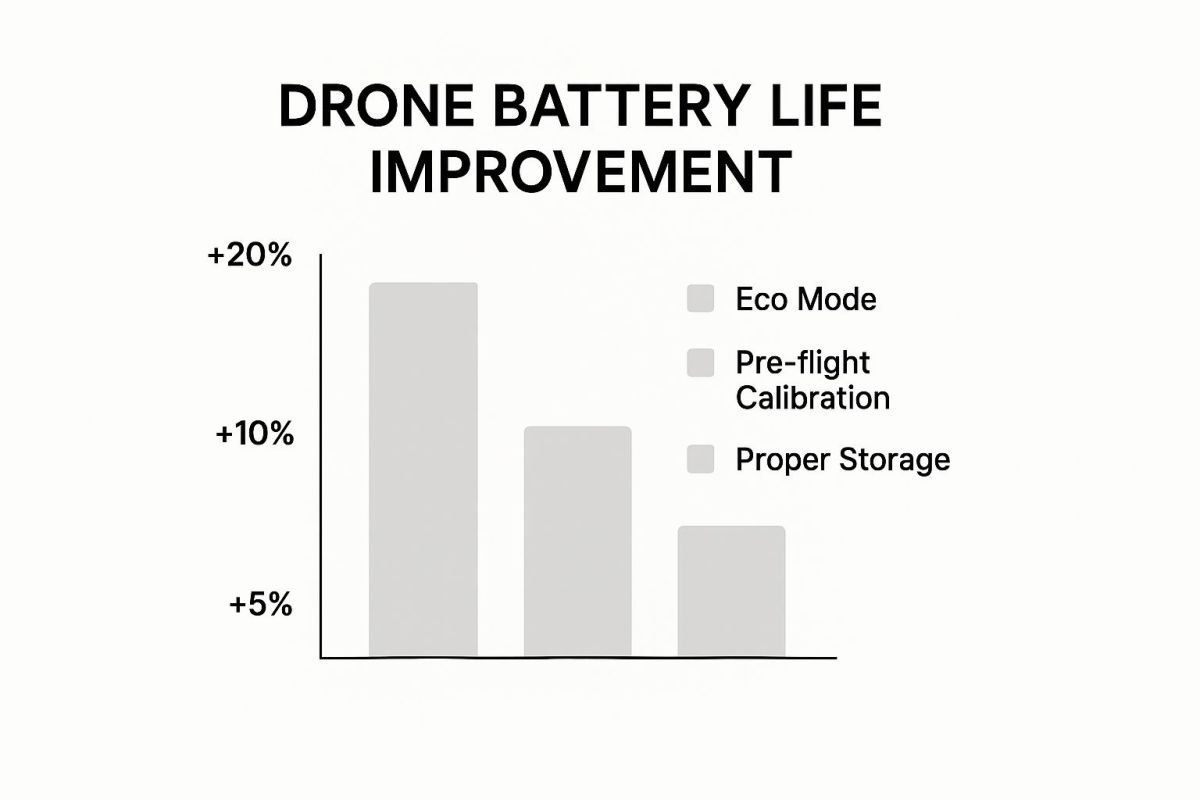
The data speaks for itself. Simply switching to an "eco mode" for smoother flight can boost battery life by up to 20%—a huge gain from a simple change in how you fly.
Practical Strategies to Extend Flight Time
Knowing what drains your drone's power is half the battle. The other half is actively fighting back against it to get a real advantage in the air. Squeezing every last drop of performance out of your drone battery life isn't about some secret trick; it's about building a set of smart habits that look after your battery before, during, and after every single flight.
These steps aren't just about adding a few more minutes to your airtime, either. Think of it as a complete care routine that protects your investment, ensuring your batteries perform reliably and last for hundreds of charge cycles.
Let’s break down the real-world strategies you can start using today.
Master Your Pre-Flight Rituals
Great flights always start on the ground. The way you prepare and charge your batteries has a huge effect on their performance in the air and their overall health in the long run. A little bit of discipline here pays off big time later.
First, let's look at your charging habits. It's so tempting to get home and immediately charge every battery back to 100%, but this can actually do more harm than good. LiPo batteries degrade much faster when they’re stored at full capacity. The best approach is to only charge them a day or two before you actually plan to fly.
Next up: always use a quality balance charger. Your drone battery is made up of several individual cells, and a balance charger makes sure each one is filled to the exact same voltage. This stops uneven wear, which is a classic culprit for premature battery failure. It’s like making sure every rower in a boat is pulling with the same strength—you get a much more powerful and efficient outcome.
Fly Smarter, Not Harder
Once your drone is airborne, how you fly it becomes the single biggest factor you can control. Smooth, deliberate flying will always be more energy-efficient than aggressive, jerky movements. Every time you punch the throttle or make a sharp turn, it’s like flooring the accelerator in your car—it just guzzles fuel.
Try to plan your flight path before you even take off. Instead of just reacting in the moment, have a clear idea of your route. This helps you avoid unnecessary climbs, sharp banking, and fighting against strong winds, all of which are massive power drains. If your drone has different flight modes, use them! A "cinema" or "eco" mode often smooths out your control inputs automatically, saving that precious battery power.
Another crucial in-flight tip is to manage your payload. Before launching, ask yourself: is everything attached to this drone absolutely essential for this mission? Taking off non-essential gear like prop guards or even switching to a lighter camera lens reduces the overall weight. This means the motors don't have to work as hard, giving you a bit more time in the air. It’s especially important when you’re already carrying heavy equipment, like the advanced sensors used for a LiDAR drone survey. Even a small weight reduction can add a valuable minute or two to your flight.
The core principle of efficient flying is conservation of momentum. Smooth, flowing flight paths require significantly less energy than a style filled with constant stops, starts, and sharp directional changes.
Implement Proper Post-Flight Care
What you do after you land is just as important as what you do before you take off. Looking after your batteries properly after a flight sets them up for success next time and is the key to a long, healthy lifespan.
First golden rule: never store your batteries fully charged or completely dead. The sweet spot for storing a LiPo battery is somewhere between a 40-60% charge. This "storage charge" puts the least amount of stress on the battery's internal chemistry. Many newer smart batteries will even discharge themselves to this safe level automatically if you leave them for a few days.
Temperature is also a make-or-break factor for storage.
- Avoid Extreme Heat: Never, ever leave your batteries in a hot car or sitting in direct sunlight. Heat is the number one enemy of battery health and can cause permanent damage.
- Avoid Extreme Cold: Storing batteries in freezing conditions isn't great for them either and can degrade their performance over time.
- Find a Cool, Dry Place: A temperature-controlled spot like a cupboard or basement is perfect. For safety, always use a fireproof LiPo bag or a dedicated battery box for storage.
You'll find these principles of battery care are surprisingly universal. In fact, many of the general strategies for maximizing battery lifespan apply to all sorts of electric vehicles. By sticking to these disciplined routines before, during, and after your flights, you can seriously improve your drone's performance and protect your gear for years to come.
The Future of Drone Power Technology
While Lithium Polymer (LiPo) batteries are the undisputed champions of the drone world right now, they're not the final word. Everyone from hobbyists to commercial pilots is feeling the push for longer flights, heavier payloads, and better safety, which is driving some incredible research into what comes next. The future of drone battery life isn’t just about making small tweaks; it’s about finding entirely new ways to keep drones in the air.
Imagine a power source that packs the same punch as a LiPo but gets rid of the flammable liquid electrolyte, making it far more stable and safer. That's the promise of Solid-State batteries. Think of them as the tough, reliable workhorse of the future, built to handle more charge cycles and perform consistently across a wider range of temperatures.
A Leap in Endurance and Safety
Closer on the horizon is the next evolution of our current tech: Lithium-Metal batteries. They aren't a complete reinvention, but they are a massive upgrade. By using lithium metal for the anode, they can squeeze a whole lot more energy into the same amount of weight. This is already making a real impact in Australia, where covering vast distances is part of the job.
Drone battery innovation here is moving fast, especially for big jobs like agricultural surveillance and emergency response. In fact, recent data shows lithium-metal batteries can deliver 60-80% longer flight times than standard lithium-ion, with a specific energy hitting over 400 Wh/kg. This kind of breakthrough means a drone can tackle a huge mission across the outback without needing to constantly land for a battery swap. You can dive deeper into this growing market in this detailed report on the drone battery market.
For a professional pilot, this could be the difference between mapping a large farm in a single go versus needing three separate flights. Longer endurance directly cuts down on operational costs and boosts efficiency, which is absolutely critical in fields like aerial surveying with UAVs.
The next generation of drone power is all about solving the core headaches of today's tech—flight time, safety, and temperature limits. Each new chemistry is a step towards making drones a more practical tool for complex, real-world jobs.
Beyond Conventional Batteries
Looking even further down the road, some developers are thinking beyond traditional battery designs altogether. One of the most exciting long-term ideas is the Hydrogen Fuel Cell. Instead of storing electricity, a fuel cell generates it on the fly by reacting hydrogen with oxygen from the air. The only thing it leaves behind is water.
It's still an emerging technology for smaller drones, but hydrogen offers a game-changing leap in flight time—we're talking hours, not minutes.
- Hydrogen Fuel Cells: These could offer unparalleled endurance, perfect for long-range pipeline inspections or continuous surveillance missions where landing to swap batteries just isn't an option.
- Graphene Supercapacitors: While they probably won't be a primary power source soon, they could act like a turbo-boost. They could provide intense bursts of power for heavy lifting or quick manoeuvres without putting a strain on the main battery.
These aren't just pie-in-the-sky ideas. They're the building blocks for the next era of unmanned flight, promising drones that can fly further, carry more, and operate more safely than ever before. For pilots, this opens the door to new capabilities and missions that are simply impossible today.
Common Questions About Drone Batteries
As you get more comfortable managing your drone's power, you'll inevitably run into a few specific questions. Think of this section as a quick reference guide, giving you clear, straightforward answers to the things pilots most often ask about drone battery life. The goal is to help you troubleshoot on the fly and feel more confident every time you take off.
How Many Years Should a Drone Battery Last?
Generally, a well-cared-for LiPo drone battery will give you 300 to 500 charge cycles. For most pilots, that works out to be about one to three years of solid performance before you start noticing it can't hold a charge like it used to.
But that's not a hard and fast rule. This lifespan really depends on how you treat the battery. If you regularly push it to 0%, leave it sitting at 100% for weeks on end, or expose it to crazy temperatures, you'll definitely shorten its life.
Is It Safe to Use Third-Party Batteries?
It's always tempting to save a few dollars with a third-party battery, but it’s a gamble that often comes with serious risks. The batteries from your drone's manufacturer are specifically designed to "talk" to the drone's flight controller, giving you accurate power readings and reliable, predictable flight.
Unofficial batteries often miss this vital communication link. This can lead to all sorts of problems, like sudden power cuts mid-air, a battery gauge that lies to you, or even physical damage to your drone's electronics. For safety and peace of mind, it’s always best to stick with official batteries or those from a very reputable aftermarket brand.
What Is the Best Way to Store Drone Batteries?
How you store your batteries between flights is one of the biggest factors in keeping them healthy for the long haul. Just follow these simple rules to keep them in great shape.
- The Right Charge Level: Never store a battery fully charged or completely dead. The sweet spot for storage is between 40% and 60%. Many newer smart batteries are clever enough to automatically discharge themselves to this safe level if you don't use them for a few days.
- A Cool, Dry Place: Keep your batteries somewhere with a stable temperature. A hot car or a tin shed in the backyard are your battery's worst enemies, as wild temperature swings will speed up its degradation.
- Safety First: For an extra layer of protection, it's a great idea to store them in a fireproof LiPo bag or a proper battery case. It's a small investment that provides essential peace of mind.
Following these simple tips will go a long way in making sure your batteries are healthy, reliable, and ready to go whenever you are.
At Innoflight Technology, we know that reliable power is everything. It’s the foundation of every successful mission, which is why we design our advanced drone platforms with performance and endurance at their very core. You can explore our range of heavy-lift and high-precision UAS solutions on our website.