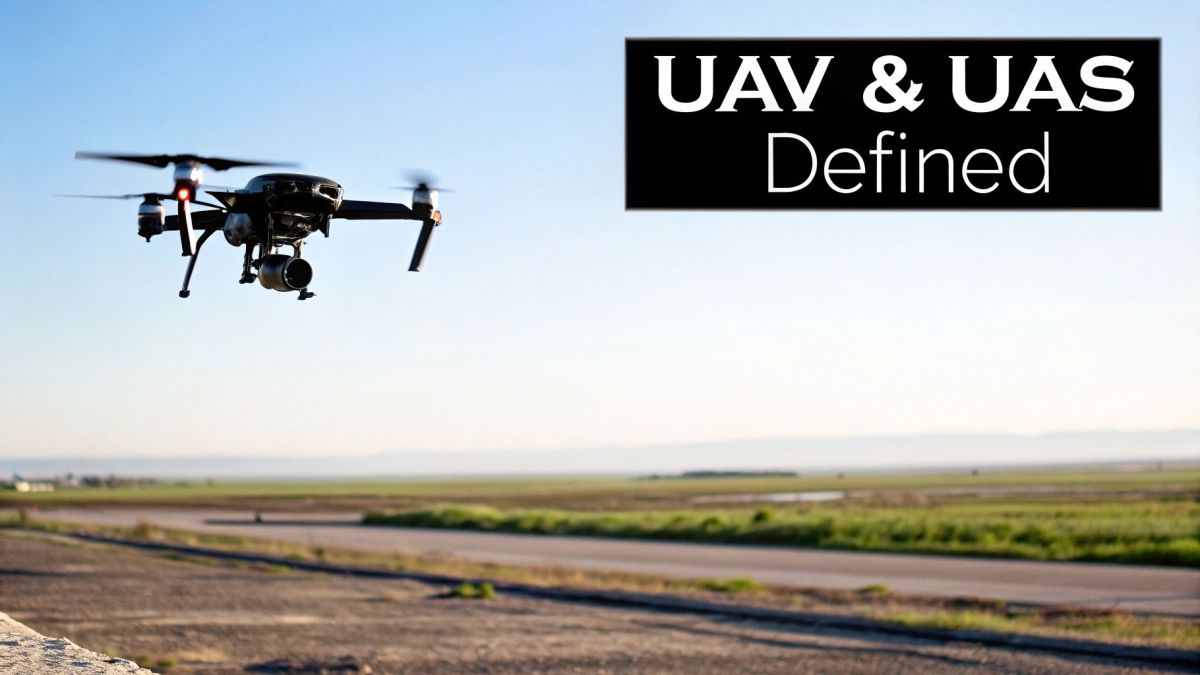
When you hear people talking about drones, the terms UAV and UAS often get thrown around interchangeably. But in the professional world, the distinction is a big deal. The simplest way to put it is this: a UAV is the aircraft, while a UAS is the whole kit and caboodle needed to get it flying and doing its job.
Think of the Unmanned Aerial Vehicle (UAV) as the drone itself—the physical machine with rotors, a frame, and a camera. The Unmanned Aerial System (UAS), on the other hand, includes the UAV plus the ground-based controller, the human pilot, and the vital communication links that tie everything together.
It's All About the System
While hobbyists might just talk about their "drone," professionals and regulators always think in terms of the entire system. Why? Because a successful mission is never just about the aircraft. It’s about how every single piece of the puzzle works together flawlessly to gather data, carry out a task, and above all, operate safely.
This system-wide perspective is non-negotiable for commercial work. If you're running complex inspections or creating detailed maps, you're relying on the whole UAS to deliver. A top-of-the-line UAV is just an expensive paperweight without a dependable control station and a solid data link to send information back to the operator on the ground. This difference is also critical when it comes to regulations, which govern the complete system, not just the aircraft.
At-a-Glance UAV vs UAS
To make this crystal clear, here’s a quick breakdown of what each term covers. This table really highlights the difference in scope between the vehicle and the full operational system.
| Element | UAV (The Vehicle) | UAS (The System) |
|---|---|---|
| Scope | The physical aircraft that flies—and that's it. | The entire operational package, from pilot to payload. |
| Components | Airframe, motors, propellers, navigation hardware. | The UAV, ground control station, pilot, and communication link. |
| Concept | A single piece of hardware; the flying component. | An integrated solution designed for a specific purpose. |
| Analogy | The car itself. | The car, the driver, the steering wheel, and the road rules. |
Ultimately, a UAV is just one component of a UAS. It can't fly or perform a mission on its own.
The key thing to remember is that a UAV cannot function without being part of a UAS. Professionals in fields like aerial surveying using a UAV always operate within the context of a complete system. This holistic approach is what separates casual flying from professional, results-driven operations.
Breaking Down the Components of Each System
To really get to grips with the UAV vs UAS debate, it helps to look under the bonnet. Think of a UAV, or Unmanned Aerial Vehicle, as just the aircraft itself—the physical bit of kit that gets off the ground.
The UAV is all about the hardware that makes flight possible. This includes:
- The Airframe: The body or skeleton of the drone, which dictates its strength and how it handles in the air.
- Propulsion System: The motors, propellers, and the electronic speed controllers that give it lift and direction.
- Onboard Avionics: Essentially the drone's brain. This is where you'll find the flight controller, GPS, and sensors like inertial measurement units (IMUs) that keep it stable and on course.
The Complete UAS Ecosystem
Now, an UAS, or Unmanned Aerial System, is the whole shebang. It’s a much bigger picture where the UAV is just one, albeit important, piece of the puzzle. A UAV on its own can't do much; it needs the rest of the system to function.
A complete UAS always includes:
- The UAV: The aircraft doing the actual flying and carrying the payload, whether that’s a camera or a package.
- Ground Control Station (GCS): The remote control or computer setup the operator uses to plan flights, issue commands, and see what the drone sees.
- Data Link: The vital communication channel that sends commands to the drone and relays data, like live video feeds, back to the operator.
- The Human Operator: The trained and often certified pilot who is ultimately responsible for flying the system safely and effectively.
This image here does a great job of showing the difference visually. It makes it clear that the UAV is the vehicle, while the UAS is the entire operational setup.
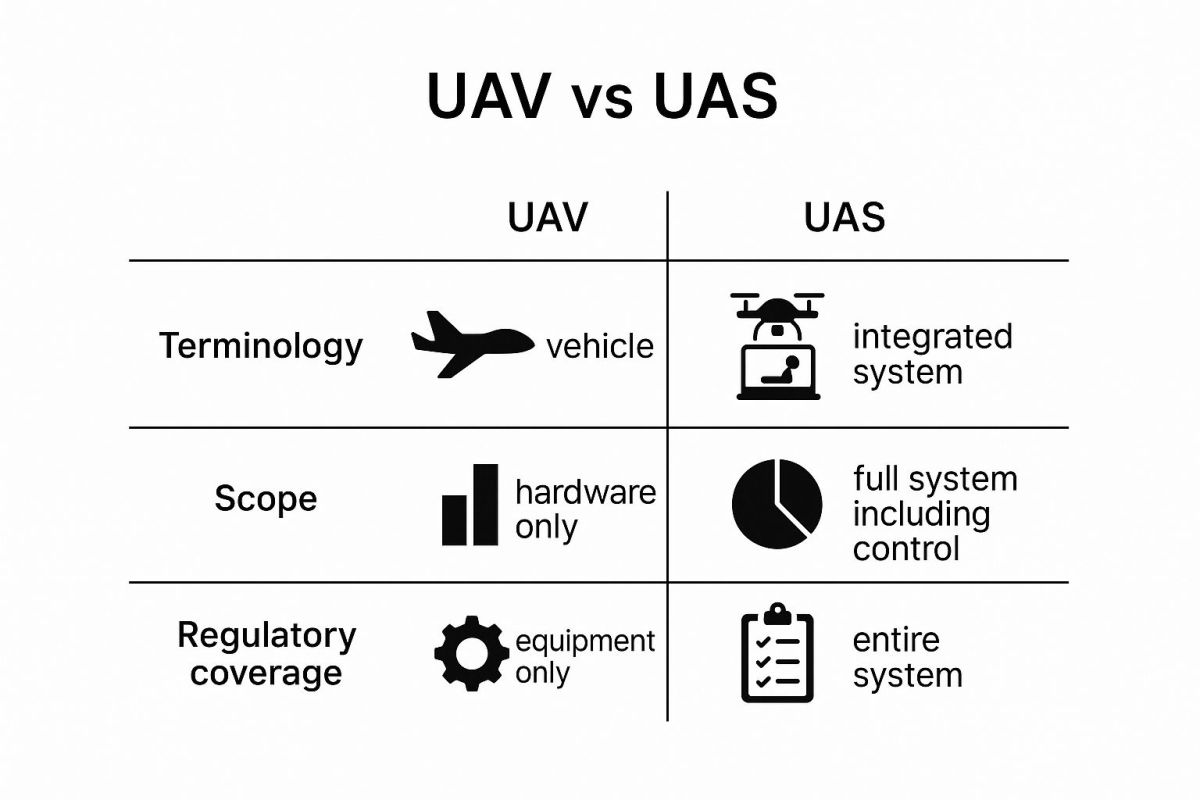
To make this even clearer, let's break it down in a table. This shows you at a glance how the scope of a UAS goes far beyond just the flying vehicle.
Detailed Comparison of UAV and UAS Components
| Aspect | UAV (The Vehicle) | UAS (The System) |
|---|---|---|
| Core Element | The physical aircraft. | The entire operational package, including the UAV. |
| Human Role | None inherent to the vehicle itself. | A certified pilot or operator is an essential component. |
| Control | Onboard flight controller for stability and navigation. | External Ground Control Station for mission planning and real-time commands. |
| Communication | Receives signals via its onboard receiver. | A two-way data link for sending commands and receiving telemetry/payload data. |
| Functionality | Can fly and carry a payload. | Manages the entire mission, from takeoff to landing and data processing. |
| Example | A DJI Mavic 3 drone sitting in its case. | The DJI Mavic 3, its remote controller, the connecting app, and the licensed pilot. |
This table really highlights that when you're talking about professional operations, you're always dealing with a UAS, not just a UAV.
This distinction is especially important in Australia's booming drone industry. As the sector matures, the conversation is shifting away from the drones themselves and toward the deployment of complete, reliable systems. If you'd like to dig deeper, you can explore further analysis of Australia's UAV market to see how these trends are playing out.
How the Difference Plays Out in the Real World
Knowing the difference between a UAV and a UAS isn’t just about getting the terminology right; it's essential for anyone running real-world operations across Australia. Professionals don't just fly drones. They operate complete, integrated systems to get a specific job done.
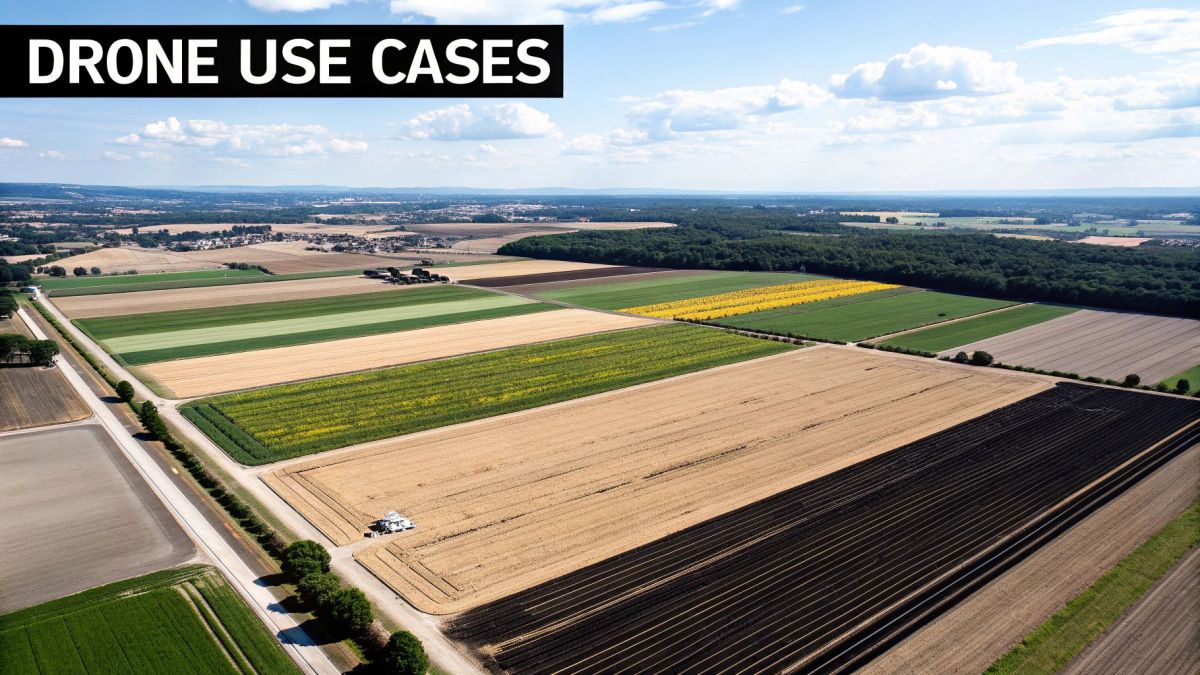
Think about a modern farm out in rural Queensland. A farmer relies on a whole UAS for crop management. The drone itself (the UAV) is just one piece of the puzzle. The system also includes specialised multispectral sensors, GPS mapping software to plan the flight path, and data analytics tools that turn aerial images into practical advice on crop health and watering schedules. The UAV collects the data, but the UAS is what makes it useful.
It's the same story in the mining industry. A UAS delivers critical information for managing stockpiles and ensuring site safety. Here, the system might pair a heavy-lift UAV with high-precision LiDAR scanners and a secure data link. This feeds information straight to a ground control station, allowing surveyors to build accurate 3D models without ever stepping into a dangerous area.

From a Flying Vehicle to a Full Capability
This 'whole system' mindset is vital for any complex task. Take emergency services, for example. They depend on the full UAS to stream a live video feed from a UAV back to a command centre, helping them make critical decisions during bushfires or search and rescue missions.
The real value isn't just in the bird's-eye view from the UAV. It's in the system's power to reliably capture, transmit, and process data for a specific purpose. That’s what turns a simple flight into a powerful operational tool.
In Australia, UAVs are the backbone of a booming market, powering growth in fields like remote sensing, surveying, and infrastructure inspection. The broader UAS market covers every type of UAV—from small quadcopters to large tactical drones—all working within these integrated systems to pull off complex jobs.
To see a great example of this in action, look at how professional services use drones for stunning drone event photography. It's a perfect case study of how the vehicle, pilot, and camera system all have to work together seamlessly to create the final product.
Navigating Australian Rules and Regulations
When you're operating a drone in Australia, getting your head around the legal side of things is non-negotiable. This is where understanding the term UAS becomes incredibly important. Australia's Civil Aviation Safety Authority (CASA) doesn't just look at the drone itself; they regulate the entire system to keep our national airspace safe.
You'll notice CASA often uses the term Remotely Piloted Aircraft (RPA), which is essentially the UAV. However, their rules are written to cover the complete Unmanned Aerial System. This means that staying compliant involves more than just the aircraft—it's about your whole operational setup, including the pilot, the ground control station, and the communication links that tie it all together.
System-Wide Compliance Is Key
For anyone operating commercially, this system-wide focus is at the heart of licensing and certification. The key qualifications from CASA, like the Remote Pilot Licence (RePL) and the RPA Operator’s Certificate (ReOC), are designed to prove that both the pilot and the business can manage the entire UAS safely and competently.
Essentially, these regulations are checking for:
- Pilot Competency: Do you have the skills to manage the whole system, not just fly the aircraft?
- Operational Procedures: Are your processes for flight planning, risk assessments, and emergency responses properly documented for the complete UAS?
- Equipment Maintenance: Are you keeping detailed logs on the maintenance of all components, from controllers to data links, not just the drone?
CASA's approach sends a clear message: a safe flight is about more than a reliable aircraft. It's about a skilled pilot running a fully integrated and well-maintained system, all while following approved procedures.
This holistic perspective ensures every single part of the operation, from the pilot’s training right through to the stability of the data link, meets strict safety standards. It’s a thorough approach, and it’s one of the big reasons many businesses buy directly from a commercial UAV manufacturer operations—local suppliers really get these system-wide requirements.
Why the UAS Distinction Is Critical for Defence
In the high-stakes world of defence and national security, the difference between a UAV and a UAS isn't just a matter of terminology—it's mission-critical. While the UAV is the aircraft itself, a military operation's success hinges on the complete Unmanned Aerial System (UAS).
For Australian defence forces, a UAS represents a total operational capability. Think of it as an integrated network: the aircraft, its sophisticated sensor payloads, the secure data links relaying real-time intelligence, and the ground crews who pilot the vehicle and interpret its findings. A single UAV can't achieve a strategic goal on its own; the entire system is what gets the job done.
A System for Situational Awareness
Let's look at a typical intelligence, surveillance, and reconnaissance (ISR) mission. The UAV acts as the "eye in the sky," but its true value is unlocked by the wider UAS that supports it. This system includes everything from encrypted communications and mission planning software to the highly trained personnel needed to analyse data on the fly and make crucial tactical decisions.
This system-based view is central to modern military thinking, as it dramatically improves situational awareness and overall effectiveness on the battlefield. It’s exactly why military procurement focuses on acquiring these fully integrated systems, rather than just buying individual aircraft off the shelf.
For defence operations, the aircraft is only one piece of the puzzle. The real strategic advantage comes from the system’s ability to gather, protect, and deliver actionable intelligence from contested environments. This is the core of the UAS concept.
This focus is clearly reflected in Australia’s strategic defence priorities. The Australian drone market was valued at USD 614 million in 2024 and is projected to hit USD 1.5 billion by 2033, a massive investment in these coordinated systems. The UAV vs UAS distinction is vital here, as this growth isn’t just about buying more drones; it's driven by the demand for comprehensive UAS capabilities. You can find more detail by reading the full report on Australia's expanding drone market.
Choosing the Right Terminology in Your Field
Getting the language right isn't just about being pedantic; it shows you know what you’re talking about and builds instant credibility in your field. The way you talk about this technology—whether you say UAV or UAS—can signal if you're a weekend flyer or a professional managing a complex operation.
For someone flying for fun or just talking about the aircraft itself, “drone” or “UAV” works just fine. Everyone knows what you mean. If you're physically holding the aircraft, calling it a UAV is technically spot-on.
Professional and Commercial Contexts
But when you step into a professional environment, that distinction really starts to matter. Fields like surveying, engineering, and public safety aren't just using a flying camera; they're depending on a complete, end-to-end solution. This is where talking about the UAS shows you understand the full picture.
It proves you're thinking about every piece of the puzzle:
- The UAV itself, along with its specific payload, like a LiDAR scanner or multispectral sensor.
- The Ground Control Station, including the software needed for mission planning.
- The Data Link and how reliable it is for secure communication.
- The Operator, their training, and all the necessary regulatory compliance.
If you're drafting a proposal, talking to a client, or dealing with regulators like CASA, UAS is the term you should be using. It tells them you’re focused on the whole process, from planning the mission and capturing data, all the way to analysing it and delivering the final product.
Using "UAS" in your professional vocabulary shows a deeper understanding of the technology. It communicates that you're not just flying a drone, but deploying an entire system to get precise, reliable, and safe results.
At the end of the day, this simple language shift reflects a much bigger operational mindset. The UAV is a vital tool, no doubt, but it’s the smart management of the entire Unmanned Aerial System that delivers real commercial value and makes sure the mission is a success.
Frequently Asked Questions About UAV and UAS
Even after breaking it down, the whole UAV vs UAS thing can still be a bit tricky. Let's tackle some of the most common questions people have to clear things up for good.
Is a Drone Considered a UAV or a UAS?
In everyday chat, when someone says 'drone', they’re almost always talking about the UAV – the actual aircraft that flies.
But think about what's in the box when you buy one. You're not just getting the drone; you're getting the remote controller and the app for your phone, right? That whole package is a basic UAS, or Unmanned Aerial System. So, while you fly the UAV, you're actually operating a complete UAS.
Why Does This Terminology Matter for Professionals?
For anyone working in the industry, getting the terms right is about more than just being pedantic. It’s about credibility and clear communication. Using UAS instead of UAV shows you understand the whole operational picture.
It tells clients and regulators that you're thinking about the ground control station, the data links, the payload, and the software—not just the drone itself. This is critical for planning complex missions, getting the right insurance, and dealing with bodies like CASA. They regulate the entire system, not just the aircraft.
A professional’s focus is always on what the system can achieve, not just what the vehicle can do. A successful commercial job relies on every part of the UAS working together perfectly.
This holistic view is especially important in specialised fields. For instance, our guide on precision agriculture with drones explains how the vehicle, specific sensors, and analysis software all come together as a complete system to give farmers real, usable data.
Does CASA Regulate the UAV or the UAS?
Australia's Civil Aviation Safety Authority (CASA) regulates the entire Unmanned Aerial System (UAS). While their official documents often call the drone itself a Remotely Piloted Aircraft (RPA), their rules cover every single piece of the operation.
CASA's regulations look at everything from the pilot's licence (like the RePL) to the technical requirements for maintaining a solid communication link. It’s all about making sure the whole system is operated safely in Australian airspace. So, for any legal commercial work, understanding your UAS is absolutely essential.
At Innoflight Technology, we design and manufacture advanced Unmanned Aerial Systems built for the demanding requirements of Australian industries. From heavy-lift platforms to precision survey drones, our solutions deliver reliability and accuracy.