Ever tried to get a recipe just right? You use a measuring cup, not a scale, to get the perfect amount of flour. That's the basic idea behind volumetric analysis: figuring out "how much" of something you have by accurately measuring its volume.
It might sound technical, but whether you're in a high-tech lab or out in a muddy field, the principle is the same. It's all about precision through volume, and it splits into two very different, but equally important, worlds.
Decoding Volumetric Analysis
So, what exactly is volumetric analysis? At its core, it's a way of measuring an unknown quantity by using volume as the key metric. This method is the backbone of any industry where getting the numbers right is absolutely critical, from building a skyscraper to ensuring food quality.
Let's break down the two main types.
The first is the classic chemistry approach you might remember from school: titration. Scientists carefully add a solution of a known concentration to another solution where the concentration is unknown. By measuring the exact volume needed for a reaction to occur, they can calculate the unknown. It’s a cornerstone of quality control everywhere, from pharmaceuticals to winemaking.
The second type is all about spatial measurement, and this is where modern tech like drones and LiDAR has completely changed the game. Instead of beakers and chemicals, we’re creating detailed 3D models of real-world spaces. Think of a massive stockpile at a mine or the changing terrain of a construction site. This branch of science is deeply connected to the management of spatial data, a field you can explore further in our guide on what is geomatics.
This infographic helps paint a clearer picture using a simple, everyday analogy.
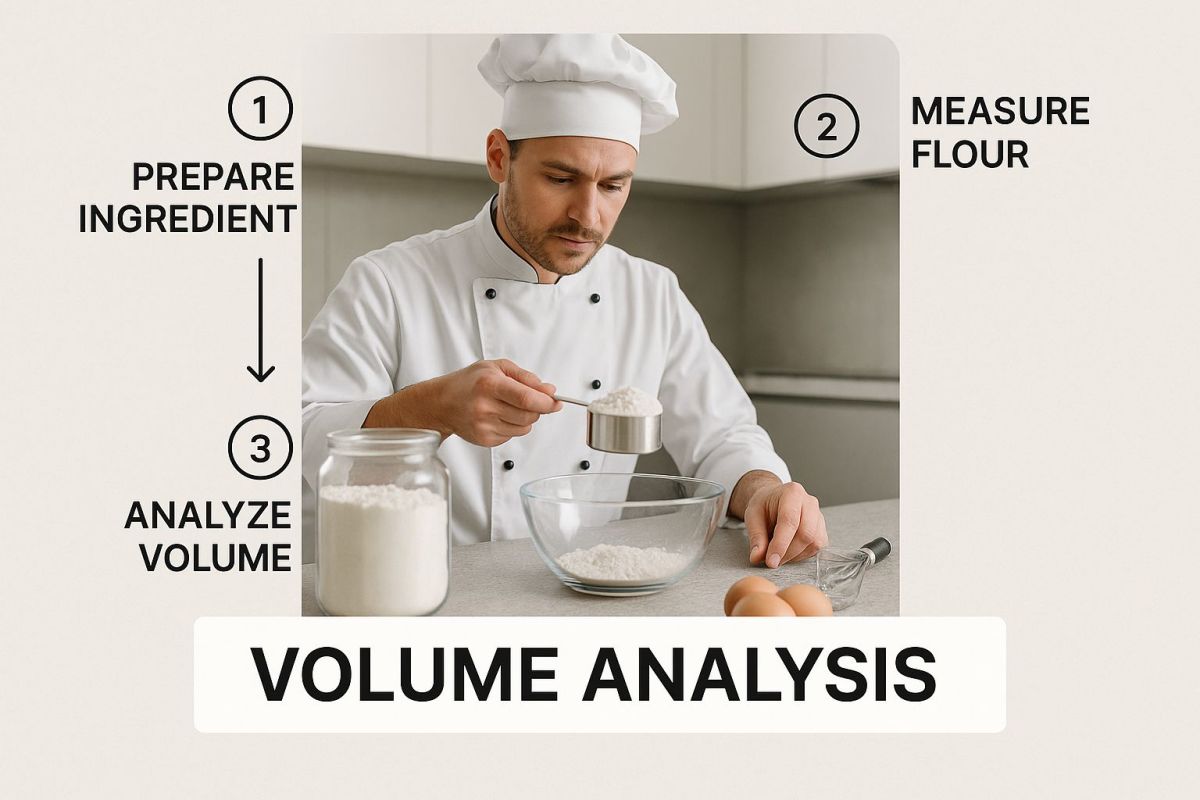
As you can see, the core idea holds true whether you're in a lab coat or a hard hat. It’s all about using volume to get an accurate measurement.
To make the distinction clearer, here's a quick breakdown of how these two approaches compare.
Volumetric Analysis At A Glance
| Aspect | Chemical Analysis (Titration) | Spatial Measurement (Surveying) |
|---|---|---|
| Primary Goal | Determine the concentration of a chemical substance in a solution. | Calculate the volume of physical objects or land features. |
| Common Tools | Burettes, pipettes, flasks, chemical indicators. | Drones, LiDAR scanners, GPS, photogrammetry software. |
| Environment | Typically performed in a controlled laboratory setting. | Conducted outdoors in real-world environments like worksites. |
| Typical Use Case | Quality control in food, beverage, and pharmaceutical industries. | Calculating stockpile volumes, earthworks for construction, or crop health. |
Ultimately, while the tools and environments couldn't be more different, both methods rely on the same fundamental principle: precise volume measurement is the key to unlocking accurate data.
How Chemical Volumetric Analysis Works
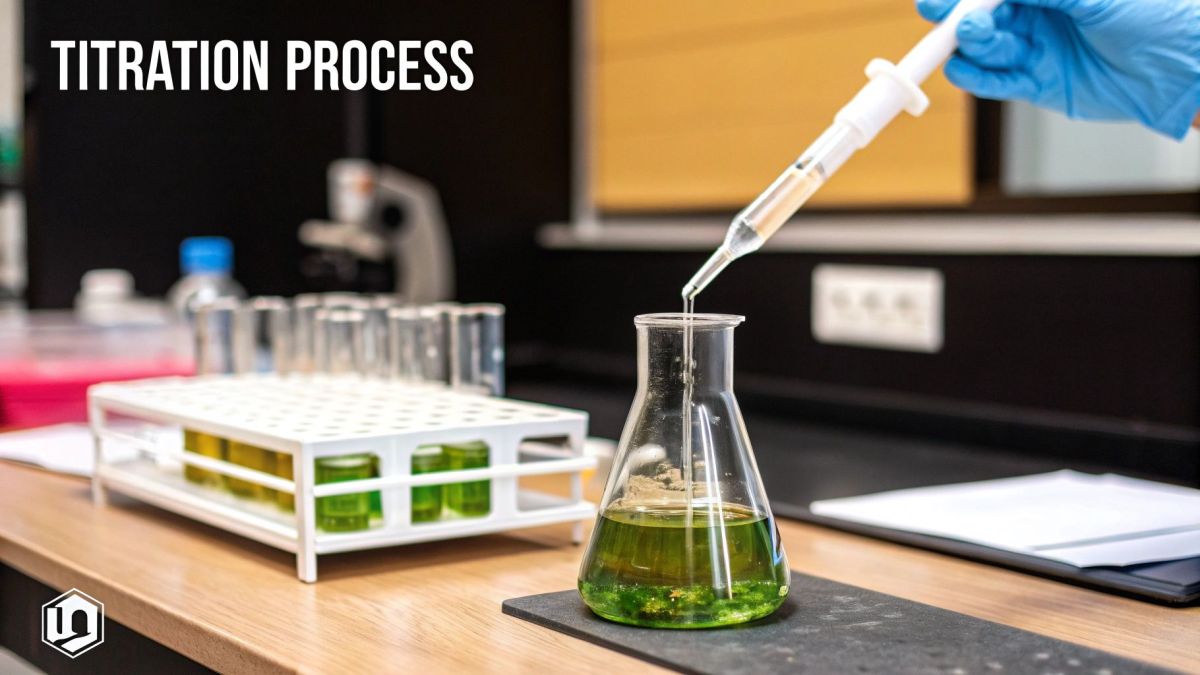
At its core, chemical volumetric analysis relies on a tried-and-true method called titration. It’s a bit like a carefully controlled chemistry experiment designed to answer one simple question: "how much of a specific substance is actually in this sample?"
Let’s break it down with an analogy. Imagine you have a glass of lemonade (the analyte – the stuff you’re measuring) and you want to know exactly how sour it is. To figure it out, you could slowly add a sugar solution (the titrant) drop by drop, stirring after each addition. You'd keep going until the sourness is perfectly cancelled out.
In a real lab, instead of taste testing, scientists use a chemical indicator. This is a special dye that changes colour the very moment the chemical reaction is complete. That colour change signals the endpoint. By measuring the precise volume of titrant it took to get there, chemists can work backwards and calculate the exact concentration of the analyte.
Common Titration Methods
While the basic idea is always the same, titration can be adapted for all sorts of different chemical reactions, which is why it’s such a go-to technique in science.
- Acid-Base Titration: This is the classic example everyone learns in school. It's used to find the concentration of an acid or a base, which is crucial in the food industry for checking the acidity of products like wine and juice to maintain consistent flavour.
- Redox Titration: This method is all about reactions where electrons jump between molecules. You see this in action when testing the chlorine levels in a swimming pool to make sure the water is safe for a dip.
The main piece of kit, a long, marked glass tube called a burette, has been fine-tuned over centuries, especially after Karl Friedrich Mohr's redesign in the 19th century. Here in Australia, these methods are critical. The Winkler titration, for instance, is used every day to measure dissolved oxygen in our waterways, helping to monitor the health of vital ecosystems like the Great Barrier Reef. For aquatic life to thrive, dissolved oxygen levels should stay above 6–7 mg/L, and titration gives us the accuracy needed to ensure this. If you’re keen to learn more, you can explore the history and principles of titration on Wikipedia.
Key Takeaway: Titration is all about a controlled reaction. By measuring the volume of a known solution needed to react completely with an unknown one, we can pinpoint the unknown's concentration with incredible accuracy.
Measuring The World With Modern Volumetric Analysis
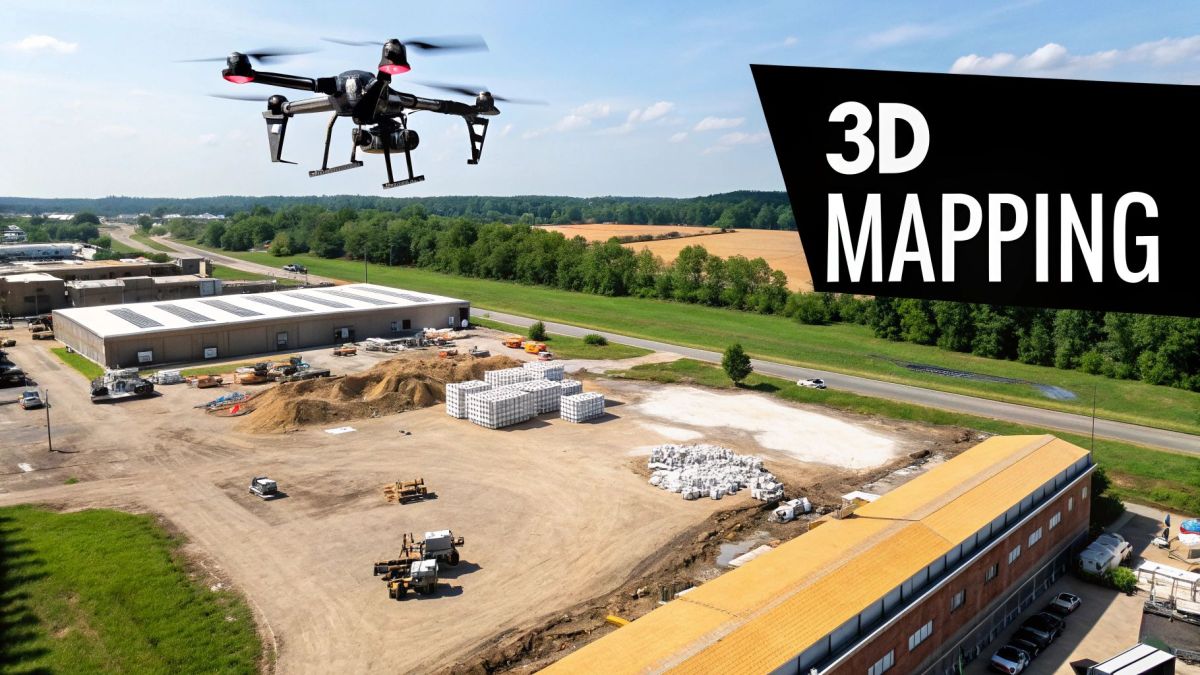
While the term ‘volumetric analysis’ might bring to mind a chemistry lab, today’s most powerful applications are happening out in the open. We've moved far beyond manual measurements, embracing technology that allows us to measure huge physical spaces with incredible speed and precision. Leading this charge are drones and a clever process called photogrammetry.
Imagine creating a perfect digital replica of a landscape. A drone flies a mission over a construction site, quarry, or farm, snapping hundreds or even thousands of high-resolution pictures from various angles. Specialised software then gets to work, stitching these images together to build a dense and highly detailed 3D model.
Once you have this digital model, figuring out the exact volume of a gravel stockpile or how much earth has been excavated becomes straightforward and amazingly accurate.
The Modern Surveying Workflow
This whole process is worlds away from sending surveyors to clamber over potentially unsafe stockpiles or difficult terrain. It’s faster, safer, and follows a clear, repeatable workflow that turns aerial photos into practical data.
The core steps usually look like this:
- Flight Planning: First, a pre-planned flight path is mapped out. This ensures the drone captures images with enough overlap for the software to piece them together seamlessly.
- Data Capture: The drone flies the mission on its own, taking high-resolution photos that are each tagged with precise GPS data. The quality of these images is crucial; you can learn more about this in our guide on what is spatial resolution.
- Data Processing: The photos are uploaded into photogrammetry software. This is where the magic happens, as the program analyses the images to create a point cloud—a massive collection of individual points, each with its own place in 3D space.
- Model Generation: Finally, the point cloud is converted into useful outputs like a Digital Elevation Model (DEM), which is essentially a 3D map of the ground’s surface.
This digital-first approach delivers accuracy often within 1-3% of traditional ground surveys but in a tiny fraction of the time. This efficiency gives site managers the power to make quicker, smarter decisions using data that's practically real-time.
Where Volumetric Measurement Makes a Real-World Difference
It's one thing to talk about the theory, but the true value of volumetric analysis really clicks when you see it in action. Across Australia's biggest industries, from the massive mines in the Pilbara to the rich farmlands of the Riverina, getting volume right is fundamental to running a safe, efficient, and profitable operation. This is where modern measurement methods really come into their own.
Take the mining and construction industries. Here, success can literally be measured in cubic metres. Knowing exactly how much ore, sand, or gravel is sitting in a stockpile isn't just a minor operational detail—it's a number that directly impacts the bottom line.
Getting a stockpile measurement wrong can throw budgets into disarray, lead to incorrect sales figures, and create complete logistical headaches. Using drones for volumetric analysis, companies can now get measurements with over 98% accuracy in a tiny fraction of the time, replacing guesswork with a genuine strategic advantage.
This gives managers the solid data they need to make smart decisions about where to put resources and how to plan project timelines.
Fine-Tuning Farming From Above
The impact isn't just limited to industrial sites. Precision agriculture is another field being completely reshaped by volumetric measurement. Farmers can now use drone-captured data to build incredibly detailed 3D maps of their land.
This kind of information is a game-changer for several critical jobs:
- Terrain Analysis: Seeing the natural contours and water flow across a field helps in designing smarter, more efficient irrigation systems.
- Earthworks Planning: When it's time to level land or build a dam, you can calculate the precise amount of soil that needs to be moved.
- Yield Prediction: By assessing the health and density of crops, farmers can get a much clearer picture of their expected harvest volumes.
High-tech surveying tools are at the heart of this. If you're curious about the technology that makes this possible, our guide on drones with LiDAR takes a closer look at how this gear captures such accurate spatial data.
Looking After Our Environment
Beyond the commercial world, volumetric analysis has become an essential tool for looking after our environment. Government bodies and conservation groups use it to track changes in our natural landscapes with remarkable precision. A key example is calculating the remaining capacity of landfills, which is vital for effective waste management planning.
It’s also used to monitor coastal erosion by measuring how sand volumes shift over the seasons and to manage precious water resources by calculating the exact volume of water held in dams and reservoirs. These practical uses show how a clear understanding of volume helps us protect the environment and manage our resources for the long haul.
The Surprising Role of Volume in Modern Healthcare
When you think of measuring volume, you probably picture a construction site or a farm, not an operating theatre. Yet, volumetric analysis is playing a an increasingly important role in modern medicine, helping surgeons plan complex procedures and improve patient outcomes.
This is especially true in cosmetic and reconstructive surgery. Think about breast reconstruction, for example. Using volumetric analysis, surgeons can map out procedures with incredible detail, ensuring the results are not just medically sound but also aesthetically pleasing. It’s a shift from estimation to data-driven precision, which makes a world of difference to patients.
Precision Where It Matters Most
This level of surgical planning isn't based on guesswork; it's grounded in clever formulas that give surgeons reliable data to work with. A great example of this is the Australian-developed BREAST-V formula, which links a patient's physical measurements directly to tissue weights.
A 2013 study highlighted just how effective this is, showing a strong correlation coefficient of R² = 0.73. This was a significant improvement on older methods, cementing its value in surgical planning. If you’re interested in the science behind it, you can read the full research about this surgical technique.
This really shows how far volumetric analysis has come from its industrial roots. It’s a versatile tool that boosts precision in fields where every millimetre counts.
Key Insight: Whether you're measuring a stockpile of gravel or planning a complex surgery, the core principle of volumetric analysis is the same. It’s all about using accurate volume data to make better, more informed decisions.
Of course, handling sensitive patient data requires a rock-solid technological backbone. The healthcare industry relies on robust IT systems to manage this information securely. This is where solutions like Cloud Hosting Healthcare come in, providing the secure infrastructure needed to support these kinds of medical advancements.
Common Questions About Volumetric Analysis
As you dig into what volumetric analysis is all about, a few questions tend to pop up time and again. Let's tackle them head-on with some straightforward answers to help you connect the dots.
What Is The Main Difference Between Volumetric And Gravimetric Analysis?
The easiest way to think about this is to picture your kitchen. Volumetric analysis is like using a measuring jug—it’s all about volume. Gravimetric analysis, on the other hand, is like using a set of kitchen scales—it measures mass, or weight.
In a chemistry lab, volumetric analysis (often called titration) figures out a substance's concentration by measuring exactly how much liquid is needed to cause a specific reaction. Gravimetric analysis is a bit different; it usually involves turning the substance into a solid and then weighing that solid to see how much of it you have.
How Accurate Is Drone-Based Volumetric Analysis?
You might be surprised. Modern drone-based volumetric analysis is incredibly accurate, often getting within 1-3% of what you'd get with traditional ground-based methods like laser scanning. That's more than good enough for most major industrial jobs.
Of course, hitting that level of precision isn't automatic. The final accuracy really hinges on a few things:
- GPS Quality: Drones fitted with RTK (Real-Time Kinematic) systems are the gold standard here, delivering centimetre-level accuracy.
- Camera Resolution: A better camera captures sharper images, which in turn creates a more detailed and accurate 3D model.
- Flight Altitude: Flying lower generally means capturing more detail, which boosts the accuracy of your measurements.
For big jobs like measuring massive mining stockpiles or tracking progress on a large construction site, this level of precision offers huge gains in both safety and efficiency compared to the old way of doing things.
Can I Perform Volumetric Analysis Myself?
That really depends on what you're trying to do. A basic chemical titration is a classic high school science experiment, and you can do it with a simple kit. But when you’re talking about professional quality control for the food or pharmaceutical industries, you need seriously calibrated equipment and a whole lot of expertise.
And when it comes to using drones for this kind of work, the bar is even higher. You’ll need a licensed drone pilot, specialised photogrammetry software like Pix4D or Agisoft Metashape, and the know-how to process the data correctly. For almost any commercial project, your best bet is to bring in a professional surveying service to make sure the results are accurate and meet all the legal requirements.
The Bottom Line: While you can certainly grasp the basics, professional volumetric analysis—whether in a lab or out in the field—demands specialised tools, proper training, and hands-on experience to get results you can actually rely on.
Ready to see what high-precision aerial data can do for your projects? Innoflight International offers advanced drone solutions for accurate volumetric analysis, from large-scale surveying to detailed asset inspection. Discover how our technology can give you a clearer picture at https://evolutionflight.com.